.png)
 2 hours ago
13
Article content
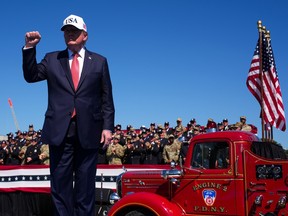
OTTAWA — U.S. President Donald Trump’s tariffs on steel and aluminum have been a “disaster” for the U.S. economy because they’ve fuelled inflation and failed to spur the promised growth in those industries, a new think report has found.

THIS CONTENT IS RESERVED FOR SUBSCRIBERS
Enjoy the latest local, national and international news.
- Exclusive articles by Conrad Black, Barbara Kay and others. Plus, special edition NP Platformed and First Reading newsletters and virtual events.
- Unlimited online access to National Post.
- National Post ePaper, an electronic replica of the print edition to view on any device, share and comment on.
- Daily puzzles including the New York Times Crossword.
- Support local journalism.
SUBSCRIBE FOR MORE ARTICLES
Enjoy the latest local, national and international news.
- Exclusive articles by Conrad Black, Barbara Kay and others. Plus, special edition NP Platformed and First Reading newsletters and virtual events.
- Unlimited online access to National Post.
- National Post ePaper, an electronic replica of the print edition to view on any device, share and comment on.
- Daily puzzles including the New York Times Crossword.
- Support local journalism.
REGISTER / SIGN IN TO UNLOCK MORE ARTICLES
Create an account or sign in to continue with your reading experience.
- Access articles from across Canada with one account.
- Share your thoughts and join the conversation in the comments.
- Enjoy additional articles per month.
- Get email updates from your favourite authors.
THIS ARTICLE IS FREE TO READ REGISTER TO UNLOCK.
Create an account or sign in to continue with your reading experience.
- Access articles from across Canada with one account
- Share your thoughts and join the conversation in the comments
- Enjoy additional articles per month
- Get email updates from your favourite authors
Sign In or Create an Account
or
Article content
The Montreal Economic Institute report, to be released Thursday, found that steel and aluminum prices in the U.S. market have soared since Trump slapped tariffs on those two critical industrial sectors, while failing to create new jobs.
Article content
Article content
Advertisement 1
Article content
Not only have the tariffs led to sharply higher steel and aluminum prices, but the two sectors are key inputs in a wide variety of other products, the report found, that have also become more expensive. It’s left consumers and industrial buyers facing higher price tags on autos, aircraft, construction, machinery, and a wide range of other products.
Article content
Article content
“The United States has imposed on itself a historically large price shock with little protected sector employment or output growth to show for it,” concluded the report, titled Tariffs Deliver a Price Shock, Not an Industrial Revival.
Article content
The study, which is in line with economists’ broader analysis of tariffs, found that steel prices in the U.S. have jumped 33.9 per cent since February 2025, while aluminum prices have increased by 58 per cent. By comparison, prices in the Canadian market for those two metals have increased by only one and 26 per cent respectively.
Article content
Trump imposed 25 per cent tariffs on steel and aluminum from a wide range of countries, including Canada, in March of last year. A few months later, those tariffs were increased to 50 per cent.
Article content
Advertisement 2
Article content
The policy’s desired benefits have been modest at best. During that 19-month period, U.S. steel production has gained 7.6 per cent, with a 0.7 per cent increase in employment. Aluminum production, meanwhile, fell 0.1 per cent, while the number of jobs in that sector increased by just 0.6 per cent.
Article content
Article content
“Trump’s tariff policy has not helped revitalize the industry as promised,” said Joseph Steinberg, an economics professor at the University of Toronto and the primary author of the study. “I don’t think a single economist will say tariffs on metal is a good idea.”
Article content
And consumers and those industries that buy steel and aluminum for their own products have paid the price, according to Steinberg’s study. Without any changes to the inputs, the new steel tariffs alone would mean cost jumps of 6.5 per cent and 13 per cent, for example, in the auto and fabricated metals sectors.
Article content
Jamie Tronnes, executive director of the U.S.-based office of the Canadian think tank the Macdonald-Laurier Institute, said she’s not surprised by the report’s conclusion and added that the tariff-fuelled price hikes on steel, aluminum and other inputs are also affecting investment decisions in the U.S. In some cases, she said, producers have decided to buy from China and elsewhere, instead of building or expanding their own operation in the U.S. because of the increased costs of construction.


























 Bengali (BD) ·
 English (US) ·