.png)
 1 hour ago
13
1 hour ago
13
Christopher Nolan has never been a director who trusts the machine over the hand. He has always insisted that, wherever possible, he prefers practical effects rather than CGI. This is why he blew up an actual Boeing 747 airplane while filming Tenet. On the press tour for The Odyssey, that instinct has curdled into something closer to a thesis. Nolan told The Telegraph:
I’ve never seen a more rapid wholesale dismissal of a supposedly foundational jump in technology in my lifetime. So much energy has been expended on bringing in AI, but if you look at that generation’s reaction, they’re utterly rejecting it.
Nolan also cites two rising genre filmmakers, Kane Parsons and Curry Barker (who are behind two of 2026’s best horror movies), as living proof that a generation raised inside the internet has developed the immune system to reject what’s fake.
It’s a comforting story. It isn’t even really wrong so much as it’s incomplete in the specific way that stories told by men with $250 million (The Odyssey’s budget, per Variety) and total creative control tend to be incomplete. Let me explain.
The Odyssey, summarized:
| Title | The Odyssey |
| Director | Christopher Nolan |
| Premise | Based on Homer’s epic poem, the film follows Odysseus’ perilous decade-long journey home to Ithaca after the Trojan War. |
| Cast | Matt Damon, Tom Holland, Anne Hathaway, Zendaya, Lupita Nyong’o, Robert Pattinson, Charlize Theron, Jon Bernthal, Benny Safdie, John Leguizamo, Elliot Page, Mia Goth |
| Release Date | July 17, 2026 |
Christopher Nolan’s Blind Spot: Studios Call the Shots
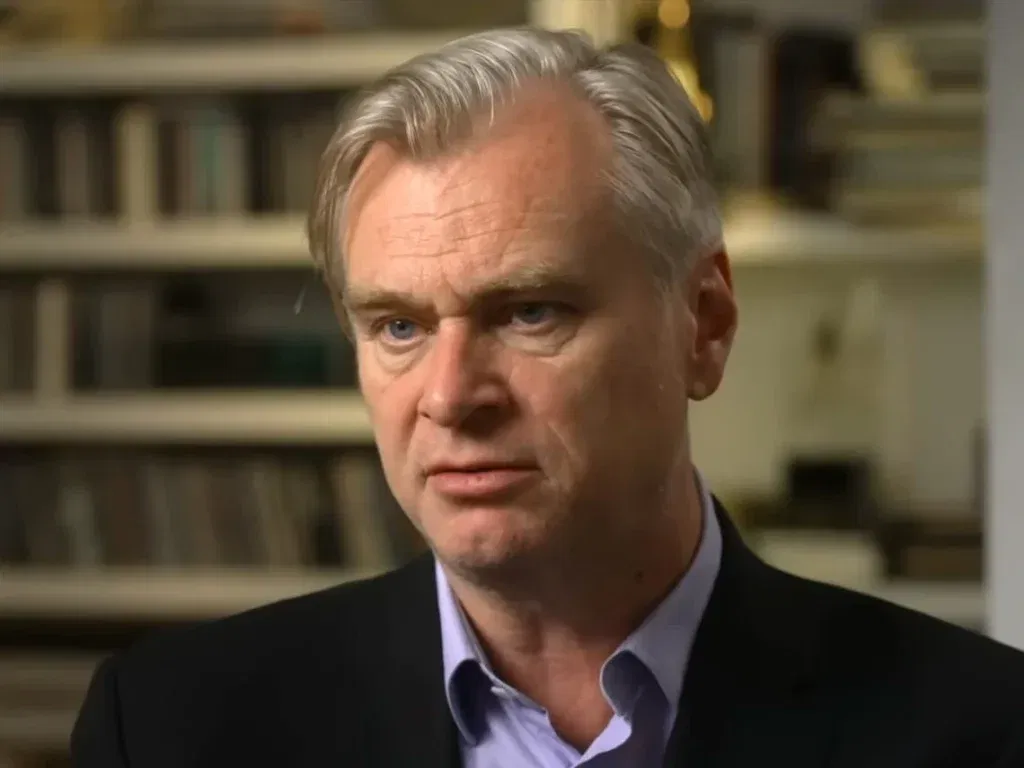 Christopher Nolan’s The Odyssey releases on July 17 | Credits: YouTube/CBS
Christopher Nolan is not lying about the sentiment. The younger generation does seem to ridicule AI slop, like practical effects, and craves something that is tangible in an age when nothing seems real. What Nolan elides, whether by generosity or by the simple fact that he’s never had to think about it, is that disdain is not leverage. Taste doesn’t run a production company. Somebody else does that, and that somebody has never once in the history of the medium made a decision based on what a nineteen-year-old finds cringe on his timeline.
Nolan added in the same interview:
Their judgment of AI slop has been immediate and harsh. They see it for what it is very quickly – and it’s much easier for them to identify it, because it grew out of an online world they know really well. And while that doesn’t mean that every aspect of the technology is useless or meaningless, in film-making it’s hitting at exactly the wrong time. After years of driving towards heavily virtual environments, we’re seeing a renewed interest in more tactile, more real forms of storytelling.
Here is the thing about his position that Nolan’s filmography itself disproves: he is the last director in Hollywood who should be treated as a representative case study. Well, he is, almost uniquely, exempt from the pressures he’s describing. When Nolan makes the choice to use practical effects, to shoot on the Mediterranean rather than construct a soundstage, to gamble nine figures on a film about a man rowing himself home after a war, studios say yes. Why? Well, because his name alone de-risks the bet.
That is not the equation for the other several thousand filmmakers trying to make something in 2026. For them, the decision of whether to use an AI system or to do a location shoot, hire a bunch of extras, set up a set, is not a matter of artistic principle. Gen Z’s disdain, however real, doesn’t matter in that room. The people who do sit in that room have never ever let the audience sentiment stand in the way of any cost-saving decision-making process, and there’s no sign whatsoever that this is the year that will change that trend.
The Odyssey Director Ignores Hollywood’s Real AI Problem
Nolan has been a bulwark against the threats that cinema faces as a medium and as a business. He makes entertainment specifically for the big screen and always does something interesting with the subject of his movie. Even in The Dark Knight, arguably Nolan’s best movie, he brought his own twist to the Batman mythos. And yet, while he may serve as an inspiration to budding filmmakers, he cannot save the medium alone.
The deeper issue is that Nolan is answering a question nobody in the industry is actually asking. The AI conversation we are having online, the one about AI-created art being slop and the algorithmically generated nothing flooding social media in particular and the internet as a whole, is a conversation about a failure that is visible. It’s easy for us to reject the thing you can immediately clock as fake. However, the AI which is already present in the films we haven’t rejected: the de-aging technology, the crowd duplication, the skies that have been made more dramatic. It was not spotted because it was not meant to be spotted. Granted, that AI is different from generative AI that’s inundated our lives. But the point stands. Already, generative AI tools are passing the Turing test. That’s worth sitting with.
Nobody left the movie theater this year thinking, “Oh my god! I cannot believe that AI was used to make the establishing shot of the bridge!” If it worked, they weren’t supposed to notice, and if they didn’t notice, no rejection was ever available to them in the first place. Nolan is using a generation’s ability to recognize slop as a shield against a technology whose greatest application was designed precisely because people were never supposed to notice it. Those are two different fights, and only one of them is winnable by vibes alone.
None of this suggests there is anything disingenuous about Nolan’s optimism. His optimism stems from the position he occupies at the head of a system and assumes that what he sees from there is what the weather is like where everybody else stands. The kids are, by his account, all right. It’s the checkbook they don’t hold that should worry him more than it seems to. He has the right instinct here, and it is the same instinct that had him building rotating hallway sets instead of faking gravity digitally in Inception (perhaps the most confusing film of Nolan’s career). What he doesn’t have, and what nobody at his altitude ever quite does, is a clear view of what happens to that instinct once it’s handed to someone without his leverage, his budget, or his name attached to the greenlight.
What do you think: is Christopher Nolan right that Gen Z’s rejection of AI slop will actually shape the industry, or is he just speaking from a position of privilege most filmmakers don’t have? Let us know in the comments below.
The Odyssey releases on July 17, 2026.
















 Bengali (BD) ·
  English (US) ·