.png)
 1 hour ago
7
1 hour ago
7
Trigger warning: This article discusses themes of psychological horror, violence, and emotional abuse.
Spoiler Alert !!!
Beware, for this article contains full spoilers for Backrooms, including its ending!
Few horror movies in recent memory have arrived with as much cultural baggage (or wielded it as brilliantly) as Backrooms, the A24 debut from 20-year-old former YouTuber Kane Parsons, the studio’s youngest filmmaker. Based on one of the internet’s most enduring creepypastas, the film stands as one of the most assured debuts in recent memory.
| Title | Backrooms |
| Director | Kane Parsons |
| Release date | May 29, 2026 |
| Runtime | 1 hour 50 minutes |
| MPA Rating | R |
| Main Cast | Chiwetel Ejiofor, Renate Reinsve, Mark Duplass |
| Premise | A therapist ventures into an otherworldly dimension to find her missing patient. |
| IMDb rating (as of May 30, 2026) | 7.2/10 |
| Rotten Tomatoes score (as of May 30, 2026) | 90% | 74% |
One big reason Backrooms is so critically acclaimed is its focus on atmosphere and a gradual buildup of dread over jump scares that plague most horror movies.
What Is the Plot of Backrooms?
The movie is set in the 1990s and centers on Clark (Chiwetel Ejiofor), an unsuccessful architect whose aspirations have all fallen apart, leaving him to run a dilapidated furniture store called Cap’n Clark’s Ottoman Empire. Divorced, he lives in his own showroom and drinks excessively. He is also reluctantly undergoing therapy with the composed Dr. Mary Kline (Renate Reinsve). He is surrounded by spaces he cannot control, whether physical or emotional.
Things take a turn for the worse when he uncovers a mysterious portal in the basement of his store. At first, it looks like nothing more than a damp wall, but it opens into an endless, maze-like dimension of yellow-wallpapered rooms. Something about it feels deeply wrong. These are the Backrooms, also known as the Complex, a liminal dimension that Async, a shadowy research institute, has been documenting since the late 1980s.
Obsessed and terrified, Clark drags his assistant manager, Kat (Lukita Maxwell), and her boyfriend, Bobby (Finn Bennett), inside to document the space. Then he disappears. Skeptical but determined, Dr. Mary enters the labyrinth herself to find her patient. What she discovers is a nightmare not only of impossible architecture, but also of the darkest corners of the man she thought she understood.
How Backrooms Uses ‘Space’ to Create Horror
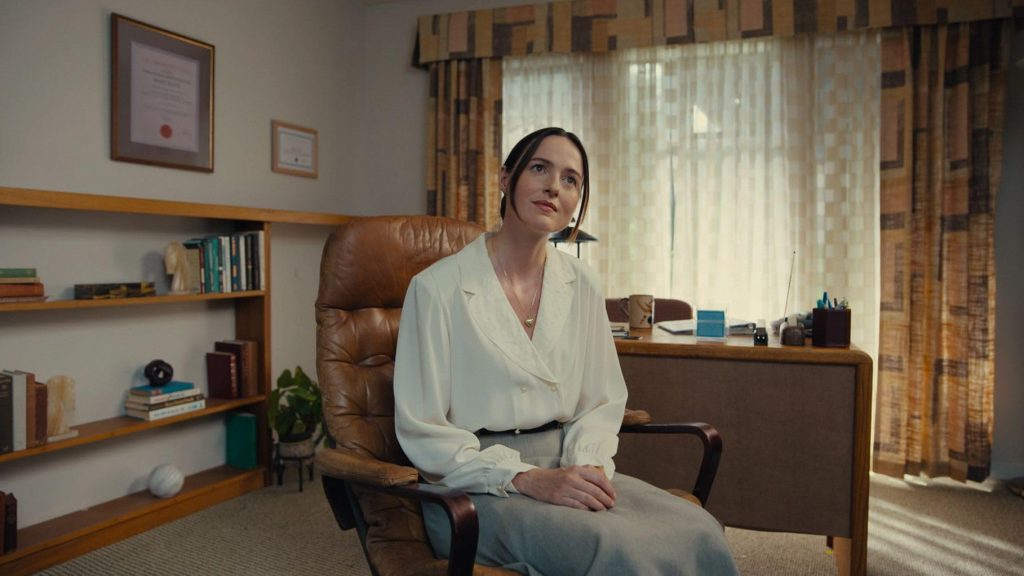 Renate Reinsve as Dr. Mary Kline in Backrooms (2026) | Credits: A24
The genius of the movie and the creepypasta has always been the weaponization of the familiar (it, by the way, makes a great case for other creepypastas to be adapted into movies in the future). It is a place the subconscious recognizes, even if the corporeal form has never been there.
The production designer, Danny Vermette, pulled real furniture from the store into the dimension itself. This was to make it seem as though this dimension feeds on and distorts the outside world. There were 30,000 square feet of labyrinthine sets built across four sound stages. There were hallways with doorways halfway up the wall, incongruous furniture sinking into the carpet, and the dreaded yellowed wallpaper that seemed alive. It gave the dimension a nightmarish feel with little CGI or special effects.
Vermette has expressed that the goal was to create both a sense of reality and the illusion of volume. He said (via IndieWire):
It was important to create an understanding for a first-time viewer that they get a sense of maybe how this world works, just a little bit. To pull real furniture from Clark’s Ottoman Empire and his throne and certain elements into the backrooms, to see that whatever it is, is getting its influence from somewhere.
The original creepypasta was, after all, about things that feel just a little off. The horror is not what jumps out; it’s what won’t resolve. All the disparate elements accumulate into dread that operates below conscious thought.
And we mean that not just for the protagonists, but also for us, the audience. Parsons understands that the true terror of the creepypasta is the endless, uncanny emptiness, and his direction mirrors that in its storytelling, for it is deliberately ambiguous. It dares you to feel disoriented rather than simply scared.
What Does Backrooms Symbolize With Clark’s Death?
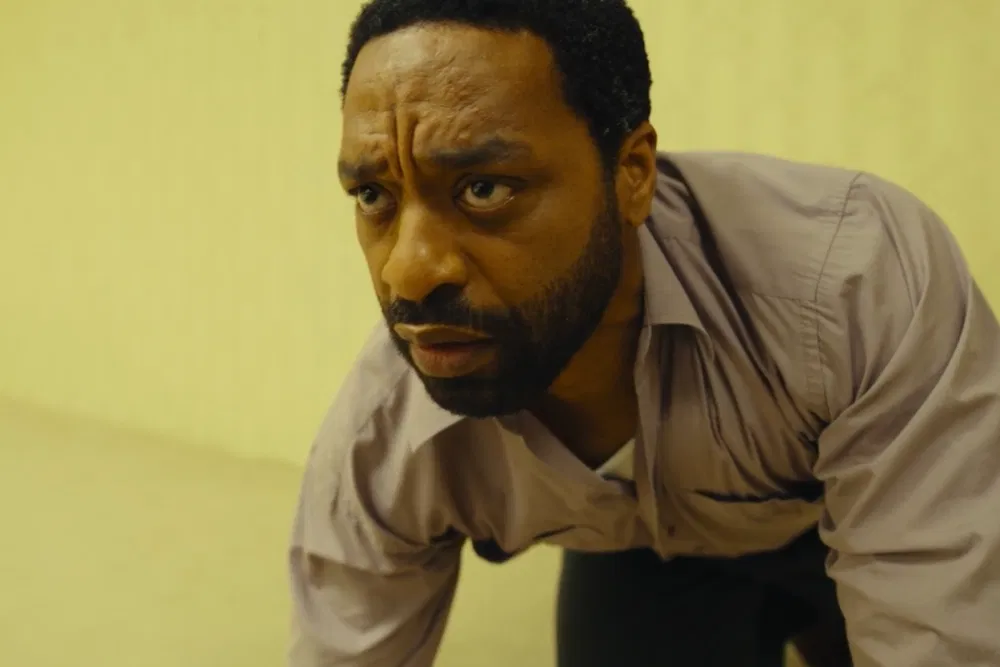 Chiwetel Ejiofor as Clark in Backrooms (2026) | Credits: A24
By the end, the Captain Clark creature has killed Kat and Bobby. They were dragged into this dimension by a deranged Clark. Mary eventually finds Clark. He promptly chokes her unconscious. When she wakes up, she finds herself tied to a chair. Clark demands that she validate his bitterness and failures. Even here, he cannot let go of his victimhood.
The creature that kills him is Captain Clark. He is the pirate mascot played by Clark himself in the commercials that Clark filmed for his store. But here, he is the physical embodiment of Clark’s aggression and unresolved mental health issues. Played by Robert Bobroczkyi, who also portrayed the Offspring, the terrifying human-xenomorph hybrid in Alien: Romulus, Captain Clark is feral and murderous. He kills Clark by ripping into his neck.
The symbolism here is that the Backrooms do more than trap people. They externalize whatever is most unresolved in whoever enters. Clark had years of unaddressed rage and unprocessed grief. The Backrooms gave it all a body, which promptly and brutally ended his life. In many ways, that end was overdue and not really a tragedy.
The Ending of Backrooms, Explained
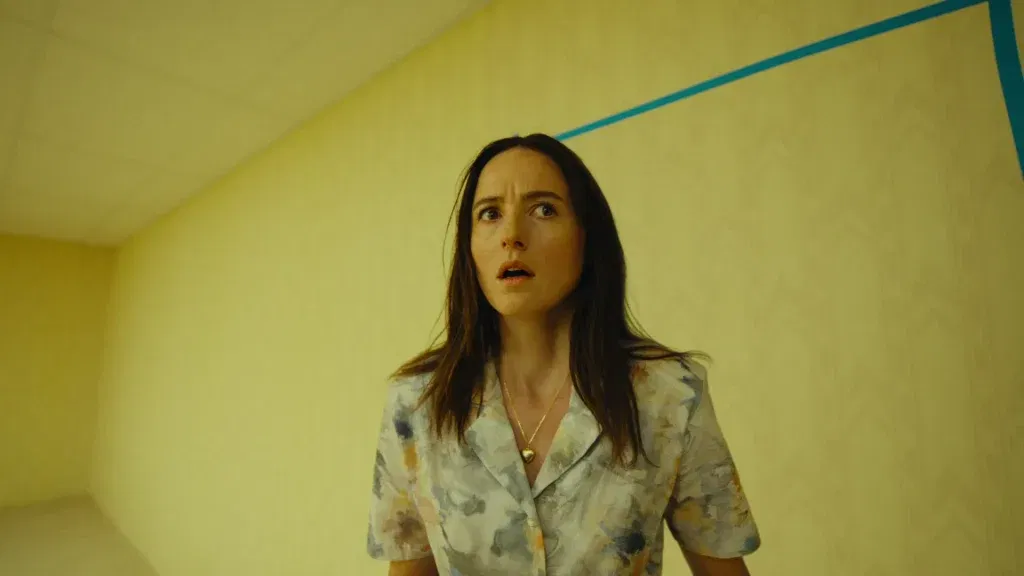 The ending of Backrooms is ambiguous | Credits: A24
So, what happens in the ending of Backrooms? Mary flees the Captain Clark entity. She eventually ends up in the custody of Async. An Async representative named Phil (Mark Duplass) debriefs her in an interrogation room. He tells us that Async was once a manufacturer of MRI machines, but they discovered the Backrooms, and their mission changed. Now, they plan to map the whole place.
Mary’s fate remains unknown. The closing montage shows a distorted version of Mary inhabiting the Backrooms. It may be that the real Mary escaped while a distorted version of her was left behind. We think so, but cannot say for certain.
Mary entered the Backrooms as a therapist worried about her delusional patient. She leaves, if she leaves at all, as a subject of study. The ending of the movie is not about solving a mystery but pointing out the horror of something that cannot be explained or reasoned with. This is what makes Backrooms one of A24’s best horror movies. It is a dimension, a sort of supernatural purgatory, that is indifferent to everyone it swallows. It will continue to expand.
Have you watched Backrooms? What did you make of the ending? Let us know in the comments below!






















/https%3A%2F%2Fsportsmole-media-prod.s3.gra.io.cloud.ovh.net%2Fuploads%2F2026%2F05%2Fimago1077546153-2-6a0b8bbf76f8f531157643.jpg)
 Bengali (BD) ·
  English (US) ·