.png)
 1 day ago
16
1 day ago
16
Few developers have had as much influence on modern action RPGs as FromSoftware, beginning with Demon’s Souls and eventually expanding the formula through Dark Souls, Bloodborne, Sekiro: Shadows Die Twice, and Elden Ring.
But which Soulsborne game is actually the best? We have put all seven major Soulsborne games in order from worst to best, considering their combat systems, level design, bosses, world-building, and overall impact.
7 Dark Souls 2
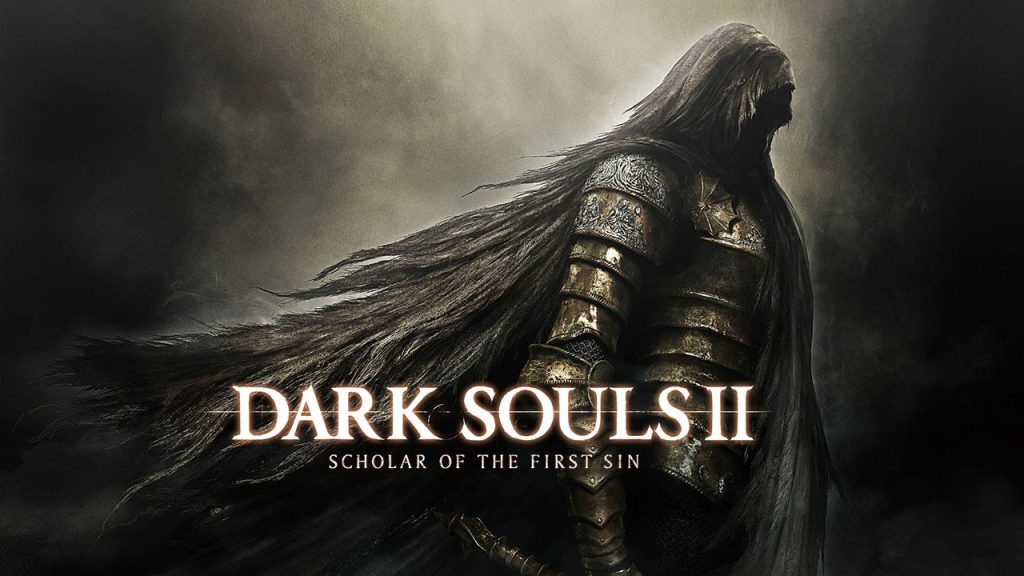 Dark Souls 2 Scholar Of The First Sin | Credit: FromSoftware
Dark Souls II is the odd one out in the trilogy, but that doesn’t make it a bad game. In fact, it takes more risks with the Souls formula than almost any other entry.
Released in 2014, Dark Souls II introduced several ideas that would later become foundational in the franchise, including a massive collection of weapons and dual-wielding through the Power Stance system, and even a more flexible approach to character progression.
Its biggest weakness is consistency. Some areas feel excellent, while others are noticeably less polished. Enemy placement can also feel frustrating, with some runbacks being too awkward for comfort. Still, the game gets credit for experimentation. The Scholar of the First Sin version also improves several aspects of the original experience.
6 Demon’s Souls
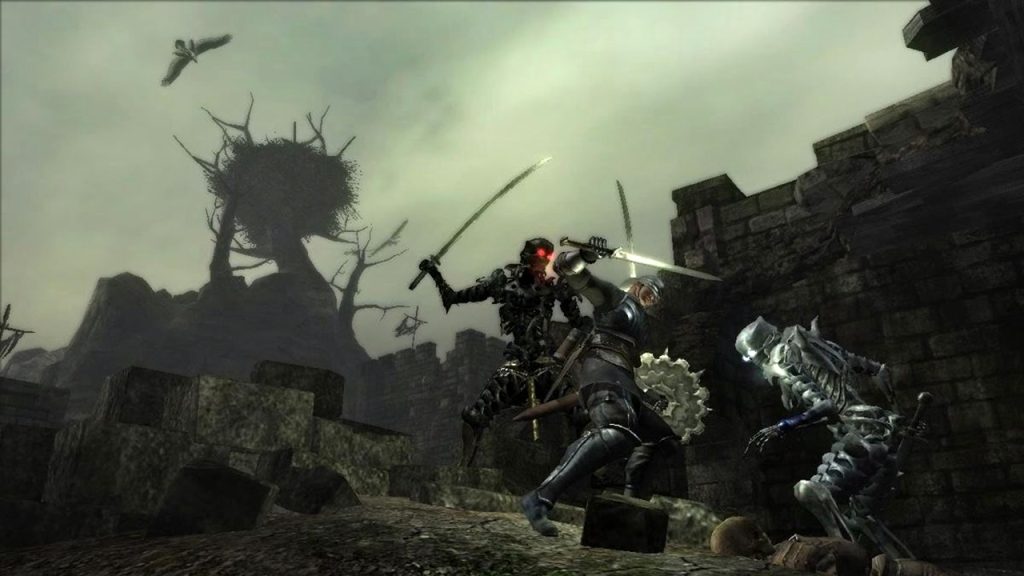 Demon’s Souls | Credit: FromSoftware
The game that started it all remains an important piece of FromSoftware history.
Demon’s Souls established many of the ideas that would eventually define the Souls genre, including the infamous difficult but rewarding combat along with the mysterious storytelling, interconnected systems, and the constant threat of losing all your resources.
Its original PlayStation 3 release was remarkably ambitious. Instead of one continuous world, the game uses the Nexus as a hub connecting players to different Archstones. This structure allowed the studio to experiment with different environments and gameplay scenarios.
The remake for the PlayStation 5 also demonstrates how strong the original’s underlying design was. Its visual presentation received a massive overhaul while retaining the game’s core structure. Unfortunately, some mechanics have aged poorly, including the world tendency, with certain areas brutally designed, and several bosses being more interesting conceptually than mechanically.
5 Dark Souls
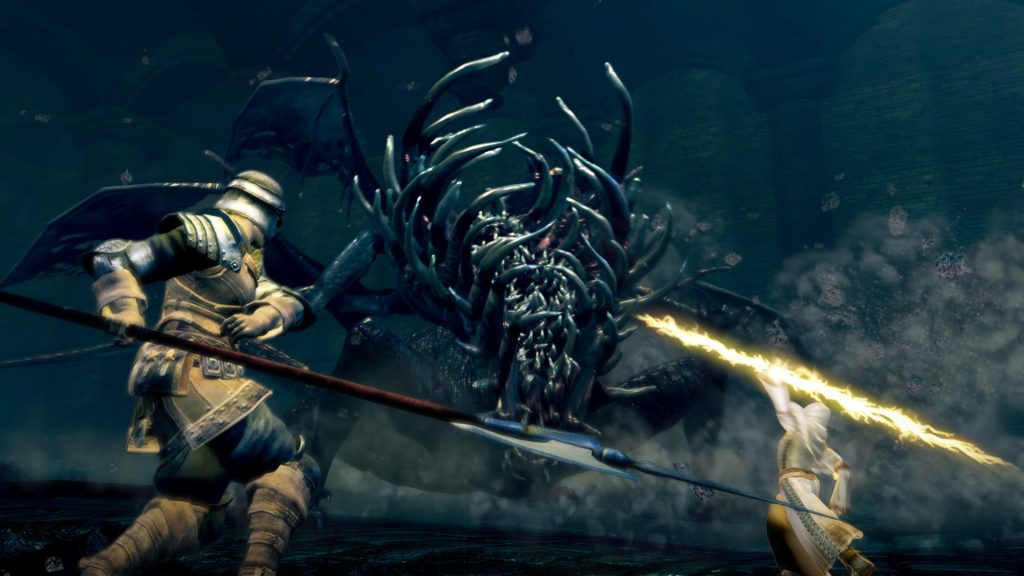 Dark Souls | Credit: FromSoftware
Dark Souls is arguably the most influential game on this list. Its greatest achievement is the way Lordran is designed. Areas connect to one another in ways that constantly reward curiosity, with shortcuts transforming previously intimidating journeys.
The game’s storytelling is equally intriguing. Rather than relying on traditional exploration, the game encourages players to piece together its history through the details hidden in the environment, as well as in item descriptions, characters, and locations.
Admittedly, the combat is slower than in later entries, but that pace helps in giving every attack and defensive decision considerable weight. Its second half is less consistent than its opening, and some bosses fail to match the quality of encounters such as Ornstein and Smough or Sif. Nevertheless, the foundation is extraordinary.
4 Dark Souls III
 Dark Souls 3 | Credit: FromSoftware
Dark Souls III is where the trilogy’s combat design reaches its most polished form. The game combines the deliberate foundations of the original Dark Souls with the faster movement and aggression that became increasingly prominent throughout the later games. The result is a combat system that feels responsive without completely abandoning the series’ RPG foundations.
Its boss lineup is another major strength. Fights such as Abyss Watchers, Pontiff Sulyvahn, Dancer of the Boreal Valley, Nameless King, and Slave Knight Gael showcase just how far the studio’s encounter design had evolved.
The world itself is more linear than Lordran, which makes exploration less exciting, but it also produces a more focused progression through its major areas. Most importantly, Dark Souls III works beautifully as a conclusion to the trilogy, constantly referencing ideas, characters, locations, and themes from previous games without requiring players to understand every connection.
It may not be as revolutionary as the original, but when seen as a whole, the game is one of FromSoftware’s most consistent and polished Souls games.
3 Sekiro: Shadows Die Twice
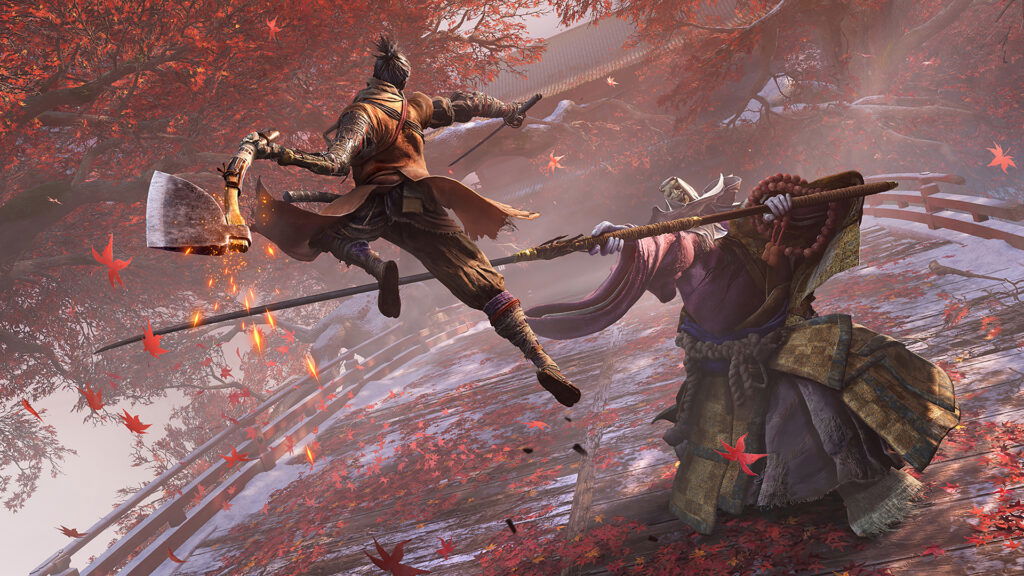 Sekiro: Shadows Die Twice | Credit: FromSoftware
Sekiro is technically the biggest departure from the traditional Souls formula, yet it remains unmistakably part of the same creative lineage. Instead of letting players construct any type of character they want, Sekiro gives them a defined protagonist with a katana, prosthetic arm, and highly specialized combat abilities. This removed much of the traditional build experimentation but allowed FromSoftware to focus entirely on swordplay.
The result is arguably the most precise combat system in the studio’s catalog. Deflecting attacks, breaking enemy postures, and exploiting openings create a rhythm unlike anything in the Dark Souls games. Its bosses further push players to fully understand those mechanics.
The grappling hook also transforms exploration, while resurrection adds another layer to combat. The downside is that Sekiro can be less accessible because players cannot simply change their build when struggling with a particular challenge. However, mastering its combat helps produce an exceptional sense of progression.
2 Bloodborne
 Bloodborne | Credits: FromSoftware
Bloodborne takes the Souls formula and rebuilds it around speed, aggression, and horror. Yharnam is one of FromSoftware’s most memorable settings, combining Gothic architecture and cosmic horror with an increasingly bizarre narrative. The world begins with what appears to be a traditional hunt for beasts before gradually revealing something far stranger beneath the surface.
Combat is where Bloodborne truly separates itself. Shields are largely abandoned in favor of firearms and aggressive attacks. The Rally system even encourages players to retaliate after taking damage rather than immediately retreating.
Its Trick Weapons are equally brilliant. A single weapon can transform into another configuration during combat, giving players a remarkable amount of versatility without requiring an enormous inventory.
Its biggest limitation is availability. Unlike the other games on this list, the game remains tied to PlayStation hardware, making it less accessible to players outside that ecosystem.
1 Elden Ring
 Elden Ring | Credit: FromSoftware
Elden Ring takes everything FromSoftware had learned from its previous games and expands it to an enormous open world. The Lands Between gives players an unprecedented amount of freedom, and instead of repeatedly crashing against one difficult boss or area, players can explore elsewhere, discovering new weapons and spells while simultaneously upgrading their characters, and even simply wandering into an entirely different region.
Its combat system also offers an enormous range of possibilities, as players can build around practically any combination of weapons, magics, abilities, summons, and even status effects. This is bundled with the sheer quantity of content the game offers.
The game’s world and mythology are ambitious, with George R.R. Martin contributing to its world-building alongside Hidetaka Miyazaki.
Elden Ring admittedly isn’t flawless, because its enormous scale means some encounters and areas can end up feeling repetitive. Nevertheless, it represents the most complete expression of FromSoftware’s design philosophy, and hence, sits at the top of this ranking.
What does your ranking of Soulsborne games look like? Drop it in the comments below and let us know!
























 Bengali (BD) ·
  English (US) ·