.png)
 1 hour ago
8
1 hour ago
8
Spoiler Alert !!!
Spoilers for Whalefall ahead!
Whalefall has an absolutely bonkers premise, and I am here for it. Well, mostly. It follows a young man searching for his dead father’s remains. Instead, he gets swallowed whole by a sperm whale. And then, he starts hearing his deceased father’s voice inside it. For Jay Gardiner (Austin Abrams), the young man in question, a dangerous dive becomes a claustrophobic struggle to stay alive.
The movie is Brian Duffield’s adaptation of Daniel Kraus’ novel. It gives that outlandish setup a poignant purpose. Jay’s father, Mitt (Josh Brolin), taught him skills that could save his life. Remembering those lessons also means revisiting the volatile relationship that drove them apart.
Is Mitt’s Voice a Hallucination or Something More?
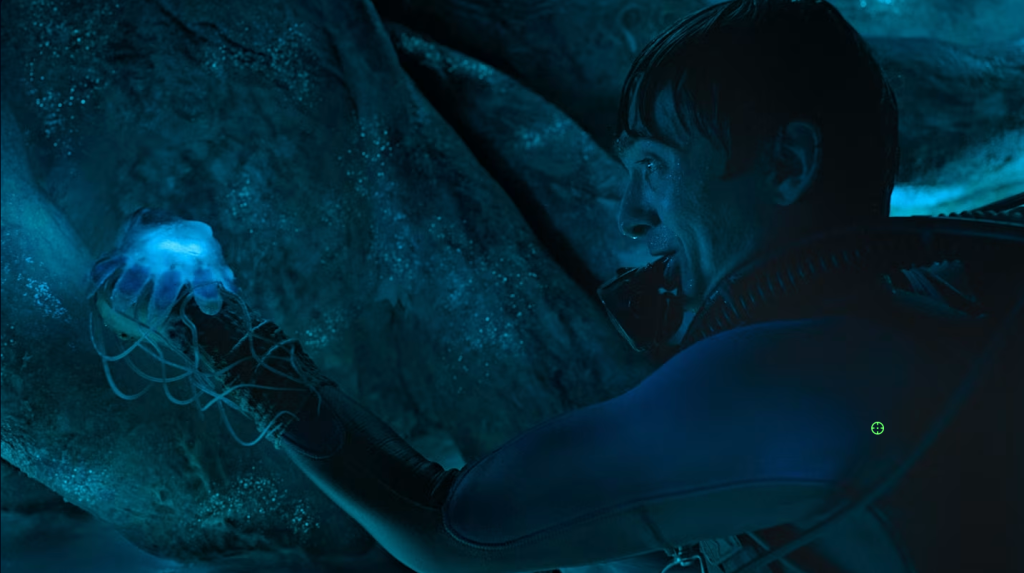 Austin Abrams in a still from Whalefall | Credits: 20th Century Studios
As Jay’s ordeal becomes increasingly punishing in Whalefall, he begins hearing Mitt speak through the whale. It is an eerie development, turning an enormous animal’s stomach into the setting for an overdue father-son conversation.
This survival thriller never confirms that Mitt’s spirit inhabits the whale. The more grounded interpretation is that Jay is hallucinating under extreme physical and psychological strain. His father’s voice gives shape to the memories and survival instructions he desperately needs.
Those memories are painful. Mitt was a demanding, aggressive parent whose attempts to toughen Jay often became abusive. Jay eventually left California for college in landlocked Iowa, distancing himself from his father and the ocean that dominated their lives.
After becoming seriously ill, Mitt died by suicide. He entered the water wearing weights. Jay’s refusal to visit during his father’s final days leaves him carrying guilt alongside his resentment. Inside the whale, those conflicting feelings finally surface. When Jay regrets failing to retrieve Mitt’s body, his father’s voice delivers Whalefall’s most affecting line: “You are my remains.”
Jay has treated recovering the body as an act of redemption. The response suggests his father already survives through him, in his knowledge, instincts, and memories.
How Does Jay Escape the Whale?
Jay’s nightmarish predicament begins when he becomes caught in a confrontation between a sperm whale and a squid. The whale swallows both, leaving Jay dependent on his diving equipment and dwindling air.
His early escape attempts fail. Moving deeper exposes him to digestive acid, while climbing toward the mouth briefly offers a tantalizing glimpse of freedom.
Using a jellyfish for illumination, Jay reaches the whale’s mouth and spots a whale-watching boat. Before he can attract help, however, the animal dives.
The situation becomes more chaotic when orcas attack the sperm whale. Other whales arrive to defend it, but its injuries prove fatal. Its return toward the surface gives Jay one final opportunity.
Remembering Mitt’s lessons, Jay improvises an explosion using available materials, including a battery and steel wool, alongside his diving equipment. The blast tears an opening in the whale’s stomach. It is a spectacularly grisly exit, and it still leaves him injured in open water. Fortunately, a nearby boat rescues him.
Jay survives at the end of Whalefall. But he never recovers his father’s remains. But his desperate fight to return gives him a reason to look beyond it.
What Do Mitt’s Letter and the Title Mean?
 Austin Abrams and Josh Brolin in Whalefall | Credits: 20th Century Studios
Before his death, Mitt wrote letters to his children. Jay has refused to open his, avoiding his father’s final words while becoming fixated on finding his body.
After surviving, he finally reads it. The film withholds the contents and shows Jay smiling, offering a quiet moment after the stomach-churning spectacle.
We cannot assume the letter contains an apology or a perfect explanation for Mitt’s behavior. Its significance lies in Jay’s willingness to receive it. He can now approach something his father left behind without turning it into another punishing obligation. For all its gruesome aquatic horror, Whalefall isn’t a typical creature feature. The whale is no monster, and its death becomes part of the film’s poignant exploration of what we leave behind.
The title supplies a broader metaphor. A whale fall occurs when a dead whale sinks to the seabed, where its remains sustain an ecosystem. The film connects that process to the influence a person leaves after death.
Mitt’s legacy includes affection, practical knowledge, and emotional wounds. Jay must decide what to carry forward and how to live with the rest. His eventual return to a boat with his family ends Whalefall on a hopeful note. The ocean can hold something beyond his father’s death and his own ordeal. Jay entered the water believing he owed his family a body. He returns with a chance to be present in their lives again.
Whalefall has received mostly positive reviews, with a 70% score on Tomatometer (as of October 16). FandomWire’s 7/10 review of Whalefall read: “While the central grief metaphor can be heavy-handed, Brian Duffield’s sharp pacing and terrifying creature effects make it a gripping ride.“
Did you hear Mitt’s voice as a hallucination or something supernatural? Share your interpretation in the comments!
Whalefall released in theaters on October 16.



























/https%3A%2F%2Fsportsmole-media-prod.s3.gra.io.cloud.ovh.net%2Fuploads%2F2026%2F10%2Fronaldo-portugal-6abeaa661f6ac972531182.jpg)
 Bengali (BD) ·
  English (US) ·