.png)
 5 hours ago
7
5 hours ago
7
Pumping oil could require investments of many billions of dollars
Author of the article:

Washington Post
Evan Halper, Karen DeYoung, Anthony Faiola, Samantha Schmidt, The Washington Post
Published Aug 28, 2026 • 6 minute read
See more Toronto Sun on Google — save as a Preferred Source
Advertisement 2

THIS CONTENT IS RESERVED FOR SUBSCRIBERS ONLY
Subscribe now to read the latest news in your city and across Canada.
- Unlimited online access to articles from across Canada with one account.
- Get exclusive access to the Toronto Sun ePaper, an electronic replica of the print edition that you can share, download and comment on.
- Enjoy insights and behind-the-scenes analysis from our award-winning journalists.
- Support local journalists and the next generation of journalists.
- Daily puzzles including the New York Times Crossword.
SUBSCRIBE TO UNLOCK MORE ARTICLES
Subscribe now to read the latest news in your city and across Canada.
- Unlimited online access to articles from across Canada with one account.
- Get exclusive access to the Toronto Sun ePaper, an electronic replica of the print edition that you can share, download and comment on.
- Enjoy insights and behind-the-scenes analysis from our award-winning journalists.
- Support local journalists and the next generation of journalists.
- Daily puzzles including the New York Times Crossword.
REGISTER / SIGN IN TO UNLOCK MORE ARTICLES
Create an account or sign in to continue with your reading experience.
- Access articles from across Canada with one account.
- Share your thoughts and join the conversation in the comments.
- Enjoy additional articles per month.
- Get email updates from your favourite authors.
THIS ARTICLE IS FREE TO READ REGISTER TO UNLOCK.
Create an account or sign in to continue with your reading experience.
- Access articles from across Canada with one account
- Share your thoughts and join the conversation in the comments
- Enjoy additional articles per month
- Get email updates from your favourite authors
Article content
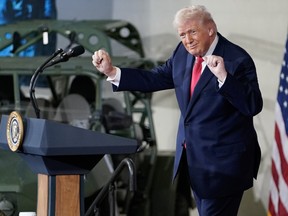
U.S. President Donald Trump on Friday announced an oil agreement with Venezuela, which he said would involve 65 billion barrels and more than double reserves “at no cost to the American Taxpayer.”
Article content
Article content
The Trump administration is negotiating a long-term stake in a vast share of Venezuela’s oil fields, according to several people close to the discussions, a costly and legally precarious proposal that aims to nudge reluctant energy companies to drill in the risky region.
The contours of the plan, which is still evolving and could change or fall apart, would involve the United States taking more direct control over Venezuelan reserves as crime and steep logistical challenges discourage private investors.
Under terms being discussed, the U.S. would acquire long-term contracts for a third of Venezuelan oil reserves, creating access to roughly 90 billion barrels of crude, according to two people familiar with the negotiations who spoke on the condition of anonymity because they were not authorized to share details.
Advertisement 3
Article content
A list shared with The Washington Post noted 17 oil fields in which the U.S. would take a stake. Several of the fields lack any infrastructure or access to transport hubs to treat and move the crude. Those where such infrastructure does exist have fallen victim to years of neglect and theft of machinery.
Pumping oil from the fields could require investments of many billions of dollars and costly security plans to protect oil workers and production facilities in lawless and violent regions.
The U.S. could mitigate some of the exposure to taxpayers by subcontracting the fields it acquires to oil companies that might be persuaded to invest in projects in which the U.S. has taken a stake.
RECOMMENDED VIDEO

We apologize, but this video has failed to load.
But luring firms to the region would still probably require the U.S. government to absorb a considerable amount of the risk involved with developing oil infrastructure in Venezuela.
“I think oil companies in the end will be pretty hesitant,” said Francisco Monaldi, director of the Latin American Energy Program at Rice University.
By signing up you consent to receive the above newsletter from Postmedia Network Inc.
Article content
Advertisement 4
Article content
The negotiations were first reported by Axios.
People close to the talks said Secretary of State Marco Rubio and Energy Secretary Chris Wright were hoping to visit Venezuela to announce a deal early next month. But some in the industry were skeptical that anything substantial would come together by then.
A deal would probably include oil fields being operated by North American Blue Energy Partners, or NABEP, the second-largest private oil producer in Venezuela, though no final agreement has been reached, according to a person familiar with the discussions.
The Pentagon, through its Office of Strategic Capital (OSC), could oversee and help fund the oil field licences, according to the person familiar and one other with knowledge of the talks. The mission of that office is to “accelerate and scale private investment in critical supply chain technologies.”
Pentagon officials said they could not comment on any particular deals being weighed at the OSC, but they stressed that the office cannot take any ownership stake in private companies.
Advertisement 5
Article content
“OSC’s role is strictly limited to providing capital assistance in the form of a loan, loan guarantee, or technical assistance (including transaction structuring for developing and financing investments),” said a statement from Pentagon spokesman Sean Parnell.
Bloomberg News first reported the involvement of NABEP and the Pentagon in a potential Venezuela deal.
NABEP is controlled by the Venezuelan businessman Alejandro Betancourt, a major player in the country’s oil sector who has become a key intermediary between the U.S. and Venezuela and has helped broker early contracts to get oil pumping fast in the country, The Post reported this week.
Betancourt has ramped up oil output by NABEP to nearly 200,000 barrels per day from 18,000 in just two years. In the past decade he has also faced multiple investigations, in Switzerland, Spain and the United States, into alleged money laundering.
U.S. officials this year have lobbied to resolve the case in Switzerland in a way that would avoid criminal charges and end travel restrictions against Britain-based Betancourt, The Post reported, citing two people familiar with the matter, who spoke on the condition of anonymity to discuss a sensitive matter.
Advertisement 6
Article content
The United States has also not acted on a Swiss arrest warrant against him, the people said. Instead, the U.S. has allowed Betancourt to enter the country repeatedly for meetings with the Trump administration, other people familiar with his travel said.
There are numerous hurdles to any oil deal, including strong opposition in Venezuela to ceding control of natural resources to the United States. Revisions to the Venezuelan constitution may be required before any such deal is finalized, and the prospects of that happening are uncertain amid U.S. antipathy.
“An illegitimate interim [Venezuelan] government with an illegitimate hydrocarbons law has no legitimacy to strike this unconstitutional deal,” Ricardo Hausmann, a Harvard economist who served as Venezuela’s minister of planning in the early 1990s, said in a post on X. “It will be a fiasco for all involved, starting with @SecRubio.”
The administration did not respond to a request for comment. But an official did confirm that President Donald Trump and Venezuela’s interim president, Delcy Rodríguez, talked by telephone this week, one of the few times the two leaders have spoken directly.
Advertisement 7
Article content
Amid the discussions, Venezuela is also weighing withdrawing from the OPEC consortium of energy-producing nations, according to people familiar, a move the Trump administration would welcome as it seeks to exert more influence over the international oil trade. Venezuela is a founding member of OPEC.
Trump made Rodríguez “interim” president while pledging that her country eventually will return to democratic, elected governance. “From a legal standpoint in Venezuela, Delcy has no standing,” said a Venezuelan with long participation in the oil industry who spoke on the condition of anonymity to provide a candid assessment.
The person said this will leave banks and other institutions typically involved in financing drilling operations asking, “Why are we signing deals with people who have zero legitimacy?”
Those with knowledge of the talks said it is unclear how much taxpayer money Washington would seek to put into oil production versus backing private investment from U.S. firms to develop the fields. The talks appear to be focused on an existing joint venture legal structure in Venezuela through which the United States would be granted access to develop the oil fields, but Venezuela would still be guaranteed a large cut of all revenue they produce.
Advertisement 8
Article content
Any deal could face stiff resistance not just in Venezuela but in the United States.
U.S. government expenditures of the size needed to lock down long-term contracts and develop oil fields would probably need congressional approval just as Trump’s GOP allies risk losing control over the legislative branch in the upcoming midterm elections.
Democrats have been unyieldingly critical of the administration’s endeavours in Venezuela, including its opaque dealmaking with the country’s natural resources industries, since the U.S. ousted former Venezuelan dictator Nicolás Maduro.
Despite claims by the Trump administration that Maduro’s removal would unleash a frenzy of drilling in Venezuela, oil production there has increased little, up only about 200,000 barrels over the past year, with projections for the same increase or less next year.
It remains unclear “whether anybody would want to operate” in a country where electricity is limited and port infrastructure is not capable of handling increased production, among other limits that “are holding back the majors from going into the country right now,” said David Goldwyn, head of the international energy consulting firm Goldwyn Global Strategies.
Advertisement 9
Article content
Even if the administration were to supersede all Venezuelan government jurisdiction over the oil fields, those areas “would have the same risks” that have limited new investment so far to smaller, less risk-averse companies, Goldwyn said.
The Trump administration has announced other major deals for the U.S. to take a big stake in energy or natural resources production, only for little to materialize. These include plans for the United States to take a stake in Ukraine’s reserve of critical minerals and an announcement nearly a year ago that the U.S. would fund construction of large nuclear reactors in return for a stake in the Westinghouse corporation.
Neither of those agreements has led to the breakthrough developments in energy production that the administration forecast when they were announced.
Article content






















 Bengali (BD) ·
  English (US) ·