.png)
 2 hours ago
9
2 hours ago
9
Article content
He’s had several “near misses” involving patients treated in chairs — close catches where a disaster was narrowly avoided because of, in the internal bleeding case, vigilance. “I got a bad vibe, which is honestly a big part of being a doctor.”
Article content
The pressure to provide treatment in whatever space they can is creating a moral, “damned if you do, damned if you don’t” dilemma for emergency staff across Canada, said Medicine Hat, Alta., emergency physician Paul Parks.
Article content
“You don’t want to watch suffering and see patients not doing well and lingering in the waiting room. But you also know that, when you walk out there, you don’t really have a nurse, you don’t have monitoring, you don’t have the standard things you would have if you had a normal care space,” said Parks, a past president of the Alberta Medical Association.
Article content
This is just a Band-Aid on a massive, gaping wound
Article content
“You, by definition, are basically kind of McGyvering-it and giving suboptimal care to a degree.”
Article content
But while some care, some intervention, may be better than nothing, “this is just a Band-Aid on a massive, gaping wound,” he said.
Article content
An average of 1,390 people seen in an emergency room on any given day in Ontario in 2023-24 received care in an unconventional space, a metric first tracked by the news outlet, The Trillium.
Article content
Article content
Not every person who lands in emergency needs to be in a space with monitors and a gurney or stretcher — the old school thinking of the 90s.
Article content
Over the years, emergency departments pulled together “minor treatment” spaces. At Parks’ Medicine Hat hospital, that meant three chairs separated by office space dividers in a public hallway outside the waiting room.
Article content
Thus, “chair care” was born.
Article content
More recently came “rapid assessment zones” designed for the “less acutely unwell” who can be safely seen in an internal waiting area or chair space — people with sprains, cuts needing stitches, sore throats, ear infections. There are comfortable padded recliners, perhaps a bed or two. The aim, to increase patient flow — assess, treat and move people out, quickly. “It maximizes your space and allows good throughput,” said Ottawa area emergency physician Dr. Michael Herman.
Article content
The potential danger occurs when the emergency department gets “jammed up with admits,” meaning every cubicle or hallway stretcher already filled with people who need to be admitted to the hospital, but with no empty beds on the wards to move them to, because those scarce beds are filled, often with people who no longer need to be there but can’t leave because there’s nowhere for them to go — no space in a nursing or long-term care home, no home care or rehab bed. What’s known as “access block,” another administrative euphemism.
Article content
Article content
Suddenly, people with more serious complaints trickle down to the fast-track zone, “where it’s really not optimized for that person or that complaint,” Herman said.
Article content
“It slowly becomes normalized — the frog in the boiling water. ‘We just wanted to see them to get things started or get things moving along,’ and then it becomes two patients, then eight, then 10.”
Article content
“You’ve normalized a patient population through one of these zones that isn’t appropriate for them,” Herman said.
Article content
That can be risky with “undifferentiated” patients: Is the chest pain acid reflux, pneumonia or an evolving heart attack?
Article content
“That’s the five-alarm fire situation many of us worry about every day,” Herman said.
Article content
Article content
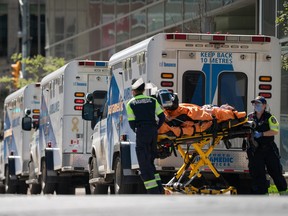
When hospitals are running at 100 per cent capacity, and the congestion backs up into emergency, “the goal posts move, and the appropriateness goes out the window,” Mackay said.
Article content
“You cannot appropriately examine a patient in a chair, physically, or from a patient privacy perspective. You have to lift up shirts, take off pants, put on monitors, get your stethoscope out.”
Article content
And when the rapid-access zones and other chair areas are overflowing, including with now very sick patients needing more prolonged care, and those areas get gridlocked, “then we’ll go out into the waiting room,” Parks said, to try to find the near misses and avert another waiting room disaster.


























/https%3A%2F%2Fsportsmole-media-prod.s3.gra.io.cloud.ovh.net%2Fuploads%2F2025%2F08%2Fimago1064957868-1-68b054b89f2ee835169758.jpg)


 Bengali (BD) ·
  English (US) ·