.png)
 1 hour ago
5
1 hour ago
5
Article content
“Champlain is unquestionably a major figure in Canadian history. He was a cartographer, a diplomat, a founder of New France, and he created maps and writings that help shape European understanding of this region,” Durnford said. “And he developed relationships with several Indigenous nations that were important to the survival and the growth of early French settlement. So, he was unquestionably an important figure.”
Article content
In 1609, 1610 and 1615, he fought alongside Indigenous groups including the Huron-Wendat against the Iroquois.
Article content
He was named Governor of New France in 1620, but he and New France itself were captured by the British in 1629. Both were returned to France in 1632. He died on Christmas Day, 1635, at the age of 68.
Article content
On the 300th anniversary of Champlain’s first sojourn to the area, local businessman and The Packet’s publisher, Charles Harold Hale and other Orillia Canadian Club members, successfully advocated for a Samuel de Champlain statue, built by Vernon March of England in 1925.
Article content
A crowd of 10,000 people witnessed the monument’s unveiling when Orillia’s population was only 6,000.
Article content
Article content
The statue was first removed in 2017 by Parks Canada which took ownership of the statue’s podium in the 1970s. Orillia is currently in the process of buying back the plinth.
Article content
In 2018, a Champlain Monument Working Group was established by Parks Canada to return the Champlain statue. The working group included McIsaac, Durnford and both the Rama and Huron-Wendat First Nations.
Article content
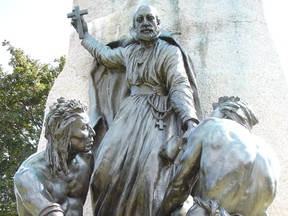
In 2019, this group made several recommendations for returning exclusively Champlain’s statue while including relevant context for reconciliation such as redesigning the monument and adding Indigenous languages.
Article content
Article content
“We pulled the Récollet father out. That was intentionally done, in deference to First Nations because we feel that it acknowledges the harm caused by the residential school legacy,” McIsaac said.
Article content
“I mean, that is a huge issue, part of reconciliation, and we think pulling a Récollet father out was exactly the right thing to do. We proposed elevating the presence and recognition of the Chippewas of Rama … here in Wendat and then the Anishinabek. You know, those stories have to be told, not as footnotes, but foundational. They need to be told in Indigenous languages, which what we did. We rewrote the plaque and it’s in four languages. So, two Indigenous, English and French.”
Article content
Article content
Parks Canada deferred the monument’s reinstallation in 2020 to allow for further discussion regarding the working group’s recommendations. It was deferred again in 2021 following the Indigenous groups exiting the working group.
Article content
Following the story of soil disturbances that signalled potential graves at the site of a former residential school in Kamloops, B.C., both Indigenous groups exited the working group in 2021.
Article content
The Rama First Nation issued a statement this past January, saying that they refuse to discuss Champlain further due to the pain that the topic elicited. This sentiment has remained to date. They respectfully declined an interview.
Article content
Other councillors left this March, including Durnford.
Article content
“Over time, over the course of the working group, I became concerned that we were moving too quickly and moving away from those goals,” she said. “And I was disappointed that Rama First Nation was not presented with the design before it came to council.”
Article content
McIsaac eventually became the sole remaining member of the working group. When Orillia City Council agreed to store the statue, he chose to store the statue back on the plinth in Couchiching Beach Park on May 21 without informing anyone else in advance.


















/https%3A%2F%2Fsportsmole-media-prod.s3.gra.io.cloud.ovh.net%2Fuploads%2F2026%2F06%2Frio-ngumoha-email-sportmole-6a27b73e9a471352625861.png)
 Bengali (BD) ·
  English (US) ·