.png)
 1 hour ago
3
1 hour ago
3
Tatsuki Fujimoto’s 17-26 is making waves like never before. Fujimoto’s early experiments have officially entered awards territory as 17-26 has been nominated for the Short-Form Series category at the 54th International Emmy Awards, putting the Chainsaw Man mangaka’s unusual anthology alongside three other international productions. Meanwhile, the series is available on Prime Video, featuring all eight episodes.
The nomination is especially notable because the project is essentially a time capsule of Fujimoto’s development written between the ages of 17 and 26, transformed into anime by seven directors and six studios. So, here’s our ranking of all the one-shots:
8 Sasaki Stopped a Bullet Turns Impossible Belief Into Absurd Comedy
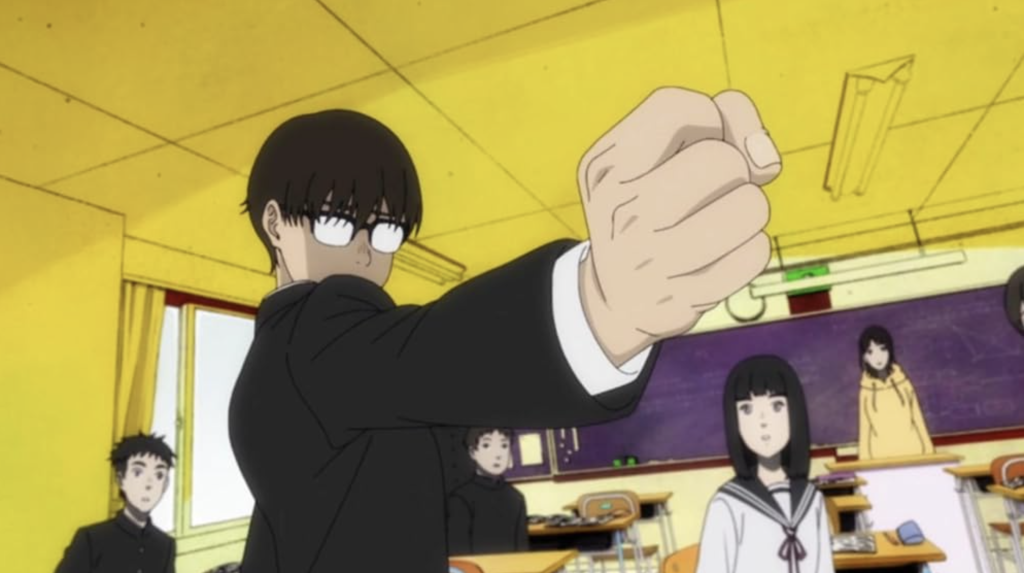 A still from Sasaki Stopped a Bullet. [Credit: Lapin Track]
Sasaki Stopped a Bullet has perhaps the purest Fujimoto elevator pitch: a lovestruck student attends remedial classes to see his teacher, an armed man storms in, and Sasaki throws himself into the disaster. The short is energetic, ridiculous and knowingly melodramatic. Lapin Track built key emotional scenes from live-action performances before translating their timing and expressions into animation. That craft makes it fun to watch, but its emotional and thematic ideas are comparatively straightforward.
7 Mermaid Rhapsody Finds Strange Beauty Beneath the Waves
 A still from Mermaid Rhapsody. [Credit: 100studio]
Mermaid Rhapsody is perhaps the anthology’s gentlest experiment. Toshihide’s relationship with Shiju, a mermaid who listens to him play a piano beneath the sea, lets Fujimoto explore music, longing and connection without leaning as heavily on violence. The anime gains something the page cannot quite reproduce: the sensation of sound moving through an underwater world. 100studio makes the piano central to the episode’s mood. Its relative simplicity keeps it below the more thematically aggressive shorts.
6 Love Is Blind Sends a Teen Romance Into Cosmic Chaos
 A still from Love Is Blind. [Credit: P.A. Works]
Love Is Blind starts with a familiar teenage problem: Ibuki wants to confess to Yuri before graduation. Then Fujimoto keeps escalating until ordinary romantic anxiety becomes something much stranger. The short works through the contrast between its straightforward emotional core and increasingly outrageous circumstances. Nobuyuki Takeuchi’s direction preserves the manga’s conversational energy and momentum. It is clever and charming, but compared with the stories above it, the characters and themes have less room to breathe.
5 Shikaku Turns a Hit Job Into Fujimoto’s Strangest Love Story
 A still from Shikaku. [Credit: GRAPH77]
A killer-for-hire being asked to assassinate a 3,500-year-old vampire sounds like a violent gag until Shikaku turns it into a story about two damaged people finding recognition in each other. Fujimoto’s ability to make grotesque characters oddly lovable is already visible. It feels like a clear bridge toward the emotional contradictions later associated with Chainsaw Man, even if its character development is more compressed than the episodes above it.
4 The Illness of Becoming a Girl Overnight Makes Identity Feel Unfamiliar
 A still from Woke-Up-as-a-Girl Syndrome. [Credit: Studio Kafka]
The Illness of Becoming a Girl (or Woke-Up-as-a-Girl Syndrome) takes a ridiculous premise and makes everyday gender expectations feel newly strange. Toshihide wakes up in a female body, faces unwanted attention and harassment, and has to reconsider his relationship and himself. It does not hit the emotional depths of the top three, but its willingness to turn bodily confusion into both comedy and introspection makes it one of the anthology’s most distinctive experiments.
3 The Garden of Eden Hides a Chilling Twist Beneath Its Calm
Officially titled “A Couple Clucking Chickens Were Still Kickin’ in the Schoolyard,” this debut-era story is classic young Fujimoto: bizarre premise, sudden danger, absurd humor, and a sharp look at prejudice. Humanity has supposedly been wiped out by aliens, while alien students inhabit the remnants of human civilization. At the center are two “chickens” carrying a secret. It lands below Nayuta because its emotional ideas are less developed, but its raw imagination is undeniable.
2 Nayuta of the Prophecy Makes a Brutal Fate Feel Heartbreaking
 A still from Nayuta of the Prophecy (Yogen no Nayuta). [Credit: 100studio]
Nayuta of the Prophecy is where Fujimoto’s fascination with monstrous people and unconditional love hits hardest. Kenji knows his little sister is feared as a prophesied destroyer, yet treats her first as family and only second as a threat. That reversal gives the short its bite: the world asks whether Nayuta is evil while Kenji asks whether she is loved. The 100studio adaptation pushes the surreal violence without losing that warmth. It also feels like an early echo of themes Fujimoto would later revisit in Chainsaw Man.
1 Sisters Turns Artistic Rivalry Into a Surprisingly Tender Story
 A still from Sister. [Credit: P.A.WORKS]
Sisters is the anthology’s most mature piece because its strangest idea gives way to something painfully human: two artists terrified of being left behind. Mitsuko’s humiliation after Kyoko’s nude portrait wins an exhibition award sparks a revenge game, but the real subject is insecurity, and how competition can hide admiration. P.A.WORKS gives the story restrained direction, letting glances and paintings carry emotional weight. It feels closest to Fujimoto’s reflective side.
Which is your favorite? Comment below!



















 Bengali (BD) ·
  English (US) ·