.png)
 56 minutes ago
7
56 minutes ago
7
Starfleet is not always the morally superior entity it claims to be. The Star Trek: TNG episode, ‘Journey’s End’, shows that the department can make mistakes and become the villain to certain civilizations because it tries to maintain larger diplomatic relations. In the episode, Picard is forced to relocate the residents of a planet just for a peace treaty.
The episode goes on to show how Starfleet operates in morally grey areas more often than necessary, and its actions are not always in service of everyone’s well-being. Other shows like Deep Space Nine have delved into this matter more deeply, but this TNG episode, which was released in 1994, showed their evil plainly.
A Peace Treaty Goes Wrong in Star Trek: TNG’s Refugee Crisis Episode
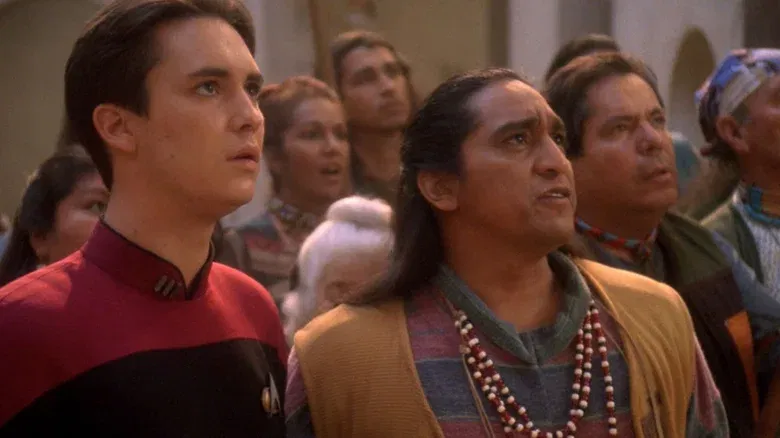 A still from Star Trek: TNG | Credits: Paramount
The Star Trek franchise has not shied away from going political and has offered commentary on the organizations that rule the in-show universe. The franchise is more of a diplomatic mission than a guns-ablazing action romp (unlike other sci-fi franchises), and its storylines reflect that. One such story is the TNG episode, ‘Journey’s End’.
In the season 7 episode, the focus is on a peace treaty between the Federation and the Cardassians, which restructures the borders that are governed by either entity. When a planet, Dorvan V, which is initially under Federation rule, comes under Cardassian borders, the Federation tries to forcibly relocate them.
Captain Picard is given the task of relocating them, but the population refuses to leave their homeworld as they have roots. They claim to be descendants of Puebloans, a native North American tribe. Wesley Crusher is the only one who sees the injustice in this forced relocation. Even Picard acts like his hands are tied in this situation.
It is a poignant commentary on the forced relocation and the refugee crises around the world at the time. The fact that they are Native American tribes adds more depth to the episode. At the end, the Dorvan V people remain as citizens of Cardassia, not letting go of their roots. It is a bittersweet ending that shows how Starfleet can be brutal in the quest for power.
‘Journey’s End’ Shows a Pattern of Morally Grey Activities Within Starfleet
 A still from Star Trek: Starfleet Academy | Credits: Paramount+
The Star Trek: TNG episode is far from the only instance where Starfleet has operated in morally grey areas. Right from its use of the Prime Directive, which forbids any Starfleet ship from getting involved in the ‘natural progression’ of an alien civilization (even if it is dire), to its espionage activities during the Dominion War, they have not been all good.
In the Voyager episode, ‘Author, Author’, the Doctor discovered that Starfleet permitted sentient hologram miners to be used as unpaid, rights-less labor in Federation mining operations. Despite prior precedent establishing that artificial lifeforms could possess legal personhood, Starfleet bureaucracy resisted extending those same protections to holograms.
The very existence of Section 31 and its activities in Deep Space Nine, including a key bluff during negotiations, is extremely evil of Starfleet. The Federation positions itself as the forebears of peace and democracy, but behind the scenes, there have been plenty of morally ambiguous activities from them, rogue Admirals aside.
The franchise repeatedly shows an organization capable of extraordinary compassion and equally capable of profound moral failure when treaties, war, or institutional self-interest take precedence over the individuals it claims to protect. Star Trek: TNG’s ‘Journey’s End’ remains one of the clearest and earliest examples of this contradiction.
Which Star Trek episode do you think exposes Starfleet’s malice the best? Comment below.
Star Trek: TNG is available to stream on Paramount+.






























 Bengali (BD) ·
  English (US) ·