.png)
 1 hour ago
7
Article content
Which brings us to Victory Square.
Article content
The cenotaph was unveiled in 1924 before approximately 25,000 people. It has changed over time, as has the way Vancouver has expressed remembrance around it.
Article content
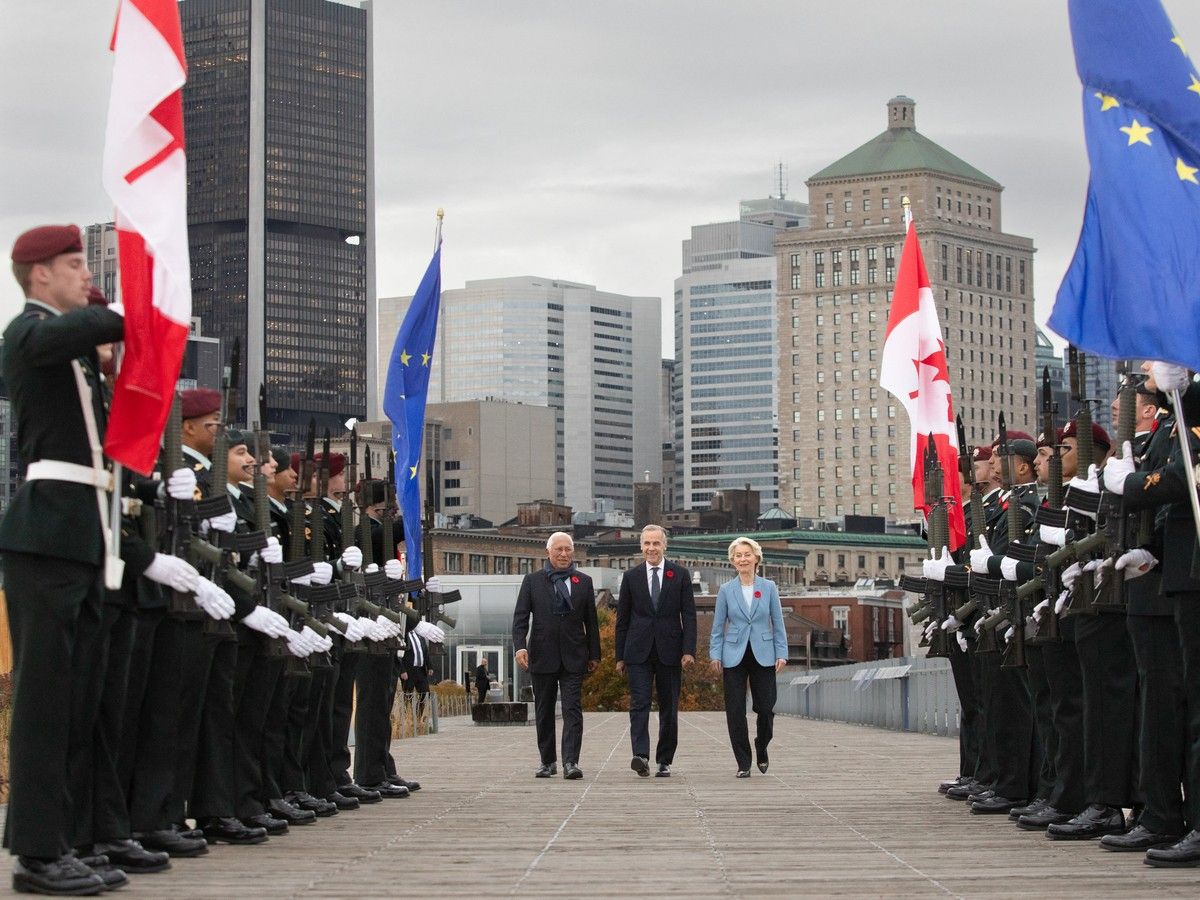
The flags displayed at the cenotaph changed over the decades. The original arrangement included the Union Jack, White Ensign (navy) and Canadian Red Ensign (then, the de facto flag for the Canadian army). Following the Second World War, the flags were raised higher, and and the flag of the Royal Canadian Air Force joined. In 1965, the Maple Leaf flag was also added.
Article content
Canada’s military has changed enormously since 1924. The Royal Canadian Navy, Canadian Army and Royal Canadian Air Force each have since adopted distinctive Canadian flags. Yet those contemporary identities are nowhere present at Vancouver’s principal war memorial.
Article content
Most curious is the continued presence of the Canadian Red Ensign. It was never Canada’s national flag. And if historical accuracy matters, the version displayed there today — the 1957–1965 version, featuring red maple leaves on the shield — is particularly curious. The historically appropriate version would be the one used from 1922 to 1957, with green maple leaves.
Article content
Advertisement 3
Article content
A memorial does not have to remain frozen at the moment it was created. Previous generations adapted Victory Square as Canada’s experience changed. There is no reason ours cannot do the same.
Article content
I spent nearly two decades standing at attention at the Remembrance Day ceremony there, often in the cold and rain. There are things I wish had never changed.
Article content
Foremost among them was the master of ceremonies, Cam Cathcart.
Article content
The timbre of his voice, its measured cadence and almost complete absence of inflection seemed perfectly suited to the occasion. I remember thinking that if one could hear the voice of God, it might sound something like him.
Article content
Before he died, I had the opportunity to meet him. I told him that.
Article content
But other traditions need not be permanent.
Article content
The songs Land Of Hope And Glory or Abide With Me were a cornerstone of Vancouver’s Remembrance Day service for decades. They were meaningful expressions of remembrance to an earlier generation. Yes, a great generation. But subsequent ones have experienced their own wars, their own losses, and their own service and sacrifice.
Article content
They should have the freedom to remember in their own way.
Article content
Advertisement 4
Article content
That is not a rejection of tradition. Tradition survives because each generation finds something in it worth carrying forward. Last year, the music included The Maple Leaf Forever and White Cliffs Of Dover. That’s a perfectly subtle change.
Article content
Remembrance should be neither a museum piece nor a political argument. It should be a living civic act amenable to change.
Article content
Some will attend this year’s ceremonies. Some will wear a poppy. Some will stand silently at a cenotaph. Some will visit a memorial on another day. And some will sleep late on Nov. 11.
Article content
That is their choice.
Article content
But public institutions do not have the luxury of indifference.
Article content
The City of Vancouver, the PNE, heritage authorities and other custodians of public spaces have inherited monuments whose meaning extends far beyond their surroundings. They have a responsibility to maintain them, explain them and, when appropriate, renew their physical expression.
Article content
Sometimes that means moving a neglected monument into the light. Sometimes it means repairing a broken wreath. Sometimes it means updating symbols so they continue to connect the memorial to the people and institutions they represent.

















 Bengali (BD) ·
 English (US) ·