.png)
 1 hour ago
8
1 hour ago
8
China’s edited version of One Piece is doing something few censorship campaigns ever manage: it is making the original look stronger. Fan-shared comparisons of the Bilibili broadcast show extra fabric, lace layers, and longer hemlines added to Wano-era outfits worn by the female characters. Surprisingly, the “conservative” versions of characters like Nami and Robin are gaining traction for looking surprisingly elegant.
By covering up fan-service, these edits have inadvertently created a “clean” aesthetic that many fans argue makes the characters look more like high-ranking officers and less like bikini-clad warriors.
| Title | One Piece |
| Original Author | Eiichiro Oda |
| Production Studio | Toei Animation |
| Total Episodes | 1,155+ episodes (ongoing) |
| IMDb Rating (as of May 10, 2026) | 9.0 / 10 |
| MyAnimeList Rating (as of May 10, 2026) | 8.73 / 10 |
| Streaming Details | Netflix, Crunchyroll |
China’s Heavy Edits Are Changing How Fans View One Piece
What makes these edits stand out is not just that they cover skin; they change the shape of the character designs. In the fan comparisons circulating online, the Wano outfits are not simply covered up; they are reworked with extra clothing that changes the silhouette. That matters because Wano is not a random setting. It is a Japan-inspired country, and the Straw Hats’ clothing there is part of the story’s world-building, not decoration.
China's censorship in One Piece pic.twitter.com/KbCxoMbDBO
— 𝐬𝐥𝐚𝐝𝐞 ☠️ (@oshoma33) May 9, 2026For many, Nami’s original Post-Timeskip design felt like unnecessary fan service that distracted from her role as a master navigator. The Chinese edits, though forced by strict regulations, often result in outfits that look like official “alternate skins.” Fans on social media have pointed out that Robin’s censored outfits (which often add dark, formal layers) make her look like the sophisticated, high-stakes archeologist she was always meant to be.
Actually like the censorship, cuz Oda be going way outta hand sometimes
Nahh Robin looks super cool in that fit
— 𝐬𝐥𝐚𝐝𝐞 ☠️ (@oshoma33) May 9, 2026… i genuinely think they look better in the censored version 💀
Like all the fans will hate me, but i prefer how they look in the censored version
Chineses fixed Oda's perversion. Not gonna lie, sometimes I get absolutely disgusted by some scenes and some unnecessary close-ups. (And that's because I like some horny stuff, but they managed to discomfort even a guy like me)
The reason these censorship edits are being received positively by a portion of the fanbase is that they highlight just how extreme Eiichiro Oda’s fan service has become. It is no secret that after the two-year timeskip in the manga, the female character designs underwent a drastic shift. Proportions became more exaggerated, and outfits became increasingly minimal. It’s hard to defend Oda after he gave Jewelry Bonney the most outrageous outfits.
Chinese Censorship Highlights Oda’s Extreme Fan Service in One Piece
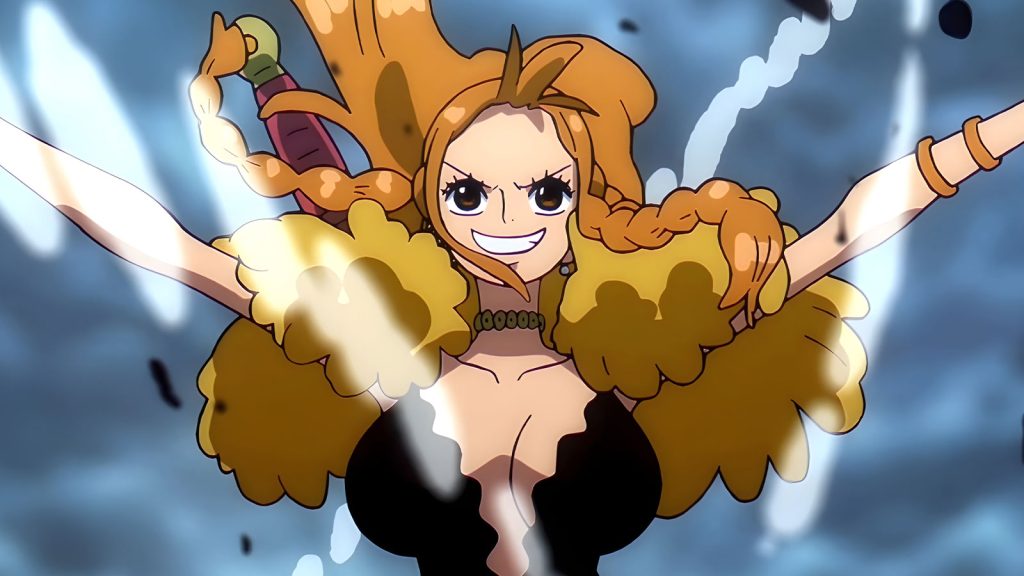 Nami from One Piece. [Credit: Toei Animation]
In the manga’s Dressrosa arc, the character Rebecca was introduced wearing “gladiator armor” that consisted of only a helmet, a cape, and a golden bikini armor. It makes you wonder whether One Piece has a misogyny problem.
From a narrative standpoint, it was hard to take her seriously as a warrior when she had zero protection against swords and spears. When censorship adds a simple layer of fabric underneath that armor, it immediately makes the character feel more like a legitimate gladiator and less like a visual trope.
The Egghead arc has pushed this even further. The futuristic outfits worn by the Straw Hat crew involve high-tech boots, but for the women, very little everything else. The Chinese edits act as a “control group” for this experiment. They show that Nami and Robin are iconic enough that they don’t need to be s*xualized to be popular.
By covering up Yamato’s sides or adding a skirt to Ulti, the censorship ironically respects the characters’ strength more than the original designs do. It forces the viewer to look at the character’s face, their expressions, and their actions. For a series that is supposed to be about the pursuit of freedom and the bonds of nakama (friends), the constant focus on revealing clothing can sometimes feel at odds with the emotional weight of the story.
Ultimately, while no one is advocating for government-mandated censorship, the “Chinese edits” of One Piece have provided a fascinating alternative look at our favorite pirates. They prove that you can take away the fan service and still have a compelling, visually striking show. One Piece is a masterpiece of world-building and storytelling; it doesn’t need to rely on such little clothing to keep our attention, and these viral comparison images are proof of that.
Do you think China’s censorship of One Piece is appropriate, or is it a breach of artistic liberty? Comment below!
One Piece is streaming on Netflix and Crunchyroll globally.

















 Bengali (BD) ·
  English (US) ·