.png)
 1 week ago
20
1 week ago
20
Most police and government agencies across Canada use drones manufactured by company based in Shenzhen
Published May 31, 2026 • 3 minute read
See more Toronto Sun on Google — save as a Preferred Source.
Advertisement 2

THIS CONTENT IS RESERVED FOR SUBSCRIBERS ONLY
Subscribe now to read the latest news in your city and across Canada.
- Unlimited online access to articles from across Canada with one account.
- Get exclusive access to the Toronto Sun ePaper, an electronic replica of the print edition that you can share, download and comment on.
- Enjoy insights and behind-the-scenes analysis from our award-winning journalists.
- Support local journalists and the next generation of journalists.
- Daily puzzles including the New York Times Crossword.
SUBSCRIBE TO UNLOCK MORE ARTICLES
Subscribe now to read the latest news in your city and across Canada.
- Unlimited online access to articles from across Canada with one account.
- Get exclusive access to the Toronto Sun ePaper, an electronic replica of the print edition that you can share, download and comment on.
- Enjoy insights and behind-the-scenes analysis from our award-winning journalists.
- Support local journalists and the next generation of journalists.
- Daily puzzles including the New York Times Crossword.
REGISTER / SIGN IN TO UNLOCK MORE ARTICLES
Create an account or sign in to continue with your reading experience.
- Access articles from across Canada with one account.
- Share your thoughts and join the conversation in the comments.
- Enjoy additional articles per month.
- Get email updates from your favourite authors.
THIS ARTICLE IS FREE TO READ REGISTER TO UNLOCK.
Create an account or sign in to continue with your reading experience.
- Access articles from across Canada with one account
- Share your thoughts and join the conversation in the comments
- Enjoy additional articles per month
- Get email updates from your favourite authors
Article content
TAICHUNG, Taiwan — As the Ontario government moves to ban Chinese-made drones from provincial ministries and law enforcement agencies, the frantic race to “de-risk” critical supply chains is being felt most urgently in Taiwan.
Article content
Article content
On May 20, Public and Business Service Delivery and Procurement Minister Stephen Crawford announced that Ontario would immediately restrict use of Chinese-made drones by government agencies and the Ontario Provincial Police — citing a desire to bolster security and protect data.
“It’s critical that we are protecting our province’s data and safeguarding our security against bad actors,” Crawford said in a news release.
“Banning government use and future purchases of Chinese–made drones is another important step in our plan to protect Ontario and better leverage Canada’s world-class drone manufacturing sector.”
Under Chinese law, corporations are obliged to share data and information with the government, even if that data is stored overseas.
By signing up you consent to receive the above newsletter from Postmedia Network Inc.
Article content
Advertisement 3
Article content
Most police and government agencies across Canada use drones manufactured by DJI — a worldwide provider of drone technology based in Shenzhen, China, providing reliable drones at price points far lower than western-made alternatives.
Cost versus risk
It’s that cost factor that’s proving the biggest challenge — not only for those who buy and use drones in mission-critical environments, but those who manufacture them.
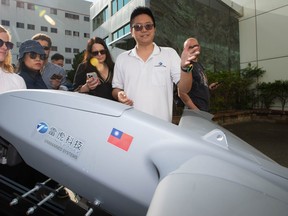
Thunder Tiger Group, a Taiwanese-based manufacturer of advanced autonomous vehicles, is in the midst of creating a “non-red” — a reference to China’s communist government — supply chain for their military drones with a goal of 99% “non-red” components.
“Magnets and rare-earth metals are probably the hardest to source and battery cells as well,” Thunder Tiger’s Allan Chi told the Toronto Sun in an interview last week at their company’s headquarters in Taichung.
“Most of these are coming from China; we’re trying to find another source that’s not from there.”
Advertisement 4
Article content
Replacing cheaper Chinese chips, motors and components, however, comes with a price tag.
“It’s more expensive, but it all depends on what the customer can accept,” Chi said.
“Not a lot of customers can accept those higher prices, they value things that are cheap and affordable.”
Chi said Thunder Tiger is 99% free of Chinese-sourced components.
RECOMMENDED VIDEO

We apologize, but this video has failed to load.
China threat impetus behind ‘de-risking’ supply chain
Taiwan’s motivation for “de-risking” its drone supply chains is perhaps more urgent than most nations.
Taiwan is under constant threat of invasion by mainland China, which under its “One China Policy” rejects Taiwan’s assertion of being a free and democratic country and considers the tiny island nation a “renegade state” and an immutable part of China.
After China’s nationalist government fell to the communist revolution in 1949, nearly two million civilians, troops and officials of Chiang Kai-shek’s Kuomintang government fled to Taiwan to re-establish the “Republic of China” — Taiwan’s official designation.
Advertisement 5
Article content
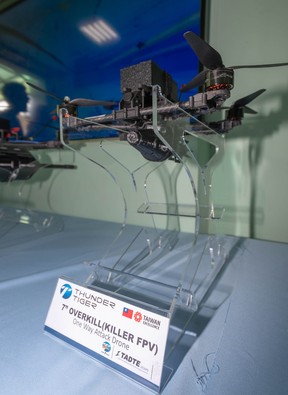
In response to this threat, Thunder Tiger pivoted from creating consumer-level radio-controlled products and toys to military-grade autonomous aircraft and seagoing drones — including their Overkill FPV drone, an AI-powered strike weapon that recently became the first Asian-constructed drone to be listed on the U.S. Department of Defence’s Blue UAS (unnamed aircraft system) cleared list.
A lack of Chinese-sourced parts is a key requirement in being granted this clearance.

Lessons learned from Ukraine and Iran
Taiwan’s interest in drone warfare was largely inspired by the success seen in Ukraine and their wildly successful use of first-person view (FPV) attack drones against Russian invaders.
“We’ve learned a lot of lessons from Ukraine,” Chi said.
“That’s where a lot of people noticed drones being used for asymmetrical warfare, where you don’t really need (boots-on-the-ground soldiers) to win wars.”
To fend off sea invasions by Chinese forces, Taiwan’s autonomous vehicle capacity has evolved to include seagoing variants including Thunder Tiger’s Seashark line of miniature attack boats — which use on-board, AI-powered cameras to identify targets and develop modes of attack, including “hivemind” swarm attacks against enemy vessels.
Advertisement 6
Article content
Their focus on “fast, reliable and cheap” led to development of their Papa-Delta UAV, based largely on Iran’s Shahed 136 one-way attack drone — a low-cost, long-range and successful weapons platform that’s seen wide use.
“We know that Taiwan needs something like a long-distance attack drone that can attack cities in China from Taiwan,” Chi said.
“It has to travel a long distance — that’s why we believe Shahed is something we need to make.”
Read More
-
Drone tech not fully optimized by Ontario police to clear roads faster
-

Ahead of Chinese foreign minister's Ottawa visit, Canadian warship transits Taiwan strait

Article content

























/https%3A%2F%2Fsportsmole-media-prod.s3.gra.io.cloud.ovh.net%2Fuploads%2F2026%2F05%2Fns-collage-background-v2-email-3-6a086d6eaa1a0057506880.jpg)
 Bengali (BD) ·
  English (US) ·