.png)
 1 hour ago
7
1 hour ago
7
Article content
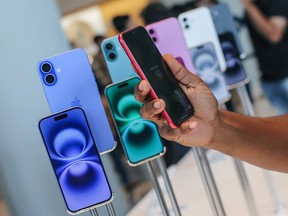
A new research paper has suggested that iPhones could be to blame for declining fertility rates.

THIS CONTENT IS RESERVED FOR SUBSCRIBERS
Enjoy the latest local, national and international news.
- Exclusive articles by Conrad Black, Barbara Kay and others. Plus, special edition NP Platformed and First Reading newsletters and virtual events.
- Unlimited online access to National Post.
- National Post ePaper, an electronic replica of the print edition to view on any device, share and comment on.
- Daily puzzles including the New York Times Crossword.
- Support local journalism.
SUBSCRIBE FOR MORE ARTICLES
Enjoy the latest local, national and international news.
- Exclusive articles by Conrad Black, Barbara Kay and others. Plus, special edition NP Platformed and First Reading newsletters and virtual events.
- Unlimited online access to National Post.
- National Post ePaper, an electronic replica of the print edition to view on any device, share and comment on.
- Daily puzzles including the New York Times Crossword.
- Support local journalism.
REGISTER / SIGN IN TO UNLOCK MORE ARTICLES
Create an account or sign in to continue with your reading experience.
- Access articles from across Canada with one account.
- Share your thoughts and join the conversation in the comments.
- Enjoy additional articles per month.
- Get email updates from your favourite authors.
THIS ARTICLE IS FREE TO READ REGISTER TO UNLOCK.
Create an account or sign in to continue with your reading experience.
- Access articles from across Canada with one account
- Share your thoughts and join the conversation in the comments
- Enjoy additional articles per month
- Get email updates from your favourite authors
Sign In or Create an Account
or
Article content
The paper, published by the National Bureau of Economic Research, notes that the fertility rate in the U.S. has fallen by 22 per cent since 2007, when the first iPhone went on sale in the country. The researchers say this decline can’t be explained by economic conditions, contraceptive use, housing or childcare costs, or other commonly cited factors.
Article content
Article content
Article content
For Canada, a recent decline in births is also stark, with the country hitting a record-low fertility rate of 1.25 children per woman in 2024, putting it on the ultra-low fertility list — below 1.30 — alongside Japan, Singapore and Spain.
Article content
Until 2011, the iPhone was only available in the U.S. to subscribers of AT&T, allowing the researchers to compare birth rates in counties with near-universal AT&T coverage to counties with little or none in the four years since the first iPhone’s release.
Article content
Article content
Their findings suggest a striking relationship between iPhone access and declining birth rates.
Article content
Teen births declined by 13.8 per cent in counties without AT&T coverage, compared to steeper declines of 18.9 per cent in counties with partial coverage and 26 per cent in counties with near-universal coverage.
Article content
Births to women in their twenties fell by 10 per cent in counties without coverage, but by 14.6 per cent in counties with extensive coverage. Among women in their thirties, births rose by 3.8 per cent in counties without AT&T coverage but fell by 1.2 per cent in counties with extensive coverage.
Article content
Article content
The researchers therefore suggest that access to the iPhone reduced births among women under 30 and suppressed the rise in births among older women.
Article content
Article content
After taking into account other forces that may have caused fertility rates in urban areas to decline more than those in rural areas, the researchers imply that iPhone access reduced births by 4.5 to eight per cent among those aged 15 to 19, and by 3.2 to 6.6 per cent among those aged 20 to 24.
Article content
The researchers concluded: “The diffusion of the iPhone explains 33–52 per cent of the decline in the general fertility rate among women aged 15–44.”
Article content
As for why exactly this is, the researchers present three candidates. iPhone use reduces in-person interactions, provides more access to information about contraception and abortion, and provides more access to pornography.
Article content
Essentially, the smartphone is an unofficial form of contraceptive.
Article content
The theory is bolstered by results from previous studies, one of which, published in the American Economic Review, found that a four-week Facebook deactivation increases offline socializing with family and friends.




























/https%3A%2F%2Fsportsmole-media-prod.s3.gra.io.cloud.ovh.net%2Fuploads%2F2026%2F05%2Fns-collage-background-v2-email-3-6a086d6eaa1a0057506880.jpg)
 Bengali (BD) ·
  English (US) ·