.png)
 11 hours ago
9
11 hours ago
9
Mortal Kombat was one of the first theatrical event films after the COVID-19 pandemic, and while fans have waited five years for Mortal Kombat II, the film delivered the goods with epic, gory action and a fun storyline bringing many beloved characters to the screen.
FandomWire got to speak with the film’s screenwriter, Jeremy Slater about stepping into the Mortal Kombat universe, writing Mortal Kombat II’s epic action scenes, bringing fan-favorite character Johnny Cage to life, and why he thinks it’s important to treat every character like the main character of their scene. Check out the full interview here:
Mortal Kombat II Jeremy Slater Interview
I saw the film in 4DX, and I hope you’re not a filmmaker who’s precious about that…
Jeremy Slater: I want to try it myself. It looks so much fun.
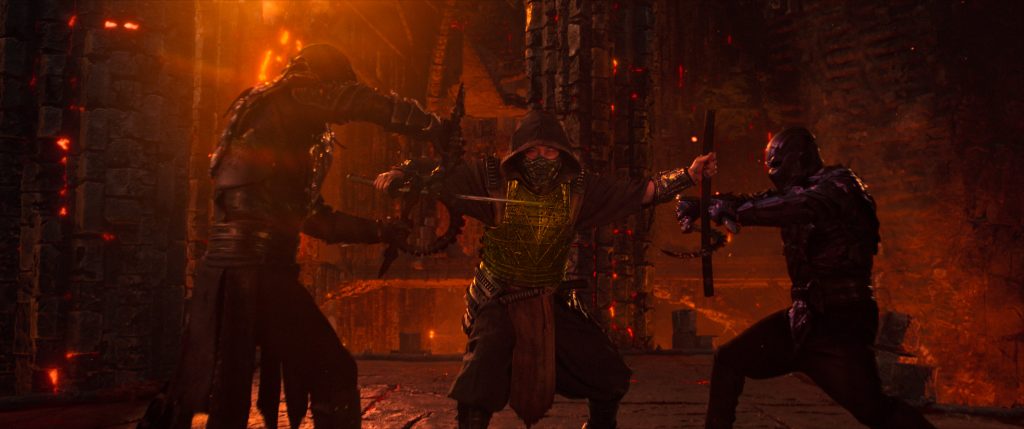 (L-R) Hiroyuki Sanada as “Scorpion”, and Joe Taslim as “Bi-Han” in New Line Cinema’s “Mortal Kombat 2,” a Warner Bros. Pictures release. Photo Credit: Photo Courtesy Warner Bros. Pictures.
Yeah, it’s a lot of fun. But I wanted to see it in the biggest, loudest, most over-the-top way possible. Why do you think that the big-screen experience is necessary for this movie?
Slater: I mean, we really designed this thing from the ground up to be a big, crowd-pleasing spectacle. That was part of my pitch for getting the job in the first place. I saw the potential of what this franchise could become and where we could go, and that we could move it out of the realm of being smaller martial arts movies just for a core fan group and audience.
And we could make a movie that the core fan group and audience still loves, still recognizes, still says, “They did right by us. They took this seriously. They did a good job.” But let’s broaden it to the point where, if someone’s significant other is getting dragged in off the street, I want that person to have just as good of a time as the person who’s been loving this franchise for 34 years.
So balancing those two acts really meant we had to deliver on spectacle. We had to have a lot of humor; we had to have big, crowd-pleasing moments. So yeah, I think seeing this in a packed theater with the crowd screaming and yelling and laughing really just elevates the entire experience. I’m sure it’ll still be great when it comes out on streaming and everything else, but if you have a chance to see it in the theater, I think that’s where it was really designed to be seen.
You’ve worked on a lot of franchises before, but with a few exceptions, you’ve generally been on the ground floor, starting a new vision for your franchise. For Mortal Kombat II, you’re joining a vision that was already established. What’s the difference for you between working in these two types of sandboxes?
Slater: Honestly, this is the ideal situation — something like Mortal Kombat — because New Line had a treasure trove of data based on that first movie. They really did their homework, and they pinpointed, “Here’s everything we did right. Here’s everything fans responded to positively about that first movie.” They liked the gore. They liked the fight choreography. They like the casting that we had actual martial artists who could actually really do these moves versus getting just a bunch of random actors and having digi doubles bouncing around.
So they could really pinpoint, “Here are the areas where we did a great job, and let’s double down on all those areas.” But they could also say, “Here are the areas where the fan base was telling us this wasn’t what they wanted, or this is not something they were necessarily excited about or things that changed the overall lore and mythology in ways that the fans kind of balked at.”
Anytime you’re faced with a sequel like that, the question is: do you double down on those things that aren’t working, or do you try to course-correct and pivot and give the fans what they actually want? So that was our approach from the beginning: let’s be really receptive. The fans are telling us what movie they want to see. Let’s deliver that. Let’s put them in the driver’s seat and give them the movie they’ve been dreaming about.
-

(L-R) Ludi Lin as “Liu Kang”, Mehcad Brooks as “Jackson ‘Jax’ Briggs”, Jessica McNamee as “Sonya Blade”, and Karl Urban as “Johnny Cage” in New Line Cinema’s “Mortal Kombat II,” a Warner Bros. Pictures release. Photo Credit: Courtesy Warner Bros. Pictures.
-

Adeline Rudolph as “Kitana” in New Line Cinema’s “Mortal Kombat II,” a Warner Bros. Pictures release. Photo Credit: Courtesy Warner Bros. Pictures.
-

Hiroyuki Sanada as “Scorpion” in New Line Cinema’s “Mortal Kombat II,” a Warner Bros. Pictures release. Photo Credit: Courtesy Warner Bros. Pictures.
-

(L-R) Martyn Ford as “Shao Kahn” and Ludi Lin as “Liu Kang” in New Line Cinema’s “Mortal Kombat 2,” a Warner Bros. Pictures release. Photo Courtesy Warner Bros. Pictures.
-

C.J. Bloomfield as “Baraka” in New Line Cinema’s “Mortal Kombat 2,” a Warner Bros. Pictures release. Photo Courtesy Warner Bros. Pictures.


I’m really interested, as a writer working on a project like this that’s built around these fight scenes, how involved are you in writing the action? Is it like, “X character does this move,” or is it just, “These guys fight,” and then the specifics are worked out by the stunt team? Or some combination of both?
Slater: The honest response is that it sort of takes a village. I certainly can’t take credit for all of it because we have a lot of really smart, really talented people. But the way the process works is you could never transcribe a fight on the page, because it would be seven pages of like, “He blocks. She kicks. She jumps. He ducks.” Your eyes would glaze over so fast.
So I’m probably writing about three pages worth of gags and just describing the fight on the page. My job is to kind of map out, “Here’s the temp of the fight. This person is the aggressor. This person might be on defense. Here’s any dialogue that’s said throughout the fight. Here are the big emotional turns where a character realizes, ‘Oh, I’m in trouble here.’”
And then I try to write out a series of gags where, “Here’s something cool.” Katana does something cool with her fan in this moment. She throws it and kicks it into the wall, and then she’s going to use that to vault up onto the roof, and then she’s going to kick Johnny. I will add in probably a dozen or so gags for every fight. Here’s what Kung Lao is doing with his hat. Here’s what Ludi [Lin (Liu Kang)] is doing with his fireballs.
Because my job is to sell my vision for the fight to the producers, the studio, the fight choreography team, the director, and then the next step in the process is, once all of those people have signed off on the fight and they’re like, “Okay I can visualize that, that sounds cool,” we hand it off to the stunt team.
And their process is awesome. They’ll build entire sets out of cardboard boxes. They’ll wrap tin foil around their arms to play Jax, and they’ll dress up in homemade characters and act out what I have on the page, and they add their own ideas to it. And they’ll come back and they’ll be like, “Here’s what Jeremy had. Here’s some stuff we added.”
And it’s really Simon [McQuoid]’s job as the director to go through that sort of early pre-vis and pinpoint the stuff that they’re doing that he really likes and the stuff that isn’t connecting. And he says, “Well, on that version, how about we combine these two moments? Or how about we push this even further?” So Simon’s the one who gives that feedback based on what the stunt team has come up with and takes all those disparate sources and combines them into the fight he wants to direct and wants to see.
So it really goes through three different stages, and I think the fights get better at every single stage. And I’m always happy to take credit for all the amazing ideas they’re coming up with. If someone comes up and they’re like, “Oh, I love that teleportation gag they did there,” I’m like, “Oh, thanks, man, that’s great,” but I didn’t write that. That was the brilliant stunt team and fight choreographers somewhere in Australia. Those guys kick so much ass and make our guys look so good. They are the true, unsung heroes of Mortal Kombat.
I think one of my favorite lines in the movie, and I’m paraphrasing, is, “People want to see Keanu Reeves kill guys with a pencil, not karate moves.” Do you agree with this or disagree, and what do you think is the future of the action genre?
Slater: I want to be very clear that I love the John Wick movies, so that is no shade to John Wick at all. I had a blast with all four of them. But yeah, I do think the current trend in action movies of everything has to be hyper-grounded, everything has to be Bob Odenkirk beating people up in his garage, is a little bit of a bummer because I am a child of the ‘90s.
I grew up in what I would say is the heyday for big, fun summer blockbusters, where every year it was like Jurassic Park, Independence Day, Speed, The Matrix, Fellowship of the Ring — just blockbuster after blockbuster that I would walk out of the theater buzzing and say, “Oh my God, have you guys seen The Rock yet? That was the f*cking greatest movie I’ve ever seen.”
And I feel like we don’t get a lot of those movies in Hollywood anymore. We get a lot more of the grounded, low-budget action movies versus the big, fun spectacle movies. So that was a big part of why I wanted to take this job and my vision for what this franchise could be. I think this could be our Fast and Furious, where every couple of years, we get to do another installment.
And who else is giving you this kind of money to make an R-rated martial arts fantasy movie? That’s just a genre Hollywood would not touch with a 10-foot pole, except we have this great IP that justifies bringing it to life.
I really feel like this is a throwback to the sort of movies we just don’t get anymore, and that’s part of the whole appeal for me. I think there is still an appetite for movies like this. I think it’s a great time at the cinema, and the crowd seems to really be loving it. And it would be great if Hollywood listened and said, “Oh my God, there’s an appetite for this. We should make more movies like this.”
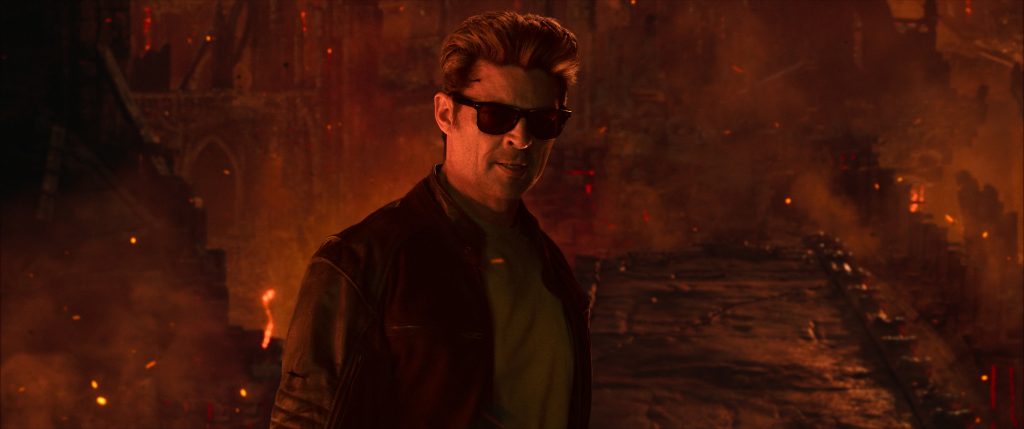 Karl Urban as “Johnny Cage” in New Line Cinema’s “Mortal Kombat 2,” a Warner Bros. Pictures release. Photo Credit: Photo Courtesy Warner Bros. Pictures.
There are obviously a lot of expectations for the fan-favorite characters, but there are also a lot of those niche characters that come in with fewer preconceived notions. Did you find it easier to write for those characters that fans have high expectations for, or the ones that were more of a blank slate?
Slater: Honestly, every character is someone’s favorite character. That’s the thing you realize once you start doing your homework, is that you have to treat everyone like they are the star of the movie in their respective scenes. Because maybe 10 people don’t care about Quan Chi, but then you get to number 11, and he’s like, “Oh, Quan Chi’s my favorite character of all time. I’ve been playing as him exclusively for 20 years. My bedroom is a shrine to Quan Chi.” You never know. There’s always going to be someone. No character is too minor not to be really, really important to someone out there.
So we knew, just from the realities of making an ensemble movie with like 20 characters, that between how vast our bench is and how much time we knew we were going to have to spend on Johnny and Kitana to land their respective arcs, we weren’t going to be able to give everyone their moment in the sun. That not everyone was going to get a full character arc.
But we did try to give everyone satisfying moments where at least that guy got a cool fight before he went out, or at least this guy gets some funny lines, or Quan Chi has a cool moment. You try to give everybody a chance to shine because you know that you can’t treat anyone as disposable in a series like this.
And I do want to talk about Johnny. I think Karl Urban brings so much of his personality to that role. While it also feels like the Johnny Cage I grew up with in the video games, there are definitely some moments that feel like you were writing for Karl Urban as Johnny Cage. How did you find this balance of writing for him and his personality versus this character that everybody loves?
Slater: Yeah, with Johnny, I knew we were going to have to make a general recalibration with the character because for that exact reason we were talking about with John Wick. The idea that this guy could be a martial arts star and also be the biggest movie star in the world just didn’t feel right. People literally aren’t making those movies anymore.
The Johnny character was kind of famously based on Jean-Claude Van Damme, who, at the time, was the biggest movie star in the world for doing splits. And that’s a dying breed that doesn’t really exist anymore. So the idea of trying to set up this guy and have him be the biggest movie star in the world, I’m like, “Well, does that character have any wants or dreams or desires?”
Like if you’re Ryan Gosling or Timothée Chalamet and you’re the biggest star in Hollywood, there’s nowhere to go. You’re already at the top of that pyramid. You’ve already won. So finding an arc for a character like that seems difficult. Versus my whole idea was if Johnny was that guy who had a chance to be Ryan Gosling — if he had a chance to be the biggest star in the world, and it slipped through his fingers and his dreams never quite got there, that suddenly becomes much more relatable.
That’s a character I can sympathize with, I can understand, and you can really take that character on a journey from point A to point B. So that was sort of the impetus for starting Johnny where we did.
In terms of Karl specifically, I totally agree with you. I think he’s fantastic in the role. It’s been so much fun watching the fans embrace this version of Johnny and his portrayal and how much he’s bringing to it. And honestly, I think I know the joke you’re referring to, and I can’t take credit for that. That was a Karl ad-lib, man.
I don’t think I would have had the balls to write a Lord of the Rings joke for him to deliver, but Karl and Josh Lawson, who plays Kano, had such great chemistry and they’re both so good at improv that they would nail whatever joke you wrote for them, but they would also throw in two or three jokes of their own that were frequently better than mine. So when I saw that Lord of the Rings joke come through in dailies, I was like, “Well that’s in the f*cking movie. That’s incredible.” So all credit goes to Karl on that one.
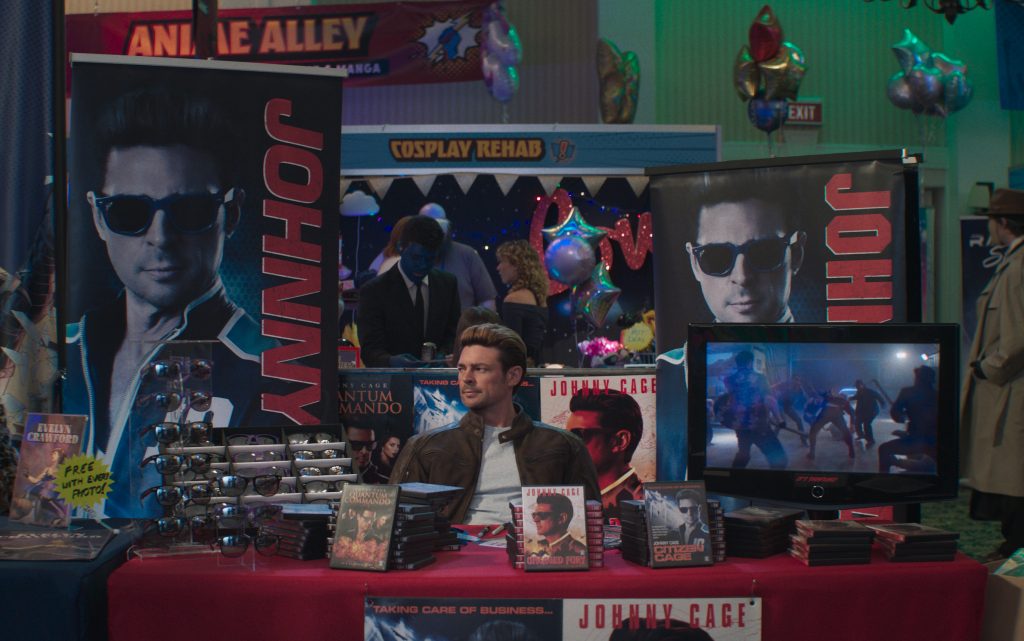 Karl Urban as “Johnny Cage” in New Line Cinema’s “Mortal Kombat 2,” a Warner Bros. Pictures release. Photo Credit: Photo Courtesy Warner Bros. Pictures.
Did you have a favorite character to write for?
Slater: Kano was my favorite character to write for. Before I agreed to take the job for part two, I was like, “Just so you guys know, you cannot stop me from bringing Kano back to life.” He was my favorite thing from the first movie by a country mile. This is the dude who understands the assignment, and honestly, he got the tone, and him adding a sense of humor to the movie was the justification I used for pushing the movie in a more crowd-pleasing direction.
I was like, “Look at how Kano was everyone’s favorite part of that first movie. It’s because he was tongue-in-cheek. He was really funny, and he gave the audience permission to laugh.” Which it’s really important in a movie like this — letting people know it’s okay to have fun with this. It’s okay for this to just be a great popcorn time in the movie. So Kano is the sort of character where I could write a dozen jokes for him in every scene and know that Josh was going to kill every single one of them. So he was the most fun to write.
Baraka was the character I was most excited to introduce, just because I was a Baraka main when I was 15. I was a horror kid, so you introduce a guy with a cross between Freddy Krueger and Wolverine, and I’m like, “You are speaking my language.” So I loved Baraka and really wanted the audience to fall in love with him too. I was really excited to get a chance to bring my favorite character to life.
And this is a huge year for you. I’d be remiss if I didn’t bring up the fact that Coyote v. Acme is also finally coming out. How does it feel to have all of these big projects come to fruition at once?
Slater: It feels wonderful. It really does. Especially with Mortal Kombat, because this movie’s been done for a while. It’s been on the shelf, and we’ve been waiting for screens to open up so that we could actually get this on them. This is a movie that was designed for IMAX, and we wanted it on those IMAX screens, but we had to find a window where it works.
And originally, we were supposed to come out in October of last year, which this didn’t feel like a Halloween movie to me; this felt like a big summer blockbuster. So when it got pushed back seven months to this May date, it was tough for all the fans. It was tough for us behind the scenes. We all knew we were sitting on something special, and we were really proud and excited to share it with the fans and share it with the world.
So waiting an extra seven months was tough, but I think it was the right move creatively. I think it’s going to allow the movie to be more successful and give us a chance to make a Mortal Kombat III and hopefully four and five and however many spin-offs and sequels we can get away with.
So it feels like we’ve had a really good Christmas present sitting inside a wrapped package underneath the tree for like two years at this point, and now the fans are finally getting to open that present. And they’re enjoying it in exactly the way we all hoped they would. So it’s a huge sense of relief to have finally gotten to this point and to realize, “Oh, we pulled it off. The fans are happy. They’re enjoying it as much as we hoped they would. Thank God.”
And the same with Coyote v. Acme. I don’t take a lot of credit for that because I just wrote the first draft 10 years ago and Samy Burch is really the writer who came in and rewrote that script and made it awesome. But my heart really broke for those guys when that movie got shelved, and I think it was really tough and a really tragic outcome.
So the fact that everyone who worked on that movie and devoted a portion of their life to bring this to the screen, that they can go and now show their families and their children, “This is what mom and dad were working on. This is what we did,” I’m just so happy they’re going to get their day in the sun and that fans are going to get a chance to see what they made. And I think it’s going to be a really special movie and I’m rooting for those guys.
Mortal Kombat II is now in theaters.















/https%3A%2F%2Fsportsmole-media-prod.s3.gra.io.cloud.ovh.net%2Fuploads%2F2026%2F05%2Fchamp-69fa166311171530187348.jpg)

 Bengali (BD) ·
  English (US) ·