.png)
 1 day ago
12
1 day ago
12
When you talk about “guilty pleasure” movies, there are few genres that scratch that itch quite as well as a good shark movie. Even when a shark movie is bad, it can still be fun, but every once in a while one comes along with genuinely impressive set pieces and drama that reminds you what made this genre so popular in the first place. That’s what we get from the new thriller The Devil’s Mouth, directed by Jeff Wadlow (Truth or Dare, Kick-Ass 2) and starring Kathryn Newton (Ant-Man and the Wasp: Quantumania), Lana Condor (X-Men: Apocalypse), and Nico Haraga (Booksmart).
We at FandomWire got to speak with Wadlow about his new shark movie, how he pulled off some of its impressive set pieces, and why he likes working with exciting new talent. Check out the full interview here:
The Devil’s Mouth Jeff Wadlow Interview
I think one of the most refreshing things about The Devil’s Mouth, if I say so myself, is that it’s just unapologetically fun. The shark is just a shark; it’s not some grand metaphor. So what do you think is the merit of high-concept horror movies like this?
Jeff Wadlow: Well, hold on a second. I take issue with the shark not having any dramatic value other than being an eating machine. I think it’s certainly a device for testing a friendship. I mean, that’s what really drew me to the script; there’s some really complex character dynamics going on in this group way more than a typical sort of body count horror movie.
It was written by these really talented young writers, Aja [Gabel] and MJ [Wesner]. They wrote a script that was on the Black List. It got sent to me, and I loved it, and worked closely with them. So for me, the shark isn’t just a shark; it’s a way to reveal character, and I think we reveal a lot of character in the piece.
What I more so meant was that I’ve seen a lot of movies recently where the shark is a metaphor for oil spills or something like that, where it’s not really a shark, it’s something else.
Wadlow: Yeah, there’s no sort of nuclear waste mutating our shark. Our sharks are not having babies on their own. It’s a normal shark in nature, but it is a meditation on what happens when human beings get too close to nature and don’t respect nature. You know, one of my favorite docs is Grizzly Man, the Werner Herzog movie, and it’s such an incredible study of how man interacts with nature and the dangers of that.
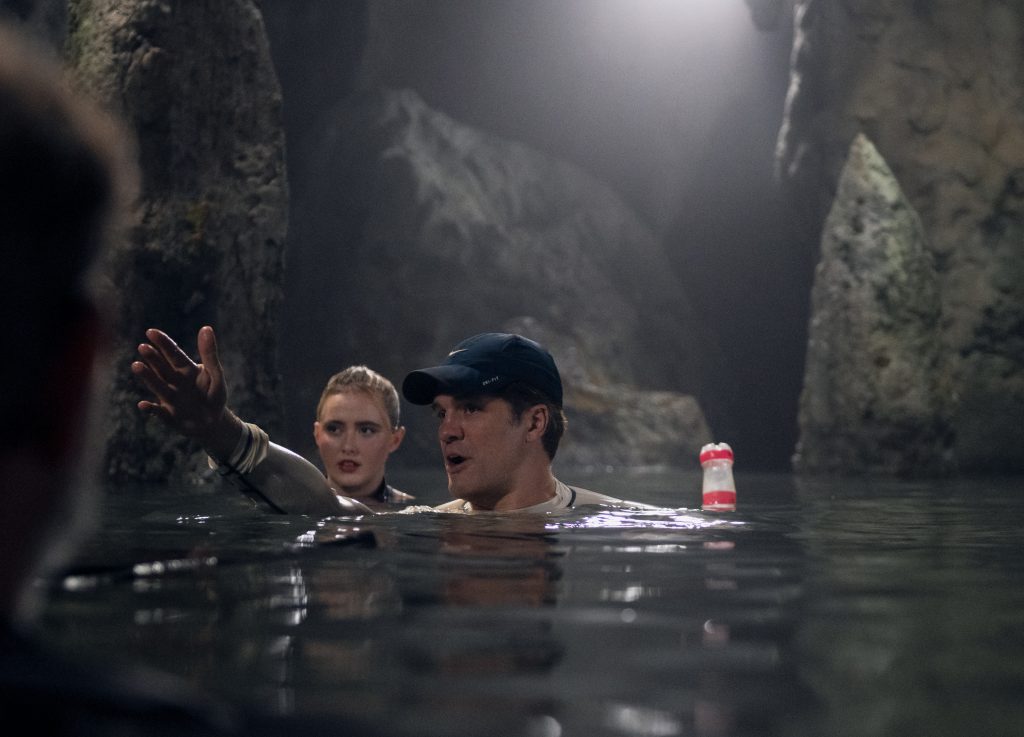 Jeff Wadlow on set of The Devil’s Mouth in Thailand. Courtesy Amazon Studios.
I think one of the really interesting things about this movie for me was that you look at a lot of shark movies, and a lot of them are set on the open water. But this one is set almost entirely, except for the first act, in that cave system. Did you find that limited setting to be restrictive or liberating for you?
Wadlow: It was the hardest thing I’ve ever done — shooting this movie in a cave in water. The whole movie takes place in a flooded cave system in Thailand. We shot in real caves for some of the scenes. Obviously, when we got into the stunt work, we were on a set. We built a 120 foot-long, 70 foot-wide cave set and flooded it with five feet of water. I had another set that was about half that size, but 15 feet deep.
And let me tell you something: working in water is quite challenging. It’s hard on the open water, but when you put yourself in really claustrophobic environments where you don’t have access to normal equipment, it’s near impossible. Every day, I put on a wetsuit; I got in the water, and I blocked the scenes while swimming. I had a floating desk. My assistant would laminate my notes. It was insanity.
That’s awesome. And I know you’ve talked in a lot of interviews for your past films about a preference for in-camera effects. While that’s obviously a challenge when you’re dealing with creatures, there’s still some really cool practical stuff in this. Like you mentioned, the locations, the stunts. How do you go about blending those practical elements with the CGI when it’s necessary for this film?
Wadlow: Yeah, for me, if I can do it for real, I want to do it for real. I’m not trying to give anything away about the movie, but there’s a really critical scene late in the movie that takes place on a cliff, and we went to a real cliff, and I took the camera team up there, I took Kathryn Newton up there, and we shot that scene on a real cliff in Thailand, looking out at the ocean.
The physical production team thought I was absolutely nuts. They were like, “Let’s just shoot her against the green screen and put her on the cliff in post,” and I was like, “No, no, this is a cool cliff that we can actually access, and I want to do it.” And Kathryn was totally game, and I think it changed her performance. I mean, she actually said it changed her life. It was one of the coolest things she’d ever done.
I think one of the really effective things that you do in this film, especially in terms of building suspense, is the feeling of disorientation. You feel like you get lost in these caves with them. How do you go about building this sense of tension?
Wadlow: Well, that was a double-edged sword. There’s some earlier cuts where that feeling became too intense when we were testing the movie, so that’s why I came up with that gimmick of those maps — those sort of old-school Indiana Jones map gags — just to give people some context so they understood there was a method to our madness; that it wasn’t just random caves.
But the feeling was certainly created by the fact that I had a limited budget. All my movies, I hope, look like they cost more than they did. I mean, Truth or Dare, we made for $5 million; Fantasy Island, I made for seven and a half. This one, I had a little bit more money for because we did have a CG shark — no real sharks — but I was very limited in the way I could shoot it.
And one of the tricks I used was that even though the movie takes place in about 15 different caves, I only had three sets. And I said to my production designer, Alec Hammond, who is a genius, “Listen, Alec, a cave wall is a cave wall. So what we’re going to do is we’re going to design these sets in a way where we can move the walls. You can create one really iconic piece of rock for each cave that we can move in and out, but I’m pretty much going to shoot all these caves on the same three sets.”
And it helped from an efficiency standpoint, but I also think it helped from a narrative standpoint because it did create this sense of disorientation because you don’t really know what cave you’re in because they all look the same. Because, spoiler alert, they are the same.
I think there’s an interesting balancing act to pull off with a film like The Devil’s Mouth because you do want it to be fun, but you also want it to be scary, and you also want it to be emotional. So how do you strike that balance between those tones coming into this film?
Wadlow: I’m just such a fan of filmmaking and big commercial filmmaking that I really just trust my gut. I’ve tried to pattern my career after a filmmaker like Richard Donner, who worked in all different genres. I’ve worked in horror; I’ve worked in action; I’ve worked in comedy; the same way Richard Donner did. You know, in addition to Lethal Weapon, the guy did The Omen and Goonies. So he worked in all these different spaces, and I’m trying to do the same thing because I am such a fan of film.
And there were two things his film always had in common. Verisimilitude — you always believed in the worlds, right? They were never farces. They were never parodies. He never sold out the stakes. And there was always humor. There’s always levity, even in the darkest moments. Lethal Weapon is about a suicidal cop, but there’s lots of humor in those films.
So I tried to do the same thing with The Devil’s Mouth. I made sure that the stakes always felt real; that the claustrophobia of the caves was overwhelming; that the violence of the shark was very much present. But I also made sure that our characters were real people and multidimensional and weren’t afraid to crack a joke and try to take some of the tension away through humor. Because I think that’s what people do. And as a result, I think I’m able to bring all these tones to the table, even though technically it is a survival horror film.
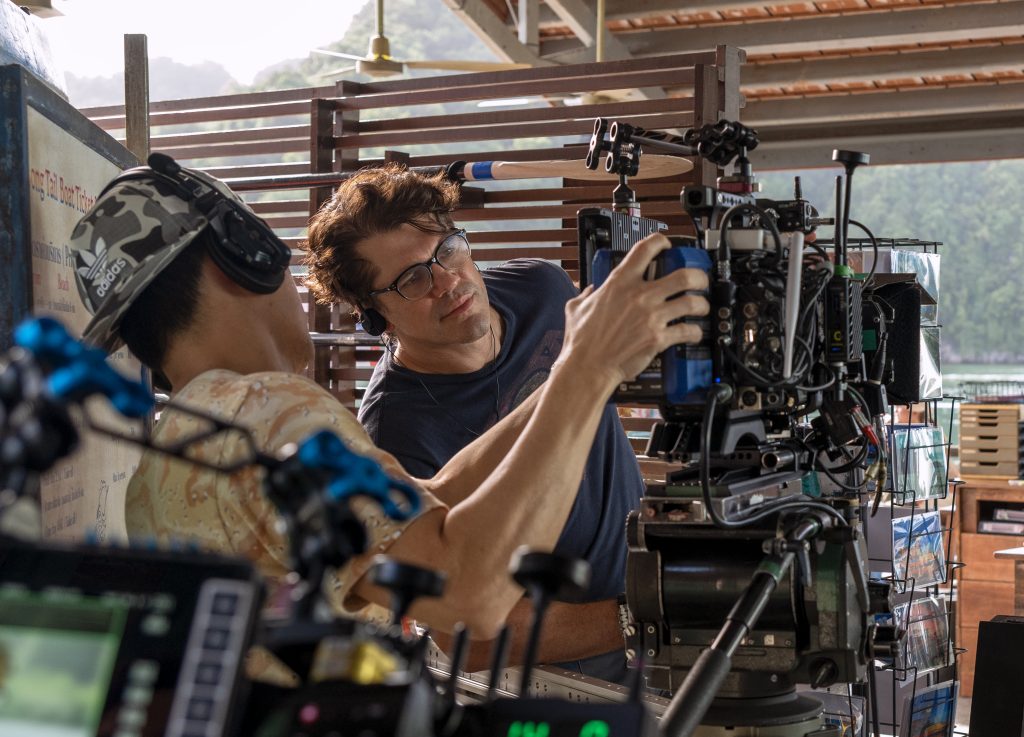 Jeff Wadlow on set of The Devil’s Mouth in Thailand. Courtesy Amazon Studios.
You mentioned how you have a lot of background in action. You’ve done some comedy too, but I’m really interested in how that background in action helps prepare you for movies like The Devil’s Mouth, which is a horror movie, but it also has these set pieces in a way.
Wadlow: I mean, as Jason Blum will tell you, I’m really more of an action movie director than a horror movie director. I love scary movies, but really, I approach scary movies as action films with the volume turned down. So all the visual language you use to create an action sequence, I try to do that in a horror set piece, but I just make everything smaller. It’s just as intense, but it’s not as bombastic.
And what action language did you use in this film?
Wadlow: It’s about setting the hook — letting the audience know that something’s coming from over there, then surprising them by having it come from over here. Misdirection. It’s about using visual energy to create the sense of pending collision.
There’s all these things you do as a filmmaker to build the sequence: understanding when to move the camera, when not to move the camera; understanding when motion from the frame affects the audience differently than motion within the frame; just the basics of screen direction. The kinds of things that Orson Welles understood very well, but a lot of filmmakers have forgotten. I think the more you can lean into those principles, the more of a structure you have for a sequence, whether it be an action sequence or a scare sequence.
I think one of the coolest scenes in the movie for me is the bioluminescence scene. I want to talk about how you pulled that off, what inspired that, how much of that was in the script versus how much did you bring to it?
Wadlow: MJ and Aja put that in the script, but there was a big debate about how to pull that off because it’s not easy. I saw it in the real world when I shot Fantasy Island in Fiji. We would go back from the islands to the cruise ship where we were all staying, and you would see the boat bottoms glowing as they moved through the water. So I’d seen it with my own eyes before, and it is quite a cool thing to witness, so I knew what I wanted it to look like. I wanted it to look like the real thing, and I think it does in the film.
But pulling that off is very tricky because it’s very hard to photograph that. It’s very hard to recreate it in any kind of controlled environment. So ultimately, what we did after many meetings with my brilliant DP, Jimmy Kneist, and again my production designer, Alec Hammond, and our visual effects team, Wes [Sewell] and Kerry [Joseph], was we came up with this plan where we were going to make the entire set glow so all the water is glowing. And then what we did was we eliminated the glow away from their bodies. So that’s ultimately how we created that effect, and I think it’s fairly effective and — at least to me — totally truthful to how it looks in real life.
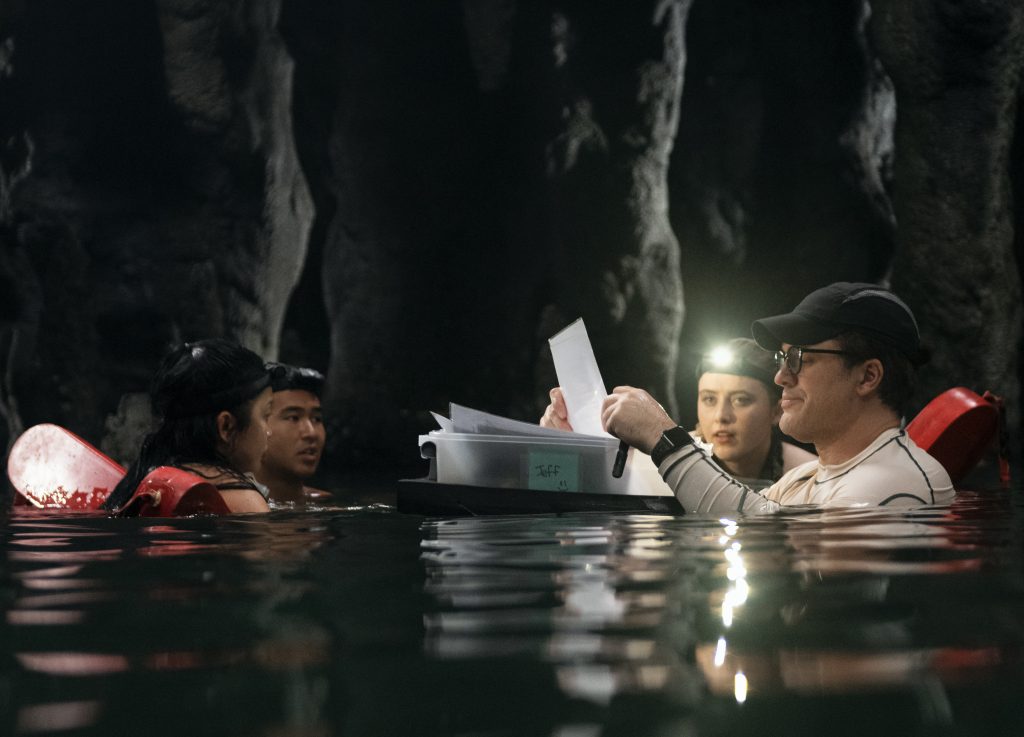 Jeff Wadlow on set of The Devil’s Mouth in Thailand. Courtesy Amazon Studios.
That’s really awesome. I never would have anticipated that’s the way you would have done that; that’s a really cool camera trick.
But I think one of the things that impresses me most about your work in the past and with this film is that you clearly have this affinity for working with young talent, whether it’s up-and-coming actors in films or the work you’re doing with Adrenaline Film Project. So what excites you about working with emerging talent?
Wadlow: Ambition. And not mine, theirs. What I like about young talent, whether I’m working with this young playwright in New York right now on a new film or when I go back to Virginia and do the Adrenaline Film Workshop with up-and-coming filmmakers, or I’m making a big studio movie like The Devil’s Mouth with a young cast is that they’re hungry and they want it and they want to do cool stuff.
You know, Kathryn and Lana, in particular, really wanted to push themselves and work hard, and train. They worked on breath-holds. They were in the pool every day for two weeks before we started shooting, working with my stunt team. And they wanted it bad. And I love that energy because I always want my films to look bigger than they are, and if you’re going to pull that off, you’ve got to A) put all the money on the screen, and B) you’ve got to have a team that is excited to push themselves and push the work. And I find it’s not always the case, but younger talent tends to be more ambitious.
You mentioned wanting your films to look bigger than they cost. I think it’s really interesting that you’re making these bigger studio films, but you’re bringing this independent mindset to it. Why do you think that’s an important approach to bring to something like The Devil’s Mouth, that is a studio film?
Wadlow: Yeah, I mean, I produced the movie with Basil Iwanyk and Erica Lee from Thunder Road. I did a rewrite on the script, but also worked closely with MJ and Aja, and it is very much still their script. And obviously, I’m the director as well. So by being able to wear all three of those hats, but also being able to collaborate with other people wearing those hats, I’m able to captain the ship in an indie sort of way and maximize our resources.
There’s no filmmaking by committee on a movie like this because the margins are so small, and we just have to hit the target every day, and that’s very much an indie mindset. And what’s great about that is you can have that mindset when you’re making a $5 million movie like Truth or Dare or you can have that mindset when you’re making a $30+ million movie like The Devil’s Mouth, and it still allows you to make a movie that looks bigger than the budget.
The Devil’s Mouth is now streaming on Prime Video.
























/https%3A%2F%2Fsportsmole-media-prod.s3.gra.io.cloud.ovh.net%2Fuploads%2F2026%2F07%2Fwc26-stencil-generic-1-player-email-6a5efced3be22784676779.jpg)
 Bengali (BD) ·
  English (US) ·