.png)
 4 hours ago
8
Bloc led by centre-right ex-military chief Gadi Eisenkot had 53 seats against 50 for Netanyahu's Likud, allies
Author of the article:

Published Oct 27, 2026 • Last updated 1 hour ago • 4 minute read
See more Toronto Sun on Google — save as a Preferred Source
Advertisement 2

THIS CONTENT IS RESERVED FOR SUBSCRIBERS ONLY
Subscribe now to read the latest news in your city and across Canada.
- Unlimited online access to articles from across Canada with one account.
- Get exclusive access to the Toronto Sun ePaper, an electronic replica of the print edition that you can share, download and comment on.
- Enjoy insights and behind-the-scenes analysis from our award-winning journalists.
- Support local journalists and the next generation of journalists.
- Daily puzzles including the New York Times Crossword.
SUBSCRIBE TO UNLOCK MORE ARTICLES
Subscribe now to read the latest news in your city and across Canada.
- Unlimited online access to articles from across Canada with one account.
- Get exclusive access to the Toronto Sun ePaper, an electronic replica of the print edition that you can share, download and comment on.
- Enjoy insights and behind-the-scenes analysis from our award-winning journalists.
- Support local journalists and the next generation of journalists.
- Daily puzzles including the New York Times Crossword.
REGISTER / SIGN IN TO UNLOCK MORE ARTICLES
Create an account or sign in to continue with your reading experience.
- Access articles from across Canada with one account.
- Share your thoughts and join the conversation in the comments.
- Enjoy additional articles per month.
- Get email updates from your favourite authors.
THIS ARTICLE IS FREE TO READ REGISTER TO UNLOCK.
Create an account or sign in to continue with your reading experience.
- Access articles from across Canada with one account
- Share your thoughts and join the conversation in the comments
- Enjoy additional articles per month
- Get email updates from your favourite authors
Article content
JERUSALEM — Israeli voters on Tuesday gave the opposition a narrow edge over Prime Minister Benjamin Netanyahu but no majority, exit polls showed, in decades-high turnout for the country’s first election since the trauma of the Oct. 7, 2023, attacks.
Article content
Article content
Netanyahu, Israel’s longest serving prime minister, had run on promises to fight enemies from Hamas to Iran and had spent election day raising fears of Israeli Arab voters who came out in historic numbers against his hard-right government.
Israeli Arab parties could play the role of kingmakers as politicians begin potentially weeks of wheeling and dealing to form a coalition that can pass the 61-seat threshold in the 120-seat parliament.
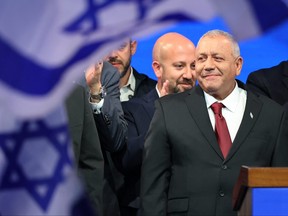
Early projections broadcast by mainstream Israeli television networks showed that the opposition bloc led by Gadi Eisenkot, a centre-right former military chief, had 53 seats against 50 for Netanyahu’s Likud and its allies.
“The initial exit poll results indicate a complete lack of confidence in Netanyahu and the Oct. 7 government,” Eisenkot said after polling stations closed.
By signing up you consent to receive the above newsletter from Postmedia Network Inc.
Article content
Advertisement 3
Article content
Yair Lapid, a centrist former prime minister allied with Eisenkot, described the result as a “crushing defeat” for Netanyahu.
At Eisenkot’s watch party in a Tel Aviv sports arena, cheering supporters described the 66-year-old as the next prime minister and chanted, using Netanyahu’s nickname, “Bibi, go home!”
But Gideon Saar, Israel’s foreign minister and Netanyahu ally, said that victory declarations by the opposition were “premature.”
Major television networks said that Likud would be the largest single party in parliament with 24 or 25 seats. Israeli Arab lists were projected to win 17 to 18 seats, a sharp gain.
Key Israeli Arab leader Mansour Abbas said he believed the right had “suffered a major loss” and was open to working with Eisenkot.
Eisenkot has said he would not govern with Israeli Arab lawmakers — a scenario that Netanyahu had warned his voters could be a consequence of an opposition victory.
But Arab lawmakers could give Eisenkot support in parliamentary votes to maintain a minority government without joining a coalition. If not, Israel could head to new elections.
Advertisement 4
Article content
Itamar Ben Gvir, a far-right firebrand who according to exit polls did not gain as much as many expected, warned Netanyahu against another option — a unity government with Eisenkot.
“It would be a terrible mistake,” said Ben Gvir, a champion of extremist settlers in the West Bank and expulsion of Palestinians.
Hebrew University of Jerusalem political scientist Gideon Rahat said Ben Gvir had succeeded in mobilizing votes — but of Israeli Arabs instead.
But he said: “Even if Netanyahu lost, that doesn’t mean Eisenkot won.”
Campaigning against Arab parties
In a dash to secure as many votes as possible, Netanyahu had charged that Israeli Arabs were out to “steal the election” and his Likud party unsuccessfully asked election authorities to keep polls open past 10 p.m.
His efforts led the opposition to say he was looking for pretexts to challenge the results.
Israelis cast their ballots in the shadow of Hamas’s 2023 attack and the multi-front regional wars that it sparked with the trauma from the attack still fresh and questions over accountability and security central to the campaign.
Advertisement 5
Article content
The vote came as Israel looks increasingly isolated on the world stage, driven by the war in Iran and the military campaign in Gaza, soaring settlement construction and violence in the occupied West Bank.
Netanyahu himself faces an arrest warrant from the International Criminal Court over Gaza as well as domestic corruption charges that could land him in prison if he loses power.
Eisenkot is a political novice whose mild manner is the antithesis of the smooth-talking incumbent.
The son of working-class Moroccan Jewish immigrants, Eisenkot would be the first prime minister of Middle Eastern or North African descent.
Before voting, the 66-year-old Eisenkot paid his respects privately at the grave of his son Gal, whose death fighting in Gaza has drawn empathy from many Israelis.
Mass turnout
Nearly 78% of Israelis voted by the close of stations, not including ballots still to be counted, the highest since 2001, the Central Elections Committee said.
Advertisement 6
Article content
Some 7.3 million people were eligible to vote with tens of thousands of Israelis estimated to have flown in from abroad for an election seen as crucial for their country.
Eilana Zisblit, 55, told AFP she had travelled back from Canada, where she has lived for almost 30 years, to vote for a centre-right party in Eisenkot’s bloc.
“The country is going in a really, really bad direction. Both for Jews and Arabs living in the country and for Jews living abroad,” she said.
The time to act is “now or the country really won’t survive anymore.”
Netanyahu, 77, who has served as prime minister on and off for more than 19 years, has been quick to allege electoral fraud.
He said Tuesday that three senior officials of the United Arab List had been arrested with envelopes full of cash in the south.
The head of the Central Elections Committee, Dean Livne, said that police had “caught individuals who tried to bribe voters” but called it an isolated local case.
Netanyahu last returned to power in December 2022, bringing into his coalition far-right ultra-nationalists such as Ben Gvir who were once shunned.
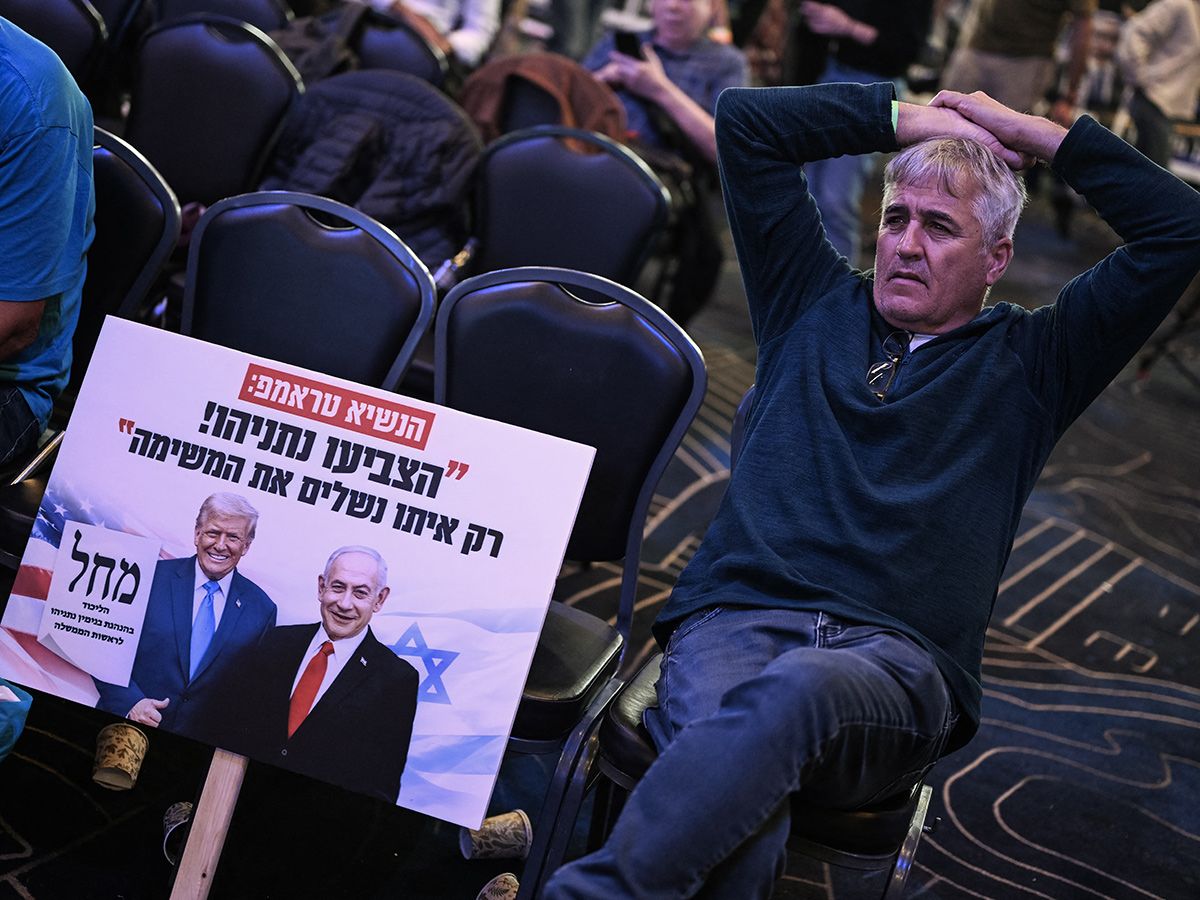
In the last days of the campaign, he posted an image of a nuclear bomb destroying Tel Aviv and talked up his endorsement by U.S. President Donald Trump, who is also fond of alleging election fraud.
Read More
-

Houthis attack Saudi Arabia before high-stakes talks in Tehran
-

Netanyahu orders West Bank closure as attack wounds Israelis before election


Article content



























 Bengali (BD) ·
 English (US) ·