.png)
 3 hours ago
17
3 hours ago
17
Runner sees action superstar Alan Ritchson (Reacher, Motor City) and comedy legend Owen Wilson (Zoolander, Marly & Me) team up for a wholly unique action outing in Runner. Filmmaker Scott Waugh, director of notable action films like Expend4bles, uses his experience as a stunt performer to bring a kinetic and raw realism to the action. It’s a style of filmmaking that feels fresh and elevates a story that, in weaker hands, might have felt flat and generic.
Waugh is no stranger to action. It runs in his blood. His father, Fred Waugh, had the honor of portraying one of the earliest on-screen iterations of Spider-Man. Fred Waugh served as the stunt double for Nicholas Hammond in 1977’s The Amazing Spider-Man television series. Those roots have given Waugh one very specific, Marvel-driven dream. We sat down with Waugh to discuss his new film, his comic book movie aspirations, and whether Alan Ritchson would make a good Batman in the DCU.
Scott Waugh discusses Runner and his approach to action
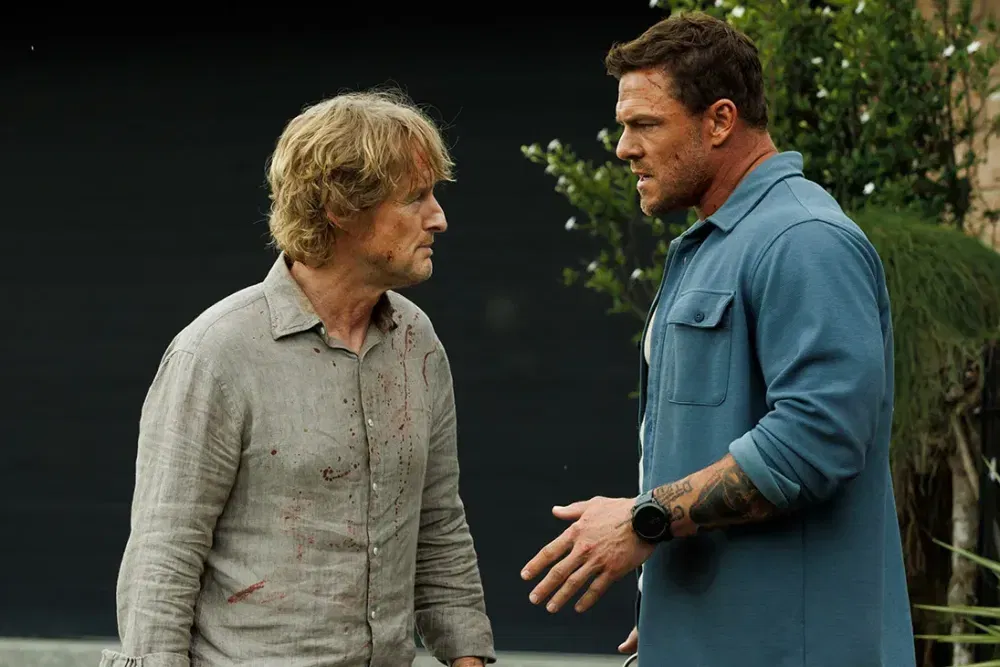 Owen Wilson (left) and Alan Ritchson (right) in Runner – Runner is now playing in theaters.
FandomWire: Hey Scott, Joshua Ryan with FandomWire. How are you?
Scott: I’m great. How are you?
FandomWire: I’m doing good. Thanks for taking the time to talk to me. I’m excited to talk about the movie Runner. This movie was a lot of fun—the action was really riveting and kinetic. With your background in stunt work, you probably approach action in a different way than a lot of filmmakers. I’m curious to hear how you approached the action and overall energy when filming scenes for Runner.
Scott: I’ve been in the stunt business my entire life. I was born on the set, and my father was the original Spider-Man, so back in those days, everything was practical. We did everything for real. I started doing stunts when I was 12.
When I film action, I want to give the audience the perspective I’ve been lucky enough to have when doing stunts. I try to film in a way that’s more immersive and participatory rather than voyeuristic—not just sitting back and watching it. I’m always trying to thrust my audience inside the action and the story so they feel like another character within it.
FandomWire: If I understand correctly, the script was on the Black List, highlighting unproduced scripts people felt needed to be made. How did the script come to you? What stood out, and how did you get attached to direct it (Runner)?
Scott: Alan Ritchson was already on as a producer, and they sent me the screenplay to see if I wanted to direct it. When I read it, I was looking for the emotional hook. If a story has something riveting that makes me root for the character, it makes it worth putting them through any amount of bullets I’m going to throw at them.
This was about a guy trying to stay sober and find redemption by saving a dying seven-year-old girl. You got me there. I knew I wanted to tell that story.
FandomWire: Were there any big changes from the script to what we see on camera? Any major story shifts?
Scott: Yeah, there were two that I proposed.
One was that I felt very endeared by the bird. In the beginning of the original script, it just came and went. My pitch was: what if we kept the bird? Then you have a third character you have to deal with the whole movie. It added a fun little wrinkle to the story that worked out well.
The other was the big twist. For spoiler reasons, I can’t give it away, but the script had a very cliché ending. I wanted to give it something where the stakes felt higher and more unexpected.
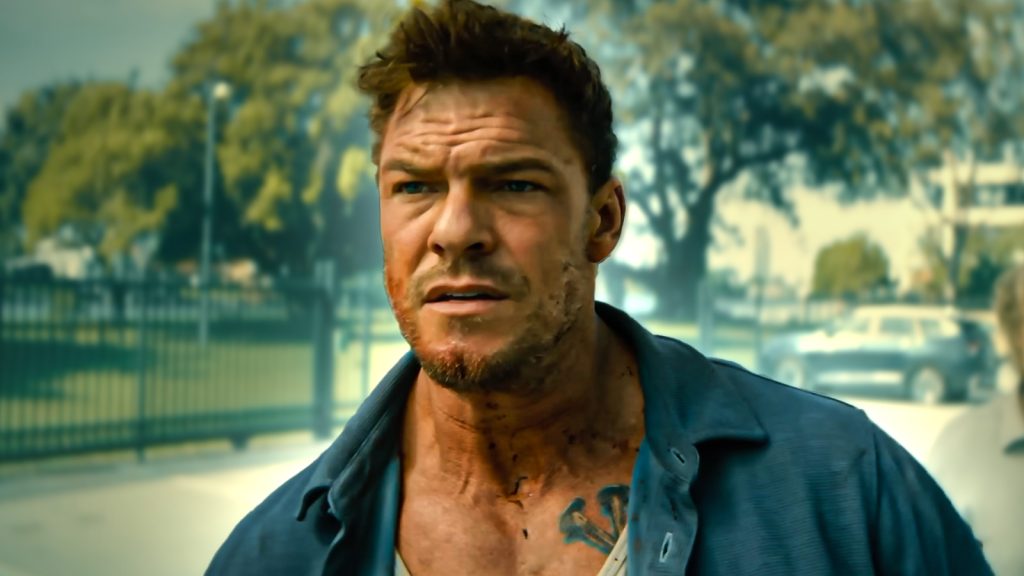 Alan Ritchson as Hank Malone in Runner – Runner is now playing in theaters
FandomWire: One key story element is the built-in ticking clock, racing to transport an organ for a dying girl under a major time crunch. How did you use that element to affect the pacing and energy of the movie?
Scott: That was inherently great about the screenplay and about organ donation—there is a short lifespan once an organ is removed before it has to reach the recipient. It gave us a natural ticking clock of expedience.
You have to be careful with your rhythms. You don’t want it to be so relentless that the audience gets numb. You want those moments of levity and brief breaks to have fun, and then get right back after it. We were always aware of the movie’s rhythm to keep viewers on the edge of their seats without exhausting them.
FandomWire: When filming these scenes, you have Alan Ritchson, an action dynamo, paired with Owen Wilson and a bird. How did the dynamic between Wilson and Ritchson work on screen and behind the camera? Were they different to direct?
Scott: Their characters were very different, which is what’s always fun about action. I approach sequences from character and story standpoints. Owen’s character is not a superhero or a brute force like Alan’s; he’s a flawed man who wants to fall in love again for the fourth time.
Because he isn’t an action hero, we had to architect action for him that felt real. Most of that involved him crawling around and trying to escape the melee while Alan acted like a tornado ripping through everybody.
FandomWire: Given Alan’s physical presence, especially being known from Reacher as an absolute powerhouse—was there anything about him you wanted to showcase that audiences hadn’t seen before?
Scott: What drew me to Alan was his work in Ordinary Angels, which was completely juxtaposed to what people normally know him for. He’s known for blasting through people, but for this character, I leaned hard into the emotional side because he’s so distraught over his past.
Using that emotion as the fuel to blow through people made it far more interesting. Alan and I architected the action to be as explosive as possible, but that underlying emotional spark gave the camera something meaningful to follow.
FandomWire: You mentioned Ritchson was attached before you came on. How did Owen Wilson get involved? Was he sought out specifically?
Scott: The producers and I sat down for a roundtable discussion about who would pair well with Alan, throwing names into a hat. When Owen’s name came up, everybody immediately went, “Whoa, I didn’t think of that—that’s great.”
They’re complete opposites, oil and water. We were chasing that Midnight Run vibe between Robert De Niro and Charles Grodin from the ’80s.
FandomWire: Owen Wilson is no stranger to action-comedies, from Shanghai Noon to I Spy, but it’s been a while since he’s done one. Their energy on screen was fantastic. Did they know each other beforehand or had they ever worked together?
Scott: No, they landed on set with a simple, “Hey man, nice to meet you.” They had never worked together, but their energies complemented each other so well that they hit their stride immediately.
As a director, you always hope for that chemistry, but you never know until the cameras roll. On take one, I knew it was going to work. They were great together.
FandomWire: Are there any films or directors that inspired your approach to (Runner) or your filmmaking in general?
Scott: One hundred percent. Tony Scott was a mentor to me, and I deeply admire his films. He made commercial movies that had tremendous heart, like Man on Fire, alongside the sheer spectacle and fun of Top Gun and Days of Thunder.
I try to tap back into that ’80s and ’90s style of action filmmaking that takes you on a complete ride. Tony is definitely someone I idolize stylistically.
FandomWire: Where do you plan to go from here? Do you have another project lined up?
Scott: I’m always trying to stretch myself. I was sent a screenplay that I really like. It’s grounded sci-fi—still action, of course, because I’m not going to pivot to straight drama. It’s a great, grounded action piece with sci-fi elements, and I really want to try my hand at that.
FandomWire: I’d be remiss if I didn’t ask a superhero-related question for FandomWire. Alan Ritchson has been heavily fan-cast as Batman, and he’s expressed interest in the role. How do you think he would do as Batman?
Scott: Alan is a force of nature. Would he be a terrific Batman? Yes. But he’d also be terrific in many roles because he has the full package. In the superhero landscape, you need characters who have sheer physical strength paired with charisma and a sense of fun.
I think he would crush it. I don’t know what his plans are, but from a director’s standpoint, he’d do great.
FandomWire: What is one key takeaway you want audiences to leave the theater thinking and feeling after seeing Runner?
Scott: Surprise. Story-wise, camera-wise, and character-wise, the film isn’t quite what you expect. The characters don’t go through what you anticipate, and the ending takes an unexpected turn.
I hope audiences leave saying, “Man, that was a lot more emotional than I anticipated, but it was still an absolute blast.” That’s why we go to the theater: to escape our daily lives, eat some popcorn, drink a Coke, and have fun. Runner is a cinematic ride meant to deliver that.
FandomWire: It definitely delivered on that; I had a blast. Is there anything else you want to share before we wrap up?
Scott: Being the son of the original Spider-Man, I hope that one day I get the chance to direct a Spider-Man film. I own the original suit my dad wore; I’m 56 and I’ve been looking at it for 50 years. I even have a matching Spider-Man tattoo that my dad and I got together.
I hope I get lucky enough to tackle that franchise one day. They’ve been doing incredible work with it, and it would be a privilege to jump in.
FandomWire: That would be an incredible full-circle moment, and seeing a stuntman’s kinetic eye applied to Spider-Man would be amazing.
Scott: Look at what Christopher Nolan did with Batman—he brought an entirely new, grounded scope that elevated the character. Bringing that kind of focused vision to Spider-Man would be fantastic, even though the recent films have done a wonderful job bringing humanity to the screen. I can only hope. I’ve still got plenty of years left, so my fingers are crossed.
FandomWire: I’ll definitely be rooting for you. Thank you, Scott!
Scott: Awesome, man. Thank you, Josh!
Runner is now playing in theaters.





















 Bengali (BD) ·
  English (US) ·