.png)
 5 days ago
18
5 days ago
18
Dragon Ball has never lacked lessons about getting stronger, but one of Goku’s simplest lines remains the best. While training with Gohan inside the Hyperbolic Time Chamber during the Cell arc, Goku tells him, “The power comes in response to a need, not a desire.”
The line comes from the English dub of Dragon Ball Z’s Episode 156, “Bow to the Prince,” which was released in 2000. It captures something the series repeatedly shows: wanting strength is not the same as having a reason to use it. More than two decades later, the idea still feels surprisingly relevant.
Goku’s Dragon Ball Lesson Turns Strength Into Something Earned
Goku is not telling Gohan that training does not matter. Their entire time in the Hyperbolic Time Chamber is built around training. Gohan simply cannot force the Super Saiyan transformation by wanting it badly enough. Goku explains that increasing his power level alone will not be enough and tells him that power comes in response to a need. He then asks Gohan to imagine Cell destroying him and his friends. Since Gohan has never actually seen Cell, Goku tells him to picture Frieza instead. Remembering his experience on Namek, Gohan briefly transforms into a Super Saiyan.
“The power comes in response to a need, not a desire”
– Goku, Dragon Ball Z, Episode 156That context gives Goku’s statement its real weight. Strength in Dragon Ball often appears when a character has something they absolutely cannot afford to lose. Goku’s first Super Saiyan transformation came after Frieza killed Krillin on Namek, while Gohan’s eventual transformation against Cell comes after Android 16 is destroyed and he realizes he must stop Cell.
The series does not present those moments as simple rewards for wanting to win. They are breakthroughs connected to desperation, anger, responsibility, or the need to protect someone.
The distinction also fits Gohan particularly well. He already has enormous latent potential, but knowing that potential exists is not enough to make him use it. Goku’s lesson is essentially that strength needs a purpose before it can become action. That is one reason the scene feels different from the series’ louder power-ups.
There is no tournament announcement or dramatic battle happening in front of them. Goku is simply trying to help his son understand what his own power requires. That is why the line has lasted. It is not really about becoming the strongest person in the room. It is about discovering what you can do when circumstances demand more from you than you thought you had.
Foucault’s Theory of Power Helps Explain Why Goku’s Words Last
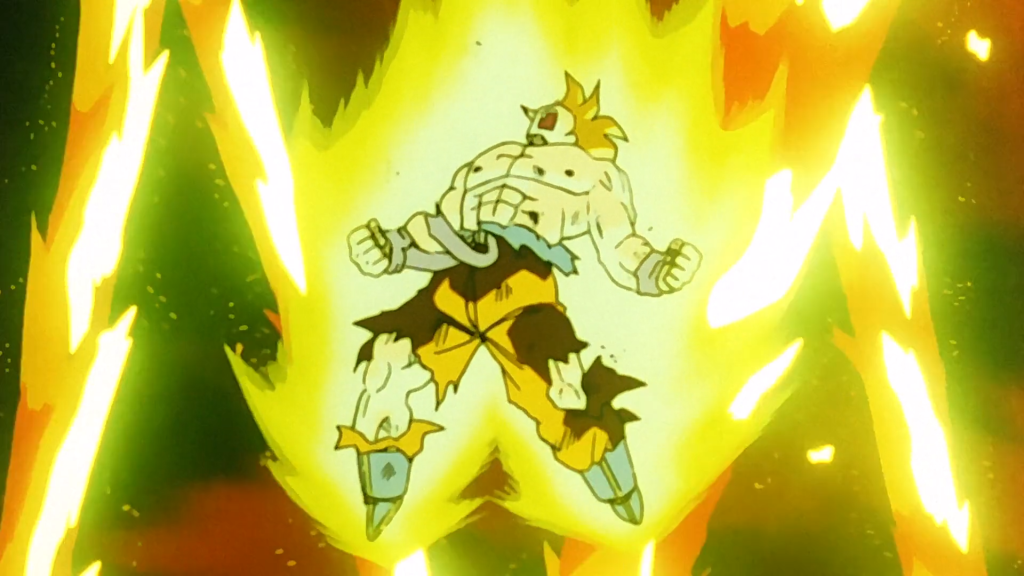 Goku from Dragon Ball Z | Credits: Toei Animation
There is an unexpected philosophical connection here. Michel Foucault’s theory of power is far more complicated than Goku’s advice, but the two can be placed beside each other because neither treats power as something that simply exists independently of circumstances.
Foucault described power relations as relationships between people and groups, emphasizing how power is exercised through networks of social relationships rather than simply possessed like an object. He also argued that power can be productive, shaping behavior and producing particular ways of acting and thinking.
Goku’s sentence can be read as a much simpler fictional version of one aspect of that broader idea. He tells Gohan that power responds to a need rather than a desire. In other words, the situation matters. A person may desperately want to become stronger, but wanting the result does not automatically create the conditions that unlock it. When the circumstances change, however, the person can respond differently.
That does not mean Goku is secretly presenting Foucault’s philosophy in Dragon Ball. The comparison is interpretive, not historical. Foucault was developing a theory about power relations, institutions, knowledge, social practices, and the ways people act upon one another.
Goku is explaining how a Saiyan can unlock a transformation. Their ideas operate on completely different levels, but Goku’s sentence offers a remarkably accessible way of thinking about one part of Foucault’s larger point: power is closely tied to relationships, circumstances, and the actions that take place within them.
That makes Goku’s line feel bigger than a piece of Super Saiyan training advice. It explains a recurring Dragon Ball pattern in plain language: characters do not always know their limits until something forces them to confront those limits. The need comes first, and the strength follows.
What are your thoughts? We’d love to know them in the comments below.



























 Bengali (BD) ·
  English (US) ·