.png)
 1 week ago
23
1 week ago
23
Article content
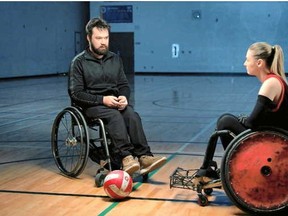
The game is murderball — or, for those who clutch pearls at such a bloodthirsty term, wheelchair rugby.

THIS CONTENT IS RESERVED FOR SUBSCRIBERS
Enjoy the latest local, national and international news.
- Exclusive articles by Conrad Black, Barbara Kay and others. Plus, special edition NP Platformed and First Reading newsletters and virtual events.
- Unlimited online access to National Post.
- National Post ePaper, an electronic replica of the print edition to view on any device, share and comment on.
- Daily puzzles including the New York Times Crossword.
- Support local journalism.
SUBSCRIBE FOR MORE ARTICLES
Enjoy the latest local, national and international news.
- Exclusive articles by Conrad Black, Barbara Kay and others. Plus, special edition NP Platformed and First Reading newsletters and virtual events.
- Unlimited online access to National Post.
- National Post ePaper, an electronic replica of the print edition to view on any device, share and comment on.
- Daily puzzles including the New York Times Crossword.
- Support local journalism.
REGISTER / SIGN IN TO UNLOCK MORE ARTICLES
Create an account or sign in to continue with your reading experience.
- Access articles from across Canada with one account.
- Share your thoughts and join the conversation in the comments.
- Enjoy additional articles per month.
- Get email updates from your favourite authors.
THIS ARTICLE IS FREE TO READ REGISTER TO UNLOCK.
Create an account or sign in to continue with your reading experience.
- Access articles from across Canada with one account
- Share your thoughts and join the conversation in the comments
- Enjoy additional articles per month
- Get email updates from your favourite authors
Sign In or Create an Account
or
Article content
Journalist John Loeppky trades his traditional wheelchair for a specialized one with a rounded front bumper and outward-tilted wheels. His gloves are taped to his hands, his feet are velcroed to his chair, and he mentally prepares to get banged up, sent skidding, or even knocked over.
Article content
Article content
Article content
Ready to sample the made-in-Canada sport, Loeppky looks at the camera crew.
Article content
“Tell my wife I love her,” he cracks.
Article content
Loeppky hosts History in 60, an AMI-tv series that highlights the disability community in Canada. Other episodes focus on pioneers in fields including comedy, dance, and politics. It’s the kind of show that a few decades ago might have seemed like a pipe dream if not for the broadcaster.
Article content
Launched in 2009, AMI-tv is the world’s first network where every program has open-format described video for viewers who are blind or partially sighted. It’s included free in basic cable packages and streams via the AMI+ app.
Article content
“AMI exists because Canadian broadcasting had a huge gap, particularly as it related to blind and partially sighted viewers,” says Cara Nye, director of content development and production for AMI. She adds that those viewers couldn’t enjoy many shows because set-top boxes were inaccessible.
Article content
“AMI bridged that access gap but, since then, we have evolved. Our audience has expanded to include Canadians of all abilities. What’s changed since then is our focus. We primarily aired other broadcasters’ shows with traditional post description added and presented it on AMI with open described video. There was no need to turn it on or off,” she says.
Article content
Article content
“Now almost 100 per cent of our schedule is original production made by, and featuring, people with disabilities … To us, the true measure of impact isn’t that accessibility just exists on Canadian TV now. It’s that disabled Canadians are working in front of and behind the camera and showcasing their lived experience through compelling stories.”
Article content
The docuseries Crip Trip, for example, follows a quadruple amputee and his best friend as they road trip from Edmonton to New York City. Underdog Inc. centres on four-foot-two Dale Kristensen, who defies expectations as a heavy-machinery operator, truck driver, and mechanic.
Article content
And the upcoming series How We Do It features hosts who empower preschoolers: Carly (Allison Lang) has a limb difference, and Isaac (Donovan Whyte) is a paraplegic who uses a wheelchair. It premièred June 27.
Article content
Combined with the rest of AMI-tv’s programming, the shows are uplifting a growing population. According to the 2022 Canadian Survey on Disability, 27 per cent of Canadians aged 15 and older — eight million people — had at least one disability that limited their daily activities. That’s up five per cent since 2017.



























/https%3A%2F%2Fsportsmole-media-prod.s3.gra.io.cloud.ovh.net%2Fuploads%2F2026%2F07%2Fdaniel-mcgregor-huyer-zuma-press-wire-luciano-gonzalez-anadolu-abacapress-com-estadio-azteca-harry-kane-jude-bellingham-composite-6a49eb8857b70695441164.png)
 Bengali (BD) ·
  English (US) ·