.png)
 1 hour ago
12
1 hour ago
12
He twice ran unsuccessfully for the Labour leadership -- in 2010 and 2015 -- before leaving Westminster to establish himself as one of Britain's most recognisable regional leaders.
Author of the article:

Published Jul 17, 2026 • 3 minute read
See more Toronto Sun on Google — save as a Preferred Source
Advertisement 2

THIS CONTENT IS RESERVED FOR SUBSCRIBERS ONLY
Subscribe now to read the latest news in your city and across Canada.
- Unlimited online access to articles from across Canada with one account.
- Get exclusive access to the Toronto Sun ePaper, an electronic replica of the print edition that you can share, download and comment on.
- Enjoy insights and behind-the-scenes analysis from our award-winning journalists.
- Support local journalists and the next generation of journalists.
- Daily puzzles including the New York Times Crossword.
SUBSCRIBE TO UNLOCK MORE ARTICLES
Subscribe now to read the latest news in your city and across Canada.
- Unlimited online access to articles from across Canada with one account.
- Get exclusive access to the Toronto Sun ePaper, an electronic replica of the print edition that you can share, download and comment on.
- Enjoy insights and behind-the-scenes analysis from our award-winning journalists.
- Support local journalists and the next generation of journalists.
- Daily puzzles including the New York Times Crossword.
REGISTER / SIGN IN TO UNLOCK MORE ARTICLES
Create an account or sign in to continue with your reading experience.
- Access articles from across Canada with one account.
- Share your thoughts and join the conversation in the comments.
- Enjoy additional articles per month.
- Get email updates from your favourite authors.
THIS ARTICLE IS FREE TO READ REGISTER TO UNLOCK.
Create an account or sign in to continue with your reading experience.
- Access articles from across Canada with one account
- Share your thoughts and join the conversation in the comments
- Enjoy additional articles per month
- Get email updates from your favourite authors
Article content
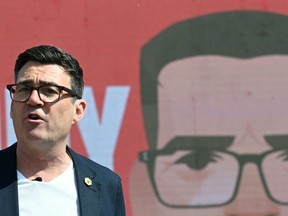
London (AFP) — Andy Burnham boasts man-of-the people vibes, but behind the casual exterior lies ruthless ambition and political reinvention that has helped propel him to become the UK’s next prime minister.
Article content
Article content
The 56-year-old was to be appointed leader of the ruling Labour Party on Friday at the third time of trying, and will replace Keir Starmer in 10 Downing Street on Monday.
His elevation to the top job follows a successful nine-year stint as Greater Manchester mayor, during which Burnham transformed himself from former government minister to political outsider.
Seen as representing Labour’s “soft left” wing and a pro-business socialist, Burnham was a member of parliament between 2001 and 2017 and held senior cabinet posts under prime ministers Tony Blair and Gordon Brown.
He twice ran unsuccessfully for the Labour leadership — in 2010 and 2015 — before leaving Westminster to establish himself as one of Britain’s most recognisable regional leaders.
By signing up you consent to receive the above newsletter from Postmedia Network Inc.
Article content
Advertisement 3
Article content
Three successive election victories for the Greater Manchester mayoralty in northwest England, and his staunch defence of the region, have earned him the nickname “King of the North”.
Slick and slightly whimsical social media videos have added to his popularity.
“I think that he is able to project himself as a normal bloke in a period in politics where a lot of politicians look very odd or very boring or very kind of systematised,” Joshi Herrmann, founder of Manchester-based start-up Mill Media, told AFP.
Andrew Murray Burnham was born in 1970 into a working-class family in Aintree, near Liverpool, and grew up in the village of Culcheth, not far from Ashton-in-Makerfield.
The loyal Everton football fan enjoyed the “Madchester” party music scene of the late 1980s and early 1990s.
Burnham, who has a Dutch-born wife and three children, told the Huffington Post he was “Catholic by upbringing” but “not particularly religious now”.
He joined Labour as a teenager before studying English at the University of Cambridge, where he said he often struggled with “imposter syndrome” owing to his working-class background.
Advertisement 4
Article content
In 2009, as culture and sport minister under Gordon Brown, he was met by a wave of raw grief and anger at a ceremony in Liverpool on the 20th anniversary of the Hillsborough football tragedy.
– ‘Manchesterism’ –
It prompted him to push for a fresh inquiry into the deaths of 97 people in the devastating Sheffield stadium crush, after which the police attempted to shift blame for their own failings onto the fans.
After leaving parliament, Burnham leapt to national prominence during the Covid pandemic, clashing publicly as Manchester mayor with prime minister Boris Johnson over lockdown funding for northern England.
The standoff cemented his reputation as an outspoken defender of regional autonomy.
He even has a worker bee tattooed on his arm, the long-standing symbol of Manchester.
There he pushed an agenda centred on public transport, housing and public health.
It was dubbed “Manchesterism”, what he called “business-friendly socialism” designed to respond to “the high-inequality, low-growth trap” that he says dominated in the 1980s.
Advertisement 5
Article content
Burnham’s move to the left after his years as a more centrist government minister has led critics to claim he is a political chameleon, tapping into the prevailing mood of the times.
In recent weeks he has had to issue several U-turns on previous positions.
Burnham wrangled with Starmer last year, calling on the UK leader to put forward a more leftist vision for Labour.
He openly opposed Starmer over welfare cuts and warned of a “climate of fear” in the party.
Starmer loyalists accused Burnham of agitating to replace him and Labour’s ruling executive committee blocked Burnham in January from trying to return to parliament.
Following disastrous local and regional election results in May, MP Josh Simons said he was giving up his Makerfield seat so that Burnham could run to replace him, and launch a leadership challenge.
Weakened, Starmer was unable to block his candidacy for a second time and Burnham resoundingly defeated the hard-right Reform UK candidate in the June 18 poll.
Burnham now takes on the task of trying claw back support from Nigel Farage’s Reform UK party, which has led Labour in national opinion polls for about 18 months.
“I think the public are crying out for a different approach to politics that is more about problem solving rather than point scoring. I’m going to try to lay that out,” Burnham said on a podcast with ex-footballer Gary Lineker on Wednesday.
Article content


















/https%3A%2F%2Fsportsmole-media-prod.s3.gra.io.cloud.ovh.net%2Fuploads%2F2026%2F07%2Fdaniel-mcgregor-huyer-zuma-press-wire-luciano-gonzalez-anadolu-abacapress-com-estadio-azteca-harry-kane-jude-bellingham-composite-6a49eb8857b70695441164.png)
 Bengali (BD) ·
  English (US) ·