.png)
 1 hour ago
22
1 hour ago
22
Article content
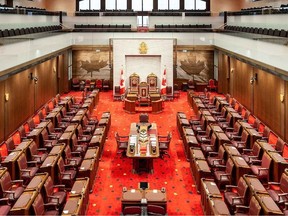
Mark Carney’s recent announcement on Senate appointments marks the most significant shift in Canada’s upper chamber since Justin Trudeau declared it “independent” nearly a decade ago. By eliminating the requirement that Senate appointees be non-partisan and openly seeking candidates with political experience, Carney has quietly acknowledged that the Trudeau experiment did not solve the Senate’s legitimacy problem. It merely disguised it.

THIS CONTENT IS RESERVED FOR SUBSCRIBERS
Enjoy the latest local, national and international news.
- Exclusive articles by Conrad Black, Barbara Kay and others. Plus, special edition NP Platformed and First Reading newsletters and virtual events.
- Unlimited online access to National Post.
- National Post ePaper, an electronic replica of the print edition to view on any device, share and comment on.
- Daily puzzles including the New York Times Crossword.
- Support local journalism.
SUBSCRIBE FOR MORE ARTICLES
Enjoy the latest local, national and international news.
- Exclusive articles by Conrad Black, Barbara Kay and others. Plus, special edition NP Platformed and First Reading newsletters and virtual events.
- Unlimited online access to National Post.
- National Post ePaper, an electronic replica of the print edition to view on any device, share and comment on.
- Daily puzzles including the New York Times Crossword.
- Support local journalism.
REGISTER / SIGN IN TO UNLOCK MORE ARTICLES
Create an account or sign in to continue with your reading experience.
- Access articles from across Canada with one account.
- Share your thoughts and join the conversation in the comments.
- Enjoy additional articles per month.
- Get email updates from your favourite authors.
THIS ARTICLE IS FREE TO READ REGISTER TO UNLOCK.
Create an account or sign in to continue with your reading experience.
- Access articles from across Canada with one account
- Share your thoughts and join the conversation in the comments
- Enjoy additional articles per month
- Get email updates from your favourite authors
Sign In or Create an Account
or
Article content
Article content
And yet Carney has announced that he would again appoint candidates to the “advisory board” who would select Senators. The idea is odious. Who are they to select individuals who would serve in our democratic institutions?
Article content
Article content
By signing up, you consent to receive the above newsletter from Postmedia Network Inc.
Article content
The Senate remains one of Canada’s most peculiar democratic institutions. Its members exercise real legislative power, yet Canadians never vote for them. Since 2017, the Trudeau government attempted to bolster the chamber’s credibility through an “independent” advisory process that emphasized expertise and non-partisanship. The result, however, was not a democratic Senate but an appointed elite selected through a process ultimately controlled by the prime minister. As I argued recently in a paper prepared for the Fraser Institute, the new model became “an insult to democracy” because it replaced open political accountability with the illusion of neutrality.
Article content
Carney’s announcement effectively concedes this point. Political experience, his government now argues, is not a disqualification but an asset. The appointment of former Conservative MP Richard Martel, alongside Liberal strategist Tom Pitfield, illustrates that philosophy in practice. Expertise still matters, but so does political judgment.
Article content
Article content
Yet changing who gets appointed does nothing to answer the larger democratic question: who should decide?
Article content
Read More


Article content
The problem has never been whether senators are partisan or independent. The problem is that Canadians themselves have no meaningful voice in choosing them.
Article content
Fortunately, there is a practical solution that avoids the constitutional dead end which has frustrated Senate reform for generations. Rather than elect senators directly or reopen constitutional negotiations — which the Supreme Court has made extraordinarily difficult — the prime minister could voluntarily allocate Senate appointments according to the popular vote in federal elections.
Article content
The principle is straightforward.
Article content
Following each federal election, each province’s Senate vacancies would be distributed proportionally among parties based on their share of the popular vote in that province. A party winning 20 per cent of the vote would receive roughly 20 per cent of available appointments. Party leaders — not the prime minister — would nominate qualified candidates, while the Governor General would continue making appointments on the advice of the prime minister. The Constitution would remain untouched. Only the political convention governing appointments would change.


























/https%3A%2F%2Fsportsmole-media-prod.s3.gra.io.cloud.ovh.net%2Fuploads%2F2026%2F07%2Fdaniel-mcgregor-huyer-zuma-press-wire-luciano-gonzalez-anadolu-abacapress-com-estadio-azteca-harry-kane-jude-bellingham-composite-6a49eb8857b70695441164.png)
 Bengali (BD) ·
  English (US) ·