.png)
 2 weeks ago
13
The Chronicles of Narnia’s Aslan should never be mistaken for a cuddly big cat, however tempting that magnificent mane makes it. For viewers who know him through the three movies, he is largely a comforting presence. He is wise and protective. He was also voiced with textured baritone gravity by Liam Neeson.
The films do give him moments of ferocity, of course. He, for instance, bites off the Jadis’ face (though the PG rating ensures we do not see the aftermath) at the end of The Lion, the Witch and the Wardrobe, the best of Walden Media’s Narnia trilogy and also the best-reviewed (76% on Tomatometer as of October 15). The book is vague, for it just says Aslan attacked the White Witch and ended her reign of terror. However, in general, the books can make his justice considerably harder to stomach.
One of his most unsettling lines appears in The Horse and His Boy, published in 1954:
I tell no one any story but his own.
Walden Media’s Narnia movies never adapted that novel. But they also never depicted that the great lion could also be harsh. Consequently, this particular encounter with his uncompromising justice has yet to reach the big screen.
Aslan’s Harsh Lesson Makes Aravis Feel the Pain Her Escape Caused
The lion delivers the line when Shasta, Aravis’ fellow traveler who in the end marries her, asks why he wounded Aravis. He declines to explain her suffering to somebody else. Later, Aravis receives the explanation herself.
Escaping a forced marriage, Aravis drugged an enslaved maid to prevent her from interfering. She knew the girl would probably be beaten for falling asleep, but considered that an acceptable price for her freedom. The lion reveals that the wounds he inflicted on Aravis matched the maid’s injuries.
When Aravis asks about the girl’s subsequent fate, Aslan refuses to disclose her story, too. The boundary applies to everyone. Aravis has a valid reason to escape. Nobody, after all, should have to marry someone against their will. But her desperate circumstances don’t make the maid’s subsequent suffering any less significant.
There is something frightening about a moral authority that acknowledges your predicament and still demands an account of your behavior. Aravis cannot make her own vulnerability the beginning and end of the argument.
It’s karma with claws (literally). Yet the sharper point is about whose pain receives attention. The maid barely occupies the adventure, but the lion insists that her suffering matters as much as the heroine’s freedom.
Greta Gerwig’s Narnia Movies Should Show His Frightening Authority
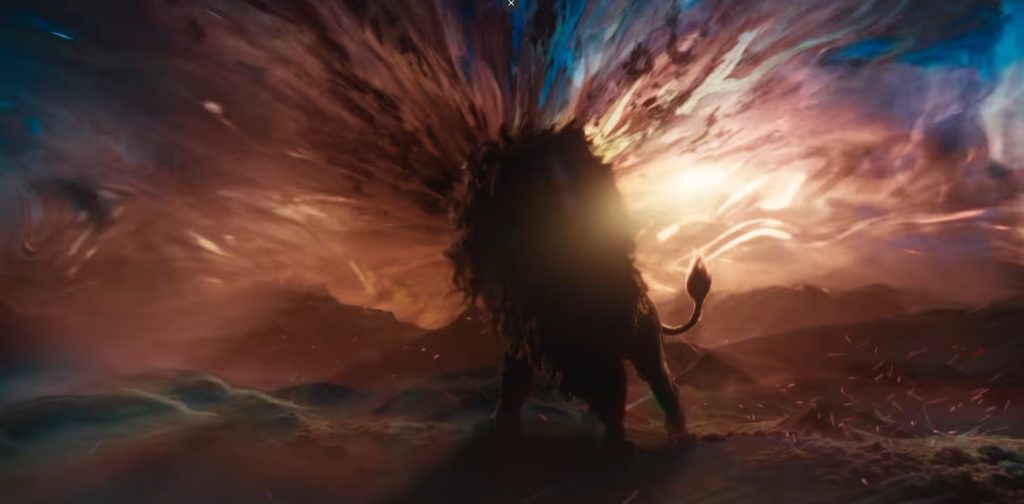 Aslan at the dawn of creation, singing Narnia into existence, as depicted in Narnia: The Magician’s Nephew trailer | Credits: Netflix/YouTube
Greta Gerwig has signed on to write and direct two Narnia films for Netflix. Her first is titled Narnia: The Magician’s Nephew and adapts the first book in the series in chronological terms. It recently got its first trailer (watch it below). Meryl Streep voices the great lion in the movie. If you didn’t know, it explores the creation of that world. It opens in theaters on February 12, 2027, before reaching Netflix on April 2. Her second adaptation has not been announced. And for that reason, a Gerwig version of The Horse and His Boy remains hypothetical.

Since she is moving chronologically, we can presume she will adapt The Lion, the Witch and the Wardrobe. The Horse and His Boy will be the third movie (assuming she extends her deal after the second movie).
Still, this encounter offers a useful principle for any portrayal of the great lion. His kindness should carry the weight of someone who can demand an answer you would rather avoid giving.
The earlier movies gave him majesty and sacrificial love. Neeson’s voice could make a simple sentence sound like a judgment. But the aforementioned passage presents a particularly difficult challenge: Aslan deliberately causes a sympathetic character pain, and the story asks us to consider his reasoning. Gerwig should preserve that discomfort wherever her adaptations find it. It is a part of the great lion’s character as imagined by Lewis.
Should Greta Gerwig’s Narnia movies embrace Aslan’s harsher side? Share your thoughts in the comments.



















 Bengali (BD) ·
 English (US) ·