.png)
 1 week ago
11
1 week ago
11
One of Star Trek: Voyager’s most underrated episodes aired 29 years ago today, on April 30. The season 3 episode ‘Distant Origin’ explored the Voth species, an alien race of humanoid lizards. Written by Brannon Braga and Joe Menosky, the episode explores key concepts of scientific theory and its politics, as well as some interesting thought experiments.
The show reveals in the episode that the Voth have genetic connections to dinosaurs, affecting the image the Voth empire has built in its galaxy. The episode is famous for its space dinos concept, but it is much more than that.
| Show | Star Trek: Voyager |
| Episode Name | Distant Origin |
| Episode Number | Season 3, Episode 23 |
| Written by | Brannon Braga, Joe Menosky |
| Directed by | David Livingston |
| IMDb (As of April 30, 2026) | 8.5 |
Star Trek: Voyager’s ‘Distant Origin’ Is More Political Than Just Space Dinos
The Star Trek franchise has never shied away from being overtly political. The original creator, Gene Roddenberry, added plenty of metaphors and allegories to real-life systems, especially US politics, to satirize and make commentary. All shows since TOS have carried forward this legacy, with even the streaming era shows continuing to be political.
The Voyager episode ‘Distant Origin’ is known for the introduction of space dinosaurs, the Voth, who are an alien race in the Delta Quadrant who seem to have genetic connections to the dinosaurs on Earth. The distant origin theory posited by a native Voth paleontologist leads him to be an exile from the civilization.
At the end of the episode, the paleontologist Gegen is put on trial for his theory and is judged guilty. He is given a chance to recant his theory, which, under coercion, he does. Despite there being an irrefutable theory that the origins of the Voth are on Earth, the alien species refuse to accept it as they culturally believe they are native to their planet.
‘Distant Origin’ speaks about the politicization of science. Gegan’s tragedy is that he was not able to smartly position his theory and instead revealed it at a time when the Voth were not in a state to accept a narrative that makes them any less native.
The episode shows that even scientific facts have to go through the cultural lens, and how the mindset of the people and their beliefs decide what is accepted, even when presented with irrefutable evidence.
Voyager’s Voth Theory Actually Has A Real Scientific Connection
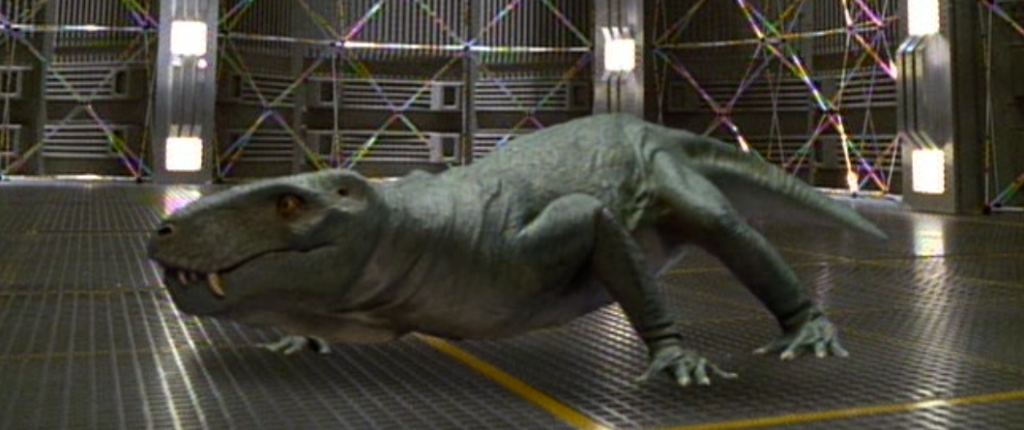 A still from Star Trek: Voyager | Credits: Paramount Television
The ‘Distant Origin’ theory in the episode shows that the Voth shared dinosaur ancestry, specifically the Hadrosaur species. This made the Voth non-native to the land they ruled, which they could not accept. The Voth are a humanoid species and have evolved into well-developed, intelligent beings.
The idea that dinosaurs could have evolved into intelligent, humanoid beings is based on a thought experiment by Dale A. Russell. Russell theorized that the contested species Stenonychosaurus, or dinosauroid, would have evolved to fit into the same ecological niche as humans, had it survived the Cretaceous-Paleogene extinction event (via Syllogeous).
The theory is not proven, and the Stenonychosaurus is itself disputed. Other scientists and paleontologists have denied the thought experiment, claiming that the Dinosauroid was too anthropomorphic (too human) to be considered in the theory. The Voth from Star Trek: Voyager seems to be the closest to Russell’s theory.
What do you think about the Voyager episode, ‘Distant Origin’? Comment below.
Star Trek: Voyager is available to stream on Paramount+.

























/https%3A%2F%2Fsportsmole-media-prod.s3.gra.io.cloud.ovh.net%2Fuploads%2F2026%2F05%2Fchamp-69fa166311171530187348.jpg)

 Bengali (BD) ·
  English (US) ·