.png)
 1 week ago
6
1 week ago
6
Solo Leveling is built around the fantasy of becoming stronger. Every level-up, new skill, and impossible victory pushes Sung Jinwoo further beyond the limits and classifications of a Hunter. Yet buried beneath all that spectacle is a remarkably melancholy thought: “I feel like something within me is lost every time I get stronger.”
The line, from manhwa Chapter 34, lands differently because Jinwoo is not celebrating his evolution. He is afraid of it. Two years after the anime introduced Jinwoo to a much wider audience, the observation feels even more important. His journey asks a deceptively simple question: if becoming powerful means slowly becoming someone else, what exactly has been won?
Jinwoo’s Greatest Power Was Realizing Strength Comes at a Cost
At the beginning of Solo Leveling, Jinwoo’s greatest defining trait is not strength but vulnerability. He is an E-Rank Hunter who routinely risks his life because his family needs money. His mother lies in Eternal Slumber, his younger sister still depends on him, and even surviving a dungeon can leave him hospitalized. The System initially looks like salvation: finally, Jinwoo can change the life that weakness has trapped him inside.
But Chapter 34 reveals the first crack in that fantasy. After fighting the murderous B-Rank Assassin Kang Taeshik, Jinwoo recognizes how dramatically he has changed. Taeshik’s death is particularly significant because Jinwoo is no longer simply defending himself from monsters. He is making a conscious decision about another human being’s fate. The chapter ends with Jinwoo acquiring the Stealth skill, immediately turning even the experience of killing into another opportunity for growth.
Jinwoo is getting exactly what he wanted. He is becoming stronger. Yet he can feel a piece of his former self disappearing in the process. Later developments make that realization harder to dismiss. His growing power gives him the means to save his mother (resurrection cup), protect Jinah, rescue Hunters on Jeju Island, and eventually shoulder a conflict far beyond ordinary humanity. The anime itself frames his progression as an escalating transformation: Season 2 takes him from the Hunter who once struggled to survive to the overwhelming force capable of turning the tide against the Ant King, Beru.
Even his Shadow Army becomes symbolic of that transformation. Jinwoo does not merely defeat enemies; he raises them as shadows and carries an ever-expanding collection of the dead behind him. By the end of Season 2, Beru has become one of the most imposing additions to that army. The irony is beautiful and unsettling. Jinwoo gains the power to protect the ordinary world while becoming increasingly separated from the ordinary life he wanted to protect.
That is why his quote is stronger than the usual anime declaration about surpassing one’s limits. Jinwoo understands something many power fantasies deliberately ignore: growth can alter the person doing the growing.
Solo Leveling’s Strongest Lesson Echoes Nietzsche’s Warning About Power
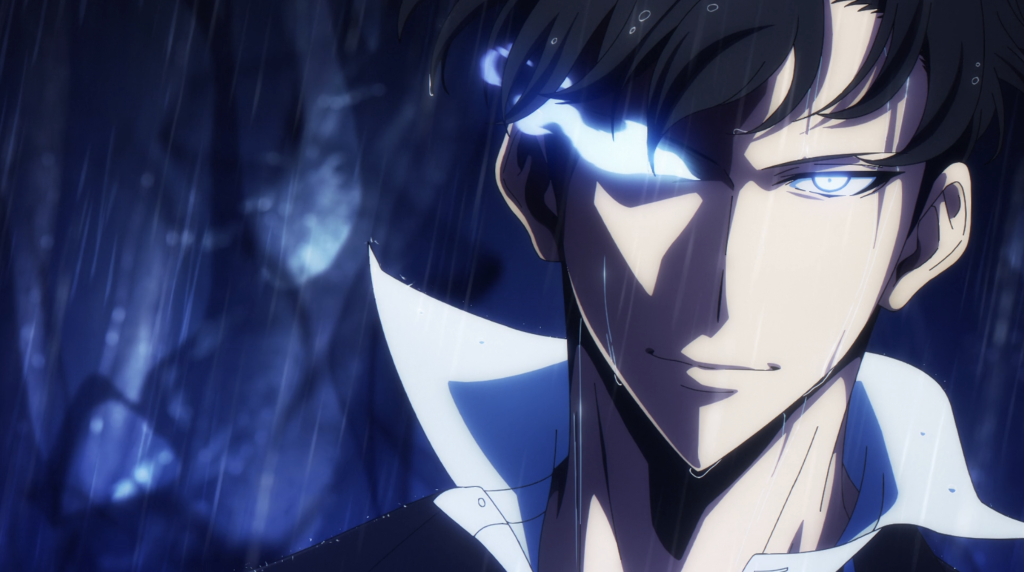 Sung Jinwoo from Solo Leveling. [Credit: A-1 Pictures]
The connection to Friedrich Nietzsche becomes especially striking because Solo Leveling itself places Jinwoo’s transformation alongside the philosopher’s famous warning. Nietzsche wrote:
Whoever fights monsters should see to it that in the process he does not become a monster. And when you look long into an abyss, the abyss also looks into you.
Nietzsche wrote those words in Beyond Good and Evil, Section 146. He was not writing about superheroes or fantasy warriors, and there is no reason to claim Chugong directly borrowed Jinwoo’s line from Nietzsche. The connection is thematic, not necessarily genealogical.
Yet the parallel is difficult to miss. Nietzsche’s warning is about the danger of allowing the struggle against something terrible to transform you into what you oppose. Jinwoo experiences an action fantasy version of that dilemma. He acquires monstrous power because monsters threaten humanity. He becomes colder because hesitation can get people killed. He becomes frightening because being frightening is sometimes the most effective way to protect the people he loves.
The tragedy is that his motives remain fundamentally human. He does not pursue strength simply because he wants to dominate everyone around him. He wants his mother to wake up. He wants Jinah to live safely. He wants his friends to survive. His desire for power begins as an act of responsibility. But responsibility becomes a burden. Burden becomes necessity. Necessity becomes identity. That progression gives the quote its real philosophical weight.
Jinwoo is not asking whether strength is good or evil. He is wondering whether the self that gains the strength can remain intact while using it. And perhaps that is why the line has endured. Solo Leveling may be famous for making Jinwoo overwhelmingly powerful, but its most human insight is that power does not simply change what a person can do. It can change what they are capable of feeling, fearing, and remembering about themselves.
If becoming stronger means becoming someone else, is that transformation really a victory?
Tell us your take in the comments below!
Solo Leveling Seasons 1 and 2 are available on Crunchyroll.



















 Bengali (BD) ·
  English (US) ·