.png)
 5 hours ago
8
5 hours ago
8
Some anime quotes age like dialogue. Others quietly become philosophies. Twenty-eight years after Cowboy Bebop first aired in 1998, Spike Spiegel’s deceptively casual “Whatever happens, happens” still belongs in the latter category. Created and directed by Shinichirō Watanabe, Cowboy Bebop follows bounty hunters Spike, Jet Black, Faye Valentine, and their eccentric companions through a 2071 solar system where space-western cool meets noir, comedy, action, jazz, and existential melancholy.
And then there is Spike: cigarette dangling from his lips, hands in his pockets, looking as though the universe has personally inconvenienced him. His most famous philosophy sounds almost careless. It isn’t. “Whatever happens, happens” is not Spike saying that nothing matters. It is Spike admitting that some things cannot be controlled and revealing just how much pain sits underneath that acceptance.
Spike’s “Whatever Happens, Happens” Still Defines Stoicism
The line appears in “Wild Horses,” an episode built around risk, machinery, and the kind of situation where Spike’s survival is never guaranteed. Yet the phrase works because it sounds exactly like him: relaxed on the surface, complicated underneath. That is where the Stoic interpretation becomes interesting.
Stoicism, broadly speaking, emphasizes distinguishing between what is within our control and what is not. Spike embodies that idea without ever behaving like a philosophical lecturer. He cannot control the people hunting him, the dangers of bounty hunting, or the consequences of decisions made years earlier. What he can control is what he does next. That distinction matters because Spike is hardly an emotionally detached man.
His past is everywhere. Before becoming a bounty hunter, he belonged to the Red Dragon Crime Syndicate and became entangled with Vicious and Julia. His attempt to leave that world did not erase his attachments; instead, the past keeps dragging him back toward violence and unfinished business. So when Spike says, “Whatever happens, happens,” it does not sound like someone who has achieved perfect inner peace. It sounds like someone who has learned not to bargain with uncertainty.
That makes the line much more interesting than the modern “go with the flow” interpretation. Spike does not float passively through life. He takes absurd risks, picks fights, chases bounties, and repeatedly walks directly toward danger. His acceptance is active: he accepts that the outcome is uncertain, then acts anyway.
That is also why the line never feels motivational in the conventional sense. Spike isn’t promising that everything will work out. He is refusing to let fear of the outcome dictate every decision. And honestly, that is considerably more useful.
Why Spike’s Best Line Remains Cowboy Bebop’s Greatest Lesson
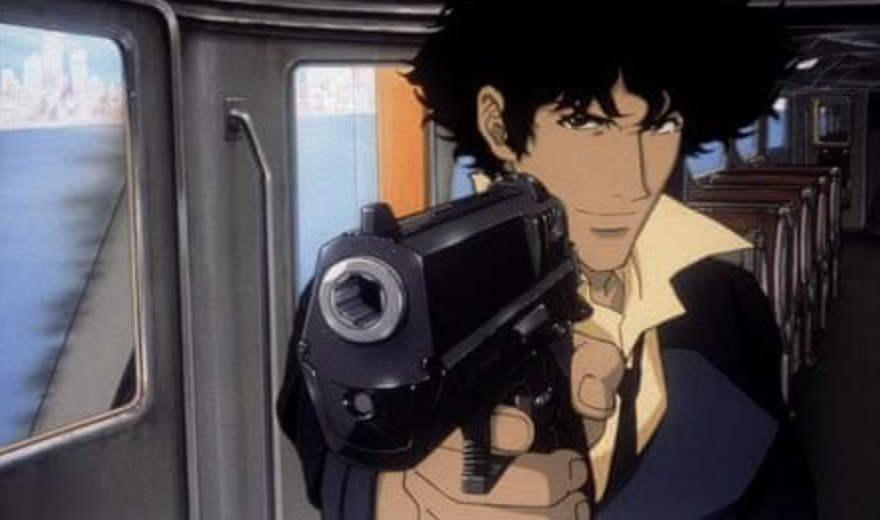 Spike Spiegel from Cowboy Bebop. [Credit: Sunrise]
The genius of the line becomes clearer when viewed against Cowboy Bebop as a whole. Shinichiro Watanabe‘s series is obsessed with people who cannot quite escape what came before. Jet carries the wreckage of his former life. Faye struggles with a past she cannot even remember properly. Spike pretends to move forward while remaining emotionally tethered to Julia and Vicious.
Even the show’s final trajectory turns that contradiction into tragedy. Spike’s relationship with his past is not healthy detachment. He often behaves as though he has already accepted his fate, but there is a crucial difference between accepting uncertainty and surrendering to it. His fatalistic streak can look like wisdom one moment and recklessness the next. Spike is not saying, “Don’t care.” He cares enormously. Julia matters. His old life matters. His friends matter. The consequences of his choices matter. He simply refuses to pretend he can control how those things end.
That philosophy also fits the show’s music. Yoko Kanno’s score, performed through the Seatbelts, helped give Cowboy Bebop its distinctive jazz-inflected identity, while English-language contributors such as Tim Jensen supplied lyrics for songs including “Words That We Couldn’t Say” and “Call Me Call Me.” Even the soundtrack frequently circles themes of memory, longing, separation and words left unsaid.
That is Cowboy Bebop in miniature: cool exterior, bruised interior. And perhaps that is why Spike’s line has survived when countless anime “life lessons” have faded. It does not offer certainty. It offers something harder: the courage to keep moving when certainty is impossible.
But after watching his story unfold, it stops sounding effortless at all. It sounds like a man who knows exactly how much he has lost and has decided that fear of losing more will not stop him from taking the next step. That is not simply going with the flow. That is Spike Spiegel staring into the unknown, lighting another cigarette, and walking forward anyway.
Do you think Spike was truly accepting fate or hiding something deeper? Tell us what you think in the comments!
Cowboy Bebop is available on Crunchyroll.

















 Bengali (BD) ·
  English (US) ·