.png)
 1 week ago
25
1 week ago
25
Deanna Troi is the resident mental health counselor aboard the USS Enterprise in Star Trek: TNG, but her powers in the sci-fi show have been a bit inconsistent. A half-Betazoid human, Troi was initially revealed to be telepathic, with the pilot episode even showing her having a completely telepathic conversation with William Riker.
However, as seasons progressed, Deanna Troi was made more of an empath, and the telepathic abilities took a backseat. So, why did the makers of TNG abandon this aspect of Troi? Was it too difficult to write for, or was there an actual reason why her telepathy was phased out? Read on to know more.
| Show Name | Star Trek: The Next Generation |
| Created by | Gene Roddenberry |
| Main Cast | Patrick Stewart, Jonathan Frakes, Brent Spiner, Marina Sirtis, Gates McFadden, LeVar Burton, Denise Crosby |
| Rotten Tomatoes (as of May 12, 2026) | Tomatometer – 92% Popcornmeter – 90% |
| IMDb (as of May 12, 2026) | 8.7 |
There Is A Biological Reason for Deanna Troi’s Telepathy Going Missing
Marina Sirtis’ Deanna Troi was the counselor of the USS Enterprise-D. Creator Gene Roddenberry created the character to establish that mental health would be as important as physical health in the 24th Century. While actress Marina Sirtis initially auditioned for the role of Tasha Yar, she was cast as Troi.
Troi belongs to the Betazoid species, a telepathic alien species that is part of the Federation. She is a half-Betazoid, with her father being human. Hence, a few of her abilities are not entirely like a Betazoid, which includes her telepathic abilities. Unlike others of her species, she only has partial telepathic powers.
The first season of the show, however, actually showed her telepathic abilities in full display. However, as the seasons progressed, her character became more of an empath and was able to feel others’ emotions. She spent her childhood on Betazed and other Betazoids around her communicated to her telepathically (especially her maternal grandfather).
Troi’s powers have been a bit difficult to write for, especially with her empathetic powers not being ideal for life-or-death situations. Her telepathy would have been very limited again. So it is possible that the writers wrote off her full telepathic powers by the end of season one.
Star Trek: TNG Writers Admitted It Was Difficult to Write For Deanna Troi
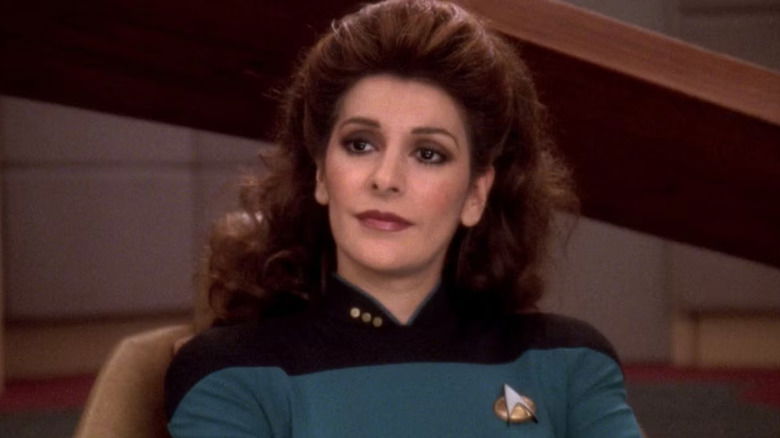 Marina Sirtis in Star Trek: TNG | Credits: Paramount Television
Gene Roddenberry intended his future to be free of internal conflicts, which meant that differences between genders and races were no longer a thing. However, this posed a fundamental logical issue for the writers of Star Trek: TNG, who wondered why the crew of such an advanced society would need a counselor.
Writers such as Brannon Braga expressed their confusion about the need for a therapist on board. Another writer, Naren Shankar, mentioned that it made no sense for him to have her on board (via Memory Alpha).
I couldn’t understand it, especially coming from an immigrant family where nobody talks about their problems, ever. The notion of having an onboard psychiatrist was so weird. I was, like, ‘What does she do all day? I don’t understand.’ She could look at the guy on the viewscreen who’s angry and go, ‘I think he’s angry. He seems angry to me, Captain.’…Poor Marina. We really tried to help her in the last few years of that show.
While many have admitted that the character was just for eye-candy, with the initial idea for her character reportedly depicted her as a three-br*asted woman, the series gave her a bit more to do as the seasons progressed, with Troi even passing the bridge commander exam.
What do you think about Deanna Troi’s character in Star Trek: TNG? Comment below.
Star Trek: TNG is available to stream on Paramount+.

























 Bengali (BD) ·
  English (US) ·