.png)
 1 hour ago
9
1 hour ago
9
Article content
Today, 20 years after his surgery, he is part of a national class action lawsuit, yet to be certified, alleging the implants he and others received are “inherently defective.”
Article content
The suit targets Wright Medical Technology, an American company that sold its orthopedics parts business to MicroPort Scientific Corporation in 2014. MicroPort, founded in Shanghai, China, is also named in another class action suit proceeding at the same time with similar allegations.
Article content
The law firms representing MicroPort and Wright, respectively, declined to comment on the lawsuits. Both have filed a notice of intent to defend their actions in Ontario.
Article content
There is debate within the North American medical community about the role of metal-on-metal hip resurfacings.
Article content
Some orthopedic surgeons interviewed by the IJB called them a vestige of the past.
Article content
Dr. Amit Atrey, an orthopedic surgeon based in Toronto and spokesperson for Arthritis Society Canada, said there’s been a shift away from metal-on-metal resurfacings because of the risks and because total “hip replacements now work so well.”
Article content
Article content
Others disagreed, saying metal resurfacings can be the best option for carefully selected patients. They allow for a higher range of motion than a total replacement and have lower dislocation rates.
Article content
Metal-on-metal is not “inherently bad,” said Dr. Prem Ramkumar, an orthopedic surgeon based in California. “It’s fine if used for the right indication, with the appropriate metallurgy, and positioned correctly during surgery.”
Article content
Dr. John Antoniou, a Montreal orthopedic surgeon who does resurfacing surgeries, agreed. “Registry data indicates that metal-on-metal resurfacing should be done on men with good bone stock who are very active,” he said.
Article content
There are only a few surgeons in Canada who do such surgeries because of the steep learning curve and volume required to maintain one’s skill, he said.
Article content
A 2025 study, published in the AME Surgical Journal, looked at online joint registry data between 2010 to 2024. Its authors concluded that resurfacing is a “safe and effective alternative to (replacement) for appropriately selected patients when performed by experienced surgeons at specialised centres.” It also called increased levels of metal ions “a significant problem.”
Article content
Article content
Metal particles released into the circulatory system when metal components rub together can eat away at tissue and cause damage in the area. According to Health Canada, it can cause pain in the groin, hip or leg, swelling at or near the hip joint, a limp and limited range of motion.
Article content
‘Missed out on life’
Article content
A year after his resurfacing, Kinney had surgery to remove the metal implant and replace it with a non-metal device. But the pain continued.
Article content
In 2016, Kinney sold his home, unable to survive on long-term disability benefits. He left Nova Scotia — rent was too high — and moved to New Brunswick, farther from his grown children. His time is spent managing pain.
Article content
“Missed out on life, pretty much,” he said.
Article content
He isn’t alone.
Article content
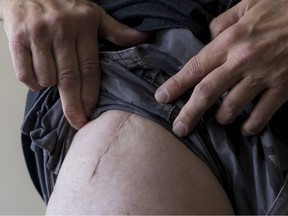
Doug Smerek, a Calgary karate instructor, was implanted with two metal-on-metal devices, one in each hip, in 2017 and 2022 respectively.
Article content
Both of Smerek’s surgeries came after the Health Canada warning, which he says his doctors never flagged.
Article content
Article content
He’s been “living a nightmare,” he told the IJB. The implants have caused him pain, cramping in his calves, and difficulty lifting the front part of his foot. He says he has anxiety attacks at night.




























/https%3A%2F%2Fsportsmole-media-prod.s3.gra.io.cloud.ovh.net%2Fuploads%2F2026%2F04%2Fimago1075785696-69f1c41377d96073966575.jpg)

 Bengali (BD) ·
  English (US) ·