.png)
 6 hours ago
11
6 hours ago
11
Article content
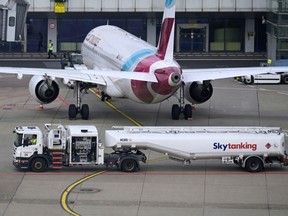
Airlines are facing surging fuel costs from the war in the Middle East, but executives say they are more concerned about taxes and regulations deemed too restrictive that could further crimp their bottom lines.

THIS CONTENT IS RESERVED FOR SUBSCRIBERS
Enjoy the latest local, national and international news.
- Exclusive articles by Conrad Black, Barbara Kay and others. Plus, special edition NP Platformed and First Reading newsletters and virtual events.
- Unlimited online access to National Post.
- National Post ePaper, an electronic replica of the print edition to view on any device, share and comment on.
- Daily puzzles including the New York Times Crossword.
- Support local journalism.
SUBSCRIBE FOR MORE ARTICLES
Enjoy the latest local, national and international news.
- Exclusive articles by Conrad Black, Barbara Kay and others. Plus, special edition NP Platformed and First Reading newsletters and virtual events.
- Unlimited online access to National Post.
- National Post ePaper, an electronic replica of the print edition to view on any device, share and comment on.
- Daily puzzles including the New York Times Crossword.
- Support local journalism.
REGISTER / SIGN IN TO UNLOCK MORE ARTICLES
Create an account or sign in to continue with your reading experience.
- Access articles from across Canada with one account.
- Share your thoughts and join the conversation in the comments.
- Enjoy additional articles per month.
- Get email updates from your favourite authors.
THIS ARTICLE IS FREE TO READ REGISTER TO UNLOCK.
Create an account or sign in to continue with your reading experience.
- Access articles from across Canada with one account
- Share your thoughts and join the conversation in the comments
- Enjoy additional articles per month
- Get email updates from your favourite authors
Sign In or Create an Account
or
Article content
Despite hand-wringing over the risk that travellers will balk at paying higher fares, the ongoing war did not appear to ruffle feathers at the International Air Transport Association’s annual conference in Rio, which ends Monday.
Article content
Article content
Article content
“We expect average jet fuel prices to be 70 percent higher year-on-year. That will add $100 billion to our collective fuel bill this year,” IATA director general Willie Walsh told the gathering.
Article content
By signing up you consent to receive the above newsletter from Postmedia Network Inc.
Article content
Yet when the CNN journalist Richard Quest asked a roundtable discussion if airlines were frustrated by “an event you have no control over,” the responses were remarkably subdued.
Article content
The chief of Turkey’s Pegasus Airlines, Guliz Ozturk, noted wryly that it was standard practice for carriers to predict various scenarios at the beginning of the year, only to see something entirely different happen.
Article content
IATA chief economist Marie Owens Thomsen recalled the uncertainty generated at last year’s conference, held in New Delhi just weeks after U.S. President Donald Trump unleashed his tariffs war.
Article content
“We thought that it was the end of the world,” she said.
Article content
But this year, there was hardly any mention of Trump despite the ongoing Mideast war, which has driven up fuel prices and caused profitability to plummet in a sector that was already struggling.
Article content
Name and shame
Article content
The IATA, which represents 370 member airlines, focused instead on naming and shaming countries that have imposed taxes on tickets — often in the name of reducing carbon emissions — or increased regulations on the industry.
Article content
Article content
The European Union was the most frequent target, with Walsh taking aim at the bloc’s “populist” Parliament for defending higher compensation for passengers impacted by flight delays.
Article content
Article content
And at a press conference on the shortage of non-fossil fuels needed to decarbonize air travel, EU regulations on the minimum amounts of such fuels required in aircraft tanks came under fire.
Article content
Even when pressed on the potential impact of a “quagmire” scenario in the Gulf that would curtail oil and jet fuel exports for several more months, executives did not appear overly alarmed.
Article content
When asked about the possibility of the war dragging out for years, research director Eleanor Budds played down the risk.
Article content
“Quagmire is a scenario… It doesn’t mean we expect this to happen,” Budds said.
Article content
A reporter then asked if, in an extreme case, the war would not just drive up prices but also lead to shortages of jet fuel.
Article content
“In our base case, we don’t have shortages,” she responded.
Article content
Our website is the place for the latest breaking news, exclusive scoops, longreads and provocative commentary. Please bookmark nationalpost.com and sign up for our newsletters here.
Article content





















/https%3A%2F%2Fsportsmole-media-prod.s3.gra.io.cloud.ovh.net%2Fuploads%2F2026%2F05%2Fns-collage-background-v2-email-3-6a086d6eaa1a0057506880.jpg)
 Bengali (BD) ·
  English (US) ·