.png)
 1 day ago
44
When you think about it, now is a perfect time to dust off Sense and Sensibility.
The 2020s have been ravaged by myriad convergent issues that have exacerbated our collective societal isolation: the scars of the COVID-19 pandemic, the fragile world economy, artificial intelligence, and the battle of sex in art and entertainment. We are essentially at war over the titular concepts that Jane Austen explored through the Dashwood sisters in her iconic novel two centuries ago. Do we live our lives through the prism of rigid logic, potentially defined by ChatGPT and uneasy access to capital, or free-flowing passion, the kind captured in love scenes or even group gatherings where people aren’t glued to their phones?
What is Sense and Sensibility about?
Of course, Austen couldn’t have anticipated our man-versus-machine present. Luckily for us, British filmmaker Georgia Oakley, filmmaker behind the BAFTA-nominated Blue Jeans, is in the thick of it with us and bridges the gap. Set in the last gasp of the 18th century, Sense and Sensibility follows the lives of the refined and restrained Elinor Dashwood (Daisy Edgar-Jones) and her free-spirited sister Marianne (Esmé Creed-Miles) in the English countryside after their father’s death. Mr. Dashwood’s estate bypasses the sisters and passes directly to their half-brother and his wife. As they contend with likely destitution, Elinor meets and falls in love with Edward Ferrars (George MacKay), her sister-in-law’s equally modest brother. Despite their mutual affection, the Dashwoods’ exile to a cottage in Devonshire after their effective eviction from their country estate nips Elinor and Edward’s blossoming romance.
Marianne, on the other hand, fields two potential romances upon the family’s arrival in Devonshire. Her neighbors point her toward the prickly but good-hearted Colonel Brandon (Herbert Nordrum), but she rebuffs him for his lack of ardor. Instead, she falls for the handsome and rakish John Willoughby (Frank Dillane), who literally sweeps her off her feet. Once again, a Dashwood finds her hopes dashed when she and her suitor are parted. Elinor and Marianne are left to contend not only with the bitter realities of their respective dreams but also with the ways in which the Regency era dictated their socioeconomic limits.
Sense and Sensibility Review
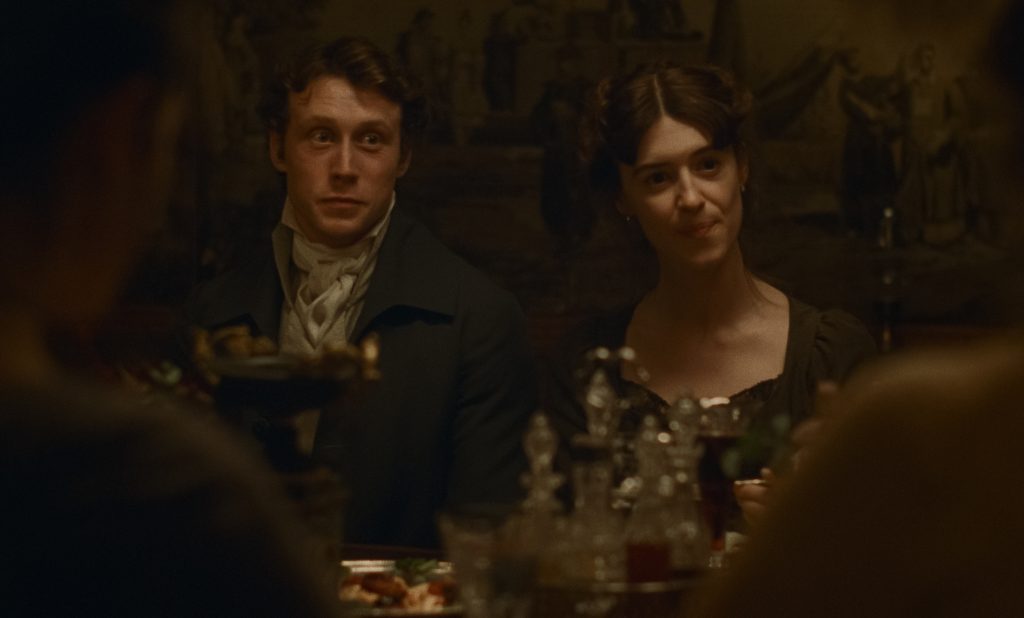 George MacKay stars as Edward Ferrars and Daisy Edgar-Jones as Elinor Dashwood
in SENSE and SENSIBILITY, a Focus Features release
Credit: Courtesy of Focus Features / © 2026 FOCUS FEATURES LLC
For a film ostensibly about matters of the heart versus the head, Oakley’s Sense and Sensibility is blissfully unrestrained in its romanticism. The film’s central relationships run the gamut of love-tinged emotions, from the playful teasing of Edward and Elinor’s first encounters to Marianne and Willoughby’s haphazard passion. Oakley conceives these moments within each couple’s appropriate register, but also with equitable rigor and intent.
For Elinor and Edward, Oakley zooms in on their briefest glimmers of physical and psychological connection, granting them intense weight. A rock passing from Edward’s hand to Elinor’s is wracked with palpable, sensual longing, as are the flustered glances. After they are parted and then reacquainted in London, Oakley positions them equally within the frames, whether they are dancing at the ball or, more heartrendingly, forced to deny themselves each other’s company. The camera demonstrates how achingly well-suited Elinor and Edward are for each other, even though the world and their own senses of duty prevent its acknowledgment. They represent a yearning of the highest order, somehow elegant and sexually charged.
 Esmé Creed-Miles stars as Marianne Dashwood in SENSE and SENSIBILITY, a Focus Features release.
Credit: Courtesy of Focus Features / © 2026 FOCUS FEATURES LLC
As for Marianne and Willoughby, with all their youthful verve and naivete, Oakley captures their courtship in beautiful wide shots that incorporate Devonshire’s burnt-grey landscapes. Stunning as they are, there is a hint of cruel irony to those compositions. Can such unabashed love truly flourish in the wilds to which the Dashwoods were basically banished? Isn’t it too good to be true? Even if you’ve never read Austen’s novel or seen the previous adaptations, the answer likely isn’t a surprise.
What is surprising is how effectively the colors of Sense and Sensibility enhance the Dashwoods’ stories. Rather than being a symptom of mainstream cinema’s disinterest in saturation, Oakley’s limited palettes put a blaring spotlight on Elinor and Marianne’s dashed hopes and critical self-discoveries. Midnight blues serve as the backdrop for Marianne’s late-night run in the rain, pushing her self-destructive agony to the forefront. Elinor and Edward’s reunion may be surrounded by ashy browns and greys, but it doesn’t dull the breathless abandon of their finally choosing themselves over societal expectations. Oakley’s choice to dial down her frames’ vibrance reflects Elinor and Marianne’s need to put aside the outside forces that have dictated their lives in order to come to their own hearts and minds, respectively. It is an added visual layer that enriches an already fertile text, beautifully adapted by Diana Reed.
Sense and Sensibility’s performances help Oakley dig even deeper into Austen’s text. Daisy Edgar-Jones delivers her best film performance yet as Elinor. She imbues the eldest Dashwood with just enough mischief to suggest a dazzling inner life that Elinor desperately deserves to escape, without losing her character’s intractable sense of duty. Esmé Creed-Miles is a stunning counterpoint as the uncompromising Marianne. There is an earthiness to her speaking cadence and movements, similar to Jessie Buckley in last year’s Hamnet, that signifies a communion with nature that Oakley frequently taps into for Marianne’s tribulations.
George MacKay is a lovely Edward, adding a surprising blend of ungainliness and sex appeal that raises the temperature of his dalliances with Edgar-Jones. Herbert Nordrum pulls off a similar trick to Colonel Brandon’s, but with an undercurrent of tenderness. Wonderful as they all are, Fiona Shaw nearly runs away with the film as the riotous cousin, Mrs. Jennings, a bawdy, unapologetic firecracker who adds some incredible sparks to the Dashwoods’ struggling fortunes.
Is Sense and Sensibility worth watching?
 Bodhi Rae Breathnach stars as Margaret Dashwood, Daisy Edgar-Jones as Elinor Dashwood and George MacKay as Edward Ferrars in SENSE and SENSIBILITY, a Focus Features release.
Credit: Alex Bailey / © 2026 FOCUS FEATURES LLC
There will probably be Sense & Sensibility adaptations long after Generation Alpha has 6-7ed themselves to death. (The evolution of our sociopolitical and economic systems should burnish the Austem estate for at least another century.) Even still, Georgia Oakley’s adaptation ranks among the best because of its picture-perfect alignment with our eroticism-starved, cynical zeitgeist. Her take on the ongoing battle between duty and love points to our need (or obsession) with self-actualization, while also offering a path forward for love, positioned as a force greater than ourselves, alone or together. It is worthy of being recognized as the year’s most romantic film.
Sense and Sensibility Review: Georgia Oakley Molds Jane Austen’s Novel into 2026’s Most Romantic Film
Georgia Oakley’s adaptation ranks among the best because of its picture-perfect alignment with our eroticism-starved, cynical zeitgeist.






























 Bengali (BD) ·
 English (US) ·