.png)
 1 hour ago
6
Canada’s economic stagnation is neither an accident nor primarily due to President Trump’s tariffs. In reality, government policies have made Canada an unfriendly place for entrepreneurs and investors.
Published Nov 04, 2026 • Last updated 30 minutes ago • 3 minute read
See more Toronto Sun on Google — save as a Preferred Source
Advertisement 2

THIS CONTENT IS RESERVED FOR SUBSCRIBERS ONLY
Subscribe now to read the latest news in your city and across Canada.
- Unlimited online access to articles from across Canada with one account.
- Get exclusive access to the Toronto Sun ePaper, an electronic replica of the print edition that you can share, download and comment on.
- Enjoy insights and behind-the-scenes analysis from our award-winning journalists.
- Support local journalists and the next generation of journalists.
- Daily puzzles including the New York Times Crossword.
SUBSCRIBE TO UNLOCK MORE ARTICLES
Subscribe now to read the latest news in your city and across Canada.
- Unlimited online access to articles from across Canada with one account.
- Get exclusive access to the Toronto Sun ePaper, an electronic replica of the print edition that you can share, download and comment on.
- Enjoy insights and behind-the-scenes analysis from our award-winning journalists.
- Support local journalists and the next generation of journalists.
- Daily puzzles including the New York Times Crossword.
REGISTER / SIGN IN TO UNLOCK MORE ARTICLES
Create an account or sign in to continue with your reading experience.
- Access articles from across Canada with one account.
- Share your thoughts and join the conversation in the comments.
- Enjoy additional articles per month.
- Get email updates from your favourite authors.
THIS ARTICLE IS FREE TO READ REGISTER TO UNLOCK.
Create an account or sign in to continue with your reading experience.
- Access articles from across Canada with one account
- Share your thoughts and join the conversation in the comments
- Enjoy additional articles per month
- Get email updates from your favourite authors
Article content
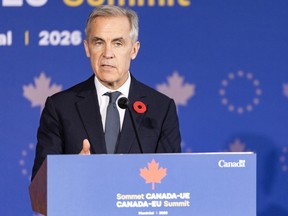
On Thurs. Nov. 5, the government of Prime Minister Mark Carney will table its second federal budget since taking office in March 2025. And unfortunately, Canadians can expect more bad news. The parliamentary budget officer (PBO) recently trimmed Canada’s economic growth forecasts, which reflect economic headwinds generated in part by the trade war and poor government policy. And the economy was already sputtering, with Canada projected to be the worst-performing advanced economy on the planet for the next four decades.
Article content
Article content
What does all this mean for Canadians and their families?
Consider some quick history. Back in 2014, per-person gross domestic product (GDP) — a key indicator of living standards — in Canada was $55,055. That’s more than 10% larger than the Organization for Economic Co-operation and Development (OECD) average ($45,116) among high-income countries. Since then, Canada’s per-person GDP grew by 4.2% — the third-lowest growth rate of 38 OECD countries (ahead of only Mexico and Luxembourg) and well below the OECD average of 17.3%. This means that by 2025, Canada ($52,148) had fallen below the average of $52,940 (all numbers adjusted for inflation and expressed in U.S. dollars).
By signing up you consent to receive the above newsletter from Postmedia Network Inc.
Article content
Advertisement 3
Article content
If we narrow the focus to the G20 group of countries, we see a similar story. Back in 2014, Canada’s per-person GDP was 51% larger than the G20 average, but fell to 38% larger by 2025, with the fourth-lowest growth in per-person GDP during that 11-year period, ahead of only Mexico, Argentina and South Africa. And during that same period, among G7 countries, Canada’s per-person GDP fell from 98% of the G7 average to 92%. Now, Canada has the second-lowest per-person GDP in the G7 (ahead of only Japan).
Canada’s economic stagnation is neither an accident nor primarily due to President Trump’s tariffs (although the tariff war has made a bad situation even worse). In reality, government policies have made Canada an unfriendly place for entrepreneurs and investors.
Reverse course on bad policy
To get Canada back on track, the Carney government must reverse course on years of bad policy. It should reduce spending to tame the deficit and create fiscal room for meaningful tax reform to make Canada more competitive with peer countries, including the U.S. And it should cut red tape to reduce Canada’s bloated regulatory regime. These reforms would help create an environment that encourages entrepreneurs to start or expand new businesses and help existing businesses attract new investment — which ultimately leads to higher wages for workers and higher living standards for Canadians.
Advertisement 4
Article content
Sadly, so far, the Carney government has only chosen targeted tax reductions rather than comprehensive reform and a government-led investment and development strategy — which benefits a chosen few who have the government’s favour — rather than broad-based regulatory reform that would benefit all investors, businesses and entrepreneurs. For example, the Building Canada Act allows Ottawa to greenlight energy projects deemed in the “national interest” rather than scrapping burdensome regulatory barriers to level the playing field for all potential projects. In other words, the Carney government is continuing down the same path that created Canada’s economic malaise in the first place.
Canadians are falling behind, not because of external economic forces but because of decisions made by government. Carney sold Canadians on his ability to solve problems and bring competent leadership back to Ottawa. Beginning with the upcoming budget, his government should focus on time-tested solutions that work, rather than making the same mistakes that brought us here in the first place.
Nadeem Esmail and Jake Fuss are research directors at the Fraser Institute
Article content




























 Bengali (BD) ·
 English (US) ·