.png)
 1 week ago
62
1 week ago
62
Spoiler Alert !!!
This article contains major spoilers for Life, Larry and the Pursuit of Unhappiness Episode 2, Farewell!
Larry David has made a career out of treating irritation like a public service, and somehow, Life, Larry and the Pursuit of Unhappiness Episode 2 finds a way to turn that old comic habit into something much more pointed. The HBO sketch comedy series, created by David and Jeff Schaffer, has already made its pitch clear: American history is going to be re-examined through Larry’s familiar obsession with rules, manners, hypocrisy, and people who make life slightly worse by pretending they are normal.
Episode 2, titled Farewell, could have been another amusing historical detour with colonial costumes and argumentative improvisation, but its final sketch gives the episode a sharper aftertaste. Rob Reiner appears as George Washington, and because this became one of his final posthumous performances, the scene lands with an emotional weight that the show itself almost seems to understand in real time.
Life, Larry and the Pursuit of Unhappiness Episode 2 Recap
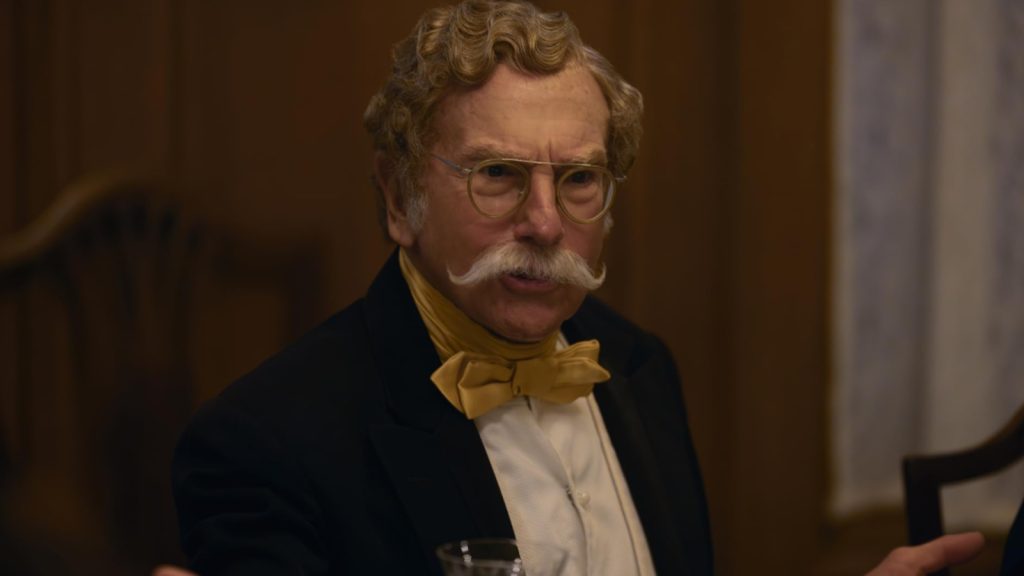 Credit: HBO
Life, Larry and the Pursuit of Unhappiness Episode 2 continues the show’s sketch-based structure, using American history as a stage for Larry David’s modern anxieties. The series itself has been framed as a seven-episode HBO limited series tied to America’s 250th anniversary, with new episodes airing weekly after its June 26 premiere. The show’s premise remains wonderfully odd because Larry does not enter history to learn from it. He enters history to complain inside it. That is why the format works better when the sketches place him near a genuine civic milestone rather than a random period joke. His comedy thrives when a social expectation meets a man constitutionally incapable of letting anything go.
Farewell saves its most important material for the closing sketch. George Washington, played by Rob Reiner, announces that he will not seek a third term as president. Historically, that decision helped shape the American expectation that presidential power should be temporary, restrained, and transferred peacefully. In the sketch, Washington treats that precedent as a noble safeguard, while Larry’s colonial character immediately begins searching for the loophole, because of course he does.
Larry asks what would happen if a future president had no respect for the Constitution. He imagines someone vain, vindictive, corrupt, and willing to bend every rule that polite society assumes no one would actually dare to break.
What Happens in the George Washington Sketch?
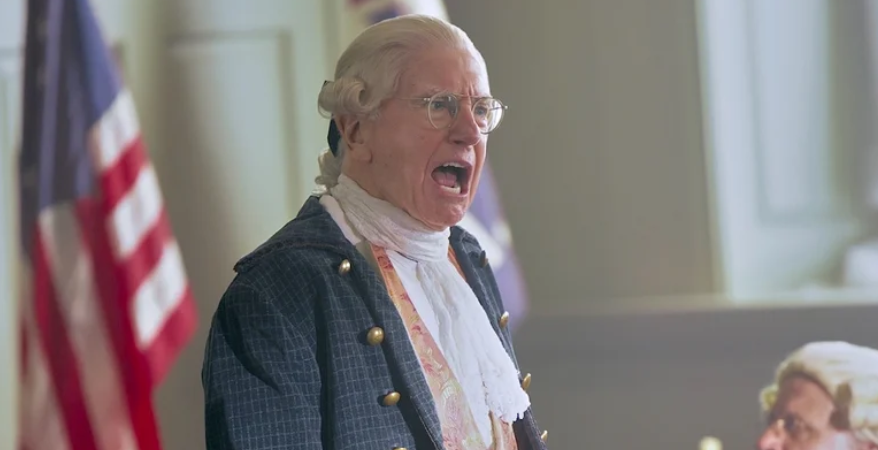 Credit: HBO
The final sketch begins with Washington addressing the crowd and explaining that he will leave office after two terms. The tone initially carries the formality of a historical farewell, but Larry soon turns the moment into a dispute over political safeguards. He wants to know what happens if some future president refuses to behave with Washington’s restraint. The joke grows more direct as Larry imagines a leader who refuses to accept election results, uses office for personal gain, manipulates public fear, attacks critics, and depends on weak institutions to keep him insulated. The episode avoids saying Donald Trump’s name, but the sketch is not exactly hiding in the shrubbery. Jeff Schaffer told TheWrap that the series uses historical settings to discuss current events, and he described this particular sketch as one of the show’s most direct attempts to speak about the present through the past.
Washington keeps trusting the system to correct itself. Larry keeps asking what happens if the system is filled with people too cowardly, too partisan, or too compromised to do the correcting. That disagreement is the real engine of the sketch. Washington represents the ideal of peaceful power, while Larry represents the miserable but necessary person at the meeting who asks whether the policy has been tested against the worst possible user.
Jimmy Kimmel then appears in period costume and adds another pointed layer with the line, “Are you suggesting that the president would taketh the time to challenge anyone who dare make fun of him, as if he were a big baby?” The cameo works because it expands the sketch from presidential power into political retaliation, media pressure, and comedy’s uneasy place in a culture where powerful people often want applause without mockery. As the crowd becomes increasingly agitated, the scene stops functioning as a clean debate and turns into a public breakdown.
Washington tries to calm everyone, but the people around him begin fighting over the imagined future that Larry has described. Reiner’s Washington finally looks at the disorder before him and says, “We’re f*cked.” The episode then cuts to an “In Memoriam” card for Reiner, turning a blunt punchline into something unexpectedly heavy.
What Jimmy Kimmel’s Cameo Adds to the Ending
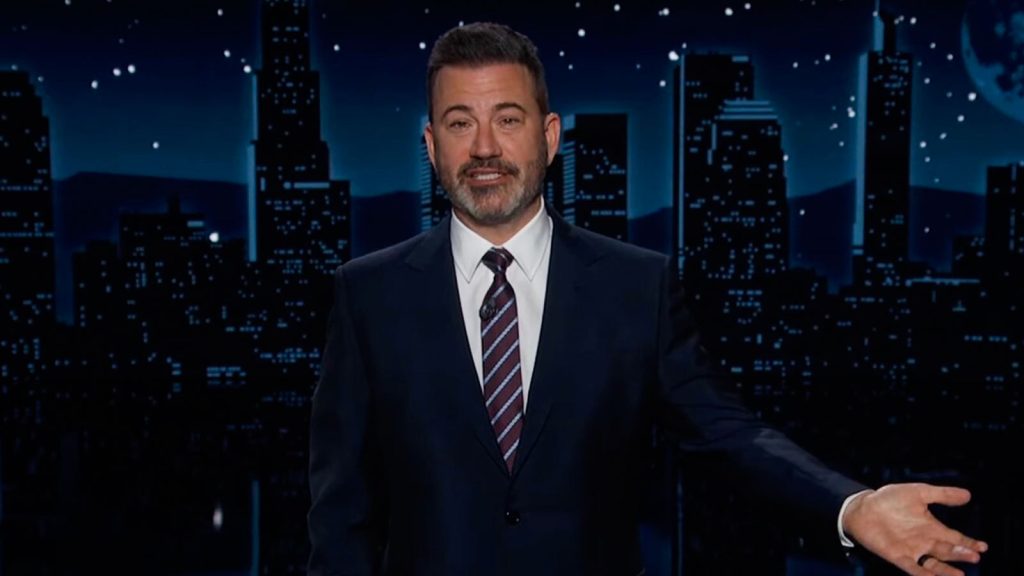 Credits: @JimmyKimmelLive / YouTube.
Jimmy Kimmel’s brief appearance could easily have felt like a celebrity drop-in, but the line is too specific to be treated as decorative. His joke about a president challenging people who mock him gives the sketch a free-speech angle, and that matters because satire becomes more revealing when the people being mocked react badly to it. TheWrap noted that Kimmel’s appearance connects to recent controversy around late-night criticism and political pressure, which explains why the cameo feels so carefully placed. He is not there only to make viewers point at the screen and say, “That’s Jimmy Kimmel.” He is there to show that the sketch’s concern is larger than elections. It is also about whether comedians, journalists, critics, and ordinary citizens can still ridicule power without becoming targets of power.
For a show built around Larry David’s obsession with social rules, this is a clever escalation. Larry’s comedy usually asks why people cannot follow the small rules that keep daily life tolerable. Farewell asks what happens when leaders stop following the large rules that keep public life functional. The scale changes, but the Larry David principle stays intact: society falls apart when people decide the rules apply only when convenient.
Life, Larry and the Pursuit of Unhappiness Episode 2 Ending Explained
 Larry David in Life, Larry and the Pursuit of Unhappiness: an Almost History of America (2026) | Credit: HBO
The ending of Life, Larry and the Pursuit of Unhappiness Episode 2 means that the series is no longer content with using history as costume comedy. “Farewell” uses George Washington’s refusal to seek a third term as a direct measure of modern political behavior, and the result is one of the show’s most acidic sketches so far. Washington’s decision represents restraint. Larry’s questions represent institutional doubt. The fighting crowd represents a divided public that can no longer agree on the danger in front of it. Reiner’s final line becomes the verdict on all three.
The sketch argues that democracy cannot survive on ceremony alone. It needs leaders who respect limits, lawmakers who value country over party, courts that do not become protective furniture for power, and citizens who can still identify authoritarian behavior before it becomes normalized. Washington believes the example will hold. Larry understands that examples fail when bad actors discover there is no real consequence for breaking them. In my view, Episode 2 is where Life, Larry and the Pursuit of Unhappiness finally proves why its strange format has teeth. The show can be uneven, and Larry David’s complaint engine occasionally sounds like a familiar machine in a new warehouse, but this final sketch gives the series a reason to exist beyond nostalgia for Curb Your Enthusiasm.
Rob Reiner’s final sketch hits harder than expected because it is funny, angry, rude, mournful, and politically literate in a way the premiere only hinted at. It made me laugh, but it also made me sit with the unpleasant question underneath the joke: what happens when a democracy built on restraint meets people who treat restraint as weakness? Did the George Washington ending feel like necessary satire to you? Drop your take in the comments below.
For more Life, Larry and the Pursuit of Unhappiness ending explainers, HBO Max updates, celebrity cameos, and TV breakdowns that do not tiptoe around the obvious, follow FandomWire and keep the debate alive.
Life, Larry and the Pursuit of Unhappiness is streaming on HBO and HBO Max.






















/https%3A%2F%2Fsportsmole-media-prod.s3.gra.io.cloud.ovh.net%2Fuploads%2F2026%2F07%2Fdaniel-mcgregor-huyer-zuma-press-wire-luciano-gonzalez-anadolu-abacapress-com-estadio-azteca-harry-kane-jude-bellingham-composite-6a49eb8857b70695441164.png)
 Bengali (BD) ·
  English (US) ·