.png)
 2 days ago
11
2 days ago
11
Article content
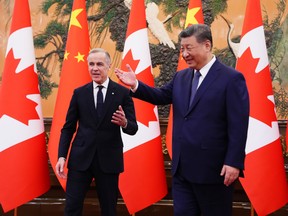
On Sunday morning, when Mark Carney declared that Canada’s historic closeness with the United States now represents “weaknesses,” he opened the door to a fundamental rethinking of Canadian foreign policy. But if diversification means turning toward China, Canadians deserve a clear-eyed assessment of the risks, not just the opportunities. That assessment becomes far more complicated when viewed against what is now unfolding inside China’s military leadership.

THIS CONTENT IS RESERVED FOR SUBSCRIBERS
Enjoy the latest local, national and international news.
- Exclusive articles by Conrad Black, Barbara Kay and others. Plus, special edition NP Platformed and First Reading newsletters and virtual events.
- Unlimited online access to National Post.
- National Post ePaper, an electronic replica of the print edition to view on any device, share and comment on.
- Daily puzzles including the New York Times Crossword.
- Support local journalism.
SUBSCRIBE FOR MORE ARTICLES
Enjoy the latest local, national and international news.
- Exclusive articles by Conrad Black, Barbara Kay and others. Plus, special edition NP Platformed and First Reading newsletters and virtual events.
- Unlimited online access to National Post.
- National Post ePaper, an electronic replica of the print edition to view on any device, share and comment on.
- Daily puzzles including the New York Times Crossword.
- Support local journalism.
REGISTER / SIGN IN TO UNLOCK MORE ARTICLES
Create an account or sign in to continue with your reading experience.
- Access articles from across Canada with one account.
- Share your thoughts and join the conversation in the comments.
- Enjoy additional articles per month.
- Get email updates from your favourite authors.
THIS ARTICLE IS FREE TO READ REGISTER TO UNLOCK.
Create an account or sign in to continue with your reading experience.
- Access articles from across Canada with one account
- Share your thoughts and join the conversation in the comments
- Enjoy additional articles per month
- Get email updates from your favourite authors
Sign In or Create an Account
or
Article content
Article content
There is a tendency in Ottawa and other Western capitals to view China’s ongoing purge of senior military leadership as a familiar exercise in political control by Xi Jinping. That reading is too narrow. What is unfolding inside the People’s Liberation Army (PLA) is not simply discipline imposed from the top. It is an indicator of stress within the system itself. It raises fundamental questions about trust, reliability and the cohesion of China’s most sensitive military capabilities. At its core, this is about confidence, and the erosion of confidence inside a nuclear-armed great power carries consequences that extend far beyond China.
Article content
Article content
By signing up you consent to receive the above newsletter from Postmedia Network Inc.
Article content
The breadth of those removed reinforces the point. Former defence minister Li Shangfu was abruptly dismissed after disappearing from public view, following an earlier investigation into his predecessor Wei Fenghe. China’s top general, Zhang Youxia, and vice chair of the powerful Central Military Commission and former head of the Armaments Department were also sacked.
Article content
Inside the PLA Rocket Force, the scale has been even more striking. Former commanders Li Yuchao, Wang Houbin and former political commissar Xu Zhongbo were removed alongside deputy commanders Liu Guangbin and Zhang Zhenzhong.
Article content
Article content
Additional senior officers tied to missile operations and procurement networks have been detained or placed under investigation, while parallel sweeps through the Equipment Development Department have targeted those responsible for weapons acquisition and oversight.
Article content
Article content
Five more generals may have been formally dismissed last week, along with other senior military leaders and government officials, including Yang Guang, Commander of the Rocket Force’s 64th Base, which controls China’s land-based nuclear deterrent. This is not a narrow campaign; it is a systemic disruption touching the core of China’s strategic deterrent.
Article content
A similar argument might be made about personnel changes under Defence Secretary Pete Hegseth, particularly toward officers associated with General Mark Milley or debates around DEI culture. But the difference is fundamental. In the United States, these moves occur within a system of civilian oversight and have not targeted the core of its strategic deterrent. In China, they have. When the most senior political leadership begins to question the reliability of its own missile forces, the implications are immediate.



























 Bengali (BD) ·
  English (US) ·