.png)
 2 hours ago
8
2 hours ago
8
Article content
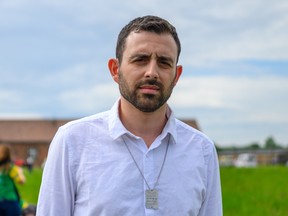
Wednesday marks the third anniversary of the October 7 terror attacks on southern Israel — and 20 days before an Israeli election in which Prime Minister Benjamin Netanyahu’s record is the clear ballot question. To survey the mood in Israel, the Post’s Adam Zivo spoke to Eylon Levy, one of the Jewish state’s best-known faces internationally. A former spokesman for the State of Israel in the days after October 7, he has hundreds of thousands of followers on social media and hosts From Here to There, the flagship international affairs show of Channel 16 in Israel, as well as the Israel Electioncast podcast.

THIS CONTENT IS RESERVED FOR SUBSCRIBERS
Enjoy the latest local, national and international news.
- Exclusive articles by Conrad Black, Barbara Kay and others. Plus, special edition NP Platformed and First Reading newsletters and virtual events.
- Unlimited online access to National Post.
- National Post ePaper, an electronic replica of the print edition to view on any device, share and comment on.
- Daily puzzles including the New York Times Crossword.
- Support local journalism.
SUBSCRIBE FOR MORE ARTICLES
Enjoy the latest local, national and international news.
- Exclusive articles by Conrad Black, Barbara Kay and others. Plus, special edition NP Platformed and First Reading newsletters and virtual events.
- Unlimited online access to National Post.
- National Post ePaper, an electronic replica of the print edition to view on any device, share and comment on.
- Daily puzzles including the New York Times Crossword.
- Support local journalism.
REGISTER / SIGN IN TO UNLOCK MORE ARTICLES
Create an account or sign in to continue with your reading experience.
- Access articles from across Canada with one account.
- Share your thoughts and join the conversation in the comments.
- Enjoy additional articles per month.
- Get email updates from your favourite authors.
THIS ARTICLE IS FREE TO READ REGISTER TO UNLOCK.
Create an account or sign in to continue with your reading experience.
- Access articles from across Canada with one account
- Share your thoughts and join the conversation in the comments
- Enjoy additional articles per month
- Get email updates from your favourite authors
Sign In or Create an Account
or
Article content
Advertisement 1
Article content
ZIVO: What has the mood been like in Israel amid the third anniversary of October 7?
Article content
Article content
By signing up you consent to receive the above newsletter from Postmedia Network Inc.
Article content
LEVY: Israelis are going to the polls at the end of October, and the election is overshadowed by the question of October 7. For the opposition, the question is responsibility for the massacre itself. The government, or Netanyahu’s Likud party at least, wants it to be about the war triggered by October 7, while conveniently overlooking the massacre itself.
Article content
This was a moment that brought Israelis back to a moment of primal vulnerability and a reminder of the existential threats facing this country, and it was a moment of weakness that has led to Israel’s greatest moment of regional dominance, but with enormous challenges on the horizon, like a looming confrontation with Turkey, which has filled the power vacuum left by the Iranian regime.
Article content
ZIVO: There is a lot of anger about the massacre, and about the way the war has been managed, about the promises of total victory that have failed to materialize, about the very unequal distribution of the burden of military service. These are the issues that are going to dominate these elections. But can you give me some personal stories from those around you that can help Canadians visualize what it’s been like for the average Israeli in the leadup to October 7?
Article content
Advertisement 2
Article content
LEVY: On an emotional level, it has been beautiful to watch the former hostages rebuilding their lives. Just recently, Eliya Cohen, who was held in Hamas captivity for 505 days, mostly in the tunnels, got married.
Article content
Article content
He had been planning to propose to his girlfriend Ziv Abud before the October 7 massacre. They were both there at the Nova music festival. They hid inside a roadside bunker. He was abducted, and she was under a pile of bloodied bodies. And for 505 days in captivity, he was sure that she was dead. He had sat awake for her. He had sat shiva. He had convinced himself that she was dead, and he was going to have to move on without her — while she was publicly campaigning for his release. And they recently got married, and they’ve just published a book of their own about what it is to rebuild your life and to rebuild a relationship after you’ve already mourned it and assumed that it was gone.
Article content
Emily Damari, who had to hide the fact that she was lesbian from her captors in Gaza, obviously because that would put her in danger, she just got married to a woman she met after she was released. So very emotional to see these hostages, who everyone had prayed about so dearly, rebuilding their lives.
Advertisement 1
Advertisement 2
Article content
But on a broader level, there is anxiety about the loose ends. Hamas is still there in Gaza. It’s refusing to disarm. It’s refusing to relinquish power, and there is international pressure on Israel to begin withdrawing in accordance with a phased disarmament of Hamas. But what that means is that Israeli troops begin to pull back from Gaza, while the rest of Gaza is still controlled by the terrorist organization that beheaded people on October 7.
Article content
In Lebanon, Hezbollah is still armed. The Lebanese government has failed to confront it and take that seriously, and there is still the threat of drone attacks against communities in the north.
Article content
So there is, even though Israel has really triumphed over those terrorist armies in ways few could have imagined before October 7, a feeling that there are still loose ends that leave the country’s borders very fragile, very vulnerable, and therefore that October 7 is still a matter of unfinished business.
Article content
ZIVO: Looking at things retrospectively, how would you say Israeli society has changed over the past three years?
Article content
LEVY: It’s a very good question because these are the sorts of changes that you can’t necessarily visualize while you are in the middle of them.
Article content
Advertisement 3
Article content
I’ll say that politically, there has been a much sharper debate about the difference between those who serve the country and those who do not, and the need to realign this country’s politics and priorities around the productive middle class who contribute taxes and military service at the expense of groups like the ultra-orthodox that have very basic secular education are not tremendously involved in the workforce and don’t serve in the army.
Article content
Article content
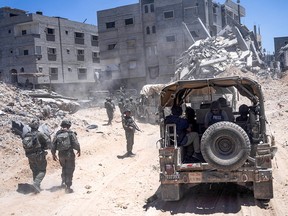
We have a reality now where young guys have often served over 500 days of reserve duty. They have not been able to hold down jobs, families, careers, startups because they keep getting called back into military service as tens of thousands of perfectly healthy young men do not serve, simply refusing orders to show up at the enlistment bureau because they claim a religious exemption. That is completely unsustainable.
Article content
And if that was a pet peeve before, and the inequality was unfair. Now it’s a major political breaking point.
Article content
So politically, the costs of the war, the financial and military costs of the war, have sharpened a debate about who does this country serve, and does this country serve those who serve it, or does it serve the special interest groups that are able to exploit their political power to get freebies for themselves at the expense of everyone else?
Article content
Advertisement 4
Article content
I would say, from a diplomatic level, which is you know what interests a lot of people outside the country, Israelis have become a lot more hawkish. So if before you would have had a discourse about the need to make painful concessions for peace, to take risks for peace, that’s just not there anymore.
Article content
You cannot talk about the two-state solution without being laughed out of the room, because Israel withdrew from the Gaza Strip in 2005, in the promise that the Palestinians could show what they would peacefully do with territory, and instead of getting Singapore we got nearly 20 years of rocket attacks.
Article content
And in all those years, when Israelis turned to the international community and said, “Hey, what guarantee do we have that that won’t happen in the West Bank,” they received no answers, absolutely no useful answers about how the disaster of Gaza would not be replicated from an area 20 times bigger overlooking Tel Aviv, surrounding Jerusalem.
Article content
And then on October 7, it turned out that the threat wasn’t just rocket attacks; it was full barbarian hordes that were going to come in, abduct little children, commit barbaric sexual atrocities, and then wage a guerrilla war from tunnels underneath people’s feet, and so Israelis have realized that we have much less wiggle room and room for error, and that the stakes are really, really high, and that has led definitely to a rightward shift in terms of security, where people simply will believe the enemy at its word, and are less likely to give it the benefit of the doubt, and believe that we can afford to live in convenient illusions.
Advertisement 2
Advertisement 3
Article content
That perhaps has been one of the driving lessons of October 7: we cannot afford to inhabit convenient illusions, and sometimes we have to stand up to pressure from our friends when our national interests are at stake. And I think that’s going to shape Israel’s conduct towards the rest of the world. Whoever wins the next election, this is not just a Netanyahu issue.
Article content
ZIVO: Now, the legislative elections are at the end of this month, and some people have framed this vote as a referendum on Netanyahu. Some have argued that this election is inextricably intertwined with the memory of October 7. Can you explain to us?
Article content
LEVY: The elections on Oct. 27 will be about October 7 because this was not just a terror attack; it was an invasion that no one thought possible, that triggered a regional war, that has seen hundreds and hundreds of dead soldiers, thousands of people ripped away from their families for months of reserve duty, immense strain placed on the welfare services in this country because of a ballooning social deficit, economic because of the ballooning economic costs, huge social pressures because the burden of supporting this war has not been spread equally among parts of society, and because we’ve spent three years running to bomb shelters, having missiles, constantly having a, “Will Iran attack tonight? Will it not attack tonight?”
Article content
Advertisement 5
Article content
It’s worth elaborating for a Canadian audience used to two main parties, three, maybe a fourth satellite party, that Israel has a system of pure proportional representation in a very diverse country. There is an electoral threshold of 3.25 per cent, which is high enough to block new actors from getting involved, but low enough that any given parliament can have around a dozen parties that will cross the electoral threshold, and that means that the elections are never about one defining issue, because there isn’t a Punch and Judy head-on-head debate between the government and the opposition.
Article content

Article content
Let’s remember, these elections are also the first in four years. Israel’s population has grown. There are about half a million young voters who didn’t vote last time, whose experience has been overshadowed by going into the army and then getting dragged straight back into reserve duty as soon as that army service was over, and therefore it’s actually difficult to predict how the election is going to go.
Article content
ZIVO: What are the competing messages amongst these two broad coalitions?
Article content
Advertisement 6
Article content
LEVY: Netanyahu’s big selling point is that he is colossus on the Israeli diplomatic stage. He’s the only one who can do the job, and frankly, has been prime minister for so long. He’s defined for many Israelis what a prime minister looks like. He is the only one who has the balls of steel to keep Israel safe. This is his argument.
Article content
Now the opposition will say, that’s ridiculous. You were the prime minister on October 7. You screwed up when we were invaded by Hamas’s barbarian army.
Article content
His argument will be: Not my fault. There was a military failure. There was an intelligence failure. If they’d woken me up two hours earlier in the morning, I could have stopped this. The military screwed up, and look at how I’ve kept this country safe. Other leaders would have buckled to pressure from President Biden, who said, “Don’t go into Rafah.” They wouldn’t have attacked Iran. They wouldn’t have had the balls to go ahead with the beeper operation against Hezbollah. They would have paid a ransom for the hostages before we got the favourable terms that ended the war. I am the only one who can keep this country safe. Yes, we screwed up, but it wasn’t my fault.
Advertisement 3
Advertisement 4
Article content
And in any case, the opposition doesn’t have a majority without the Arab parties. So if you vote for (Yashar party leader Gadi) Eisenkot, you’re going to bring in the left with the Arab parties, and that’s going to put our country in danger. That’s his argument. That’s the argument, more or less.
Article content
He’s focusing on attacking the opposition: This will be a left wing government backed by the Arabs, and he’s had one campaign (message) saying, look at who all the people are who are going to be proud, happy if Netanyahu falls. It’s going to be (New York City Mayor Zohran) Mamdani. It’s going to be (Iranian Supreme Leader) Mojtaba Khamenei. They’re rooting for Netanyahu to fall. So, do you really want to be on the side of Mamdani? I mean, that’s the election message.
Article content
ZIVO: There has been this debate about accountability for several years now. So how has that debate shifted in recent months? Obviously, there is still conflict with Iran, but Iran has mostly been contained for the moment. I understand that many Israelis would want a firmer approach, but at the very least, you know, Iran was humbled.
Article content
Advertisement 7
Article content
LEVY: I’m not sure that Iran has been contained.
Article content
ZIVO: Suffice it to say, there is a ceasefire. Hamas still exists, but they are a shadow of what they once were. There is still conflict in Lebanon, but at the same time, Hezbollah has mostly been crippled, and of course there is always the looming risk of further conflict with Iran, but, as of now, it seems as if the Islamic Republic is licking its wounds. So in this situation, now that there seems to be a brief window where Israelis can take some kind of breather, how does that influence the debate about accountability for October 7? Has this window of relative peace shifted conversations about retrospective accountability and investigations?
Article content
LEVY: No, I don’t think this breather has shifted anything. The battle lines are already pretty clear. For the opposition parties, a state commission of inquiry is non-negotiable. For Netanyahu, it’s simply not an option, and I think it’s understood this is an issue that’s just going to be determined by the elections. Both sides know what they want.
Article content
If the opposition wins an election, it will set up a state commission of inquiry on day one, and if they’re forced into some arrangement with Netanyahu, then it’s not clear what will happen. These are issues that are going to have to be litigated after the election.
Article content
Advertisement 8
Article content
ZIVO: I want to go back to something that we touched upon earlier in our conversation, which is the Haredi conscription issue. Now, many Canadians are unfamiliar with what’s happening here. Can you just walk them through this topic and some of the developments that we’ve seen in the past few months that have inflamed its importance relative to this election.
Article content
LEVY: Israel has universal military conscription at age 18, with exceptions. Arabs are not required to serve in the army, religious women are not required to serve in the army, and all ultra-orthodox men were historically exempt.
Article content
It started in the early days of independence when David Ben-Gurion gave an exemption to 400 Torah scholars to rebuild the life of religious scholarship that had been destroyed in the Holocaust. Over time, because of the ultra-orthodox parties’ political power and exponential demographic growth, that exemption expanded to a point where every year there are tens of thousands of perfectly healthy young men who, instead of going into the army and instead of going into the workforce, remain in religious seminaries studying, and this has put immense strain on the army, which says it needs another 10,000 men in combat.
Advertisement 4
Advertisement 5
Article content
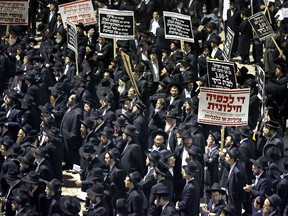
Now recently there was a Supreme Court ruling that struck down the exemption. They said it declared it was unconstitutional based on Israel’s basic laws. It violated the principle of equality, and ordered the government to begin enlisting the ultra orthodox. They’ve now tried to find every which way to let them get off the hook, and you have a situation now of tens of thousands of ultra-orthodox men who are defined as deserters because they are refusing to enlist.
Article content
Article content
This is not about the military service as such. It is about tearing down the ghetto walls, and the leadership of the ultra-orthodox community, fearful that they will lose their power and their ability to tell their flock what to do, if at age 18 they go out into the wider world, into an army that Israel has always proudly considered a melting pot. They don’t want that. They want guarantees that they can continue their closed religious way of life, and so this is shaping up to be the defining fault line within Israeli politics now.
Article content
ZIVO: There’s a political tension within Netanyahu’s brand because he presents himself as being a firm and strong leader who prioritizes national security, but at the same time, here he is making excuses for men who refuse to serve, and so there’s a conceptual conflict here, right? How has that tension been discussed and understood within Israel?
Article content
Advertisement 9
Article content
LEVY: You’re right. That is the core tension, the dissonance between Netanyahu’s ambitions and Israel’s expanded footprint in the region, with buffer zones in Gaza, Syria, Lebanon, and the reality of an army that is strained to breaking point, and citizens who are strained to breaking because of everything they have been forced to endure and take on over the last few years.
Article content
Netanyahu will say that, look, this isn’t going to happen by force. We can’t impose it on ultra-orthodox society. It has to happen slowly through dialogue. But others saying, look, this is just not happening quickly enough and if we don’t put an end to this they’re going to run rings around us and exploit every loophole to get out of this, and that is why you have really broad agreement across a lot of the opposition bloc, saying our security requires a more equal application of the burden because we have to release our most talented and productive young people to go back to building families, back to building businesses and careers and startups.
Article content
Every university-educated 35-year-old man who is doing 600 days of reserve duty is a potential billion-dollar startup that isn’t being founded. So we need to reallocate resources in society in a way that maximizes our country’s economic and military potential, instead of squandering our most productive citizens, spitting in their faces, and giving freebies to people who don’t contribute. You’re right; that is absolutely the core tension.
Article content
Advertisement 10
Article content
ZIVO: Now, let’s talk about the economic costs of war. So obviously, war is not cheap. Israeli society has struggled to fund this multi-front war …
Article content
LEVY: Just to give you an illustration of how not cheap it is, Israel’s defence budget is half the size of the United Kingdom’s. The United Kingdom has a population and GDP seven times the size of Israel. It has a network of overseas territories to defend, like the Chagos Islands and the Falkland Islands, which are back in the news. Israel is one tiny sliver of territory with a defence budget half the size of a country seven times as big. It’s an extraordinary strain on national resources.
Article content
ZIVO: And so, what does that strain look like in practice in Israel? What are some of the sacrifices that have been necessary?
Article content
LEVY: The extraordinary defence expenditure in Israel means that, despite having a GDP per capita larger than most European countries, the level of public services is far inferior to what you would expect for a wealthy country with high taxes.
Article content
It reflects in the school system. It reflects in public transport. It reflects in the investment we can make in the police and in personal security and in infrastructure, because the defence budget takes so much of the tax burden, and so there is an understanding that if we’re going to avoid really excruciating tax hikes, or an even further reduction in social services to support defence, you have to expand the tax base. At the moment the ultra-orthodox are 15 per cent of the population. They contribute two per cent of all income taxes.
Advertisement 5
Advertisement 6
Article content
ZIVO: Earlier I had said that many Israelis seemingly view this election as a referendum on Benjamin Netanyahu, but based on our conversation, it seems as if this is also a referendum on the role of the ultra-orthodox in Israeli society more broadly speaking. Is that fair to say?
Article content
LEVY: Yes, and it’s increasingly difficult to separate those two issues because Netanyahu has, since returning to power in 2009, seen the ultra-orthodox parties as his natural allies. They’re very easy to pay off. They’re parties that, if you give them what they want in terms of the status quo on religion and state, draft exemption and budgets, they will not intervene in any policy decisions in the questions of war and peace and security.
Article content
And the opposition will say: Look, October 7 showed that this entire system is completely bankrupt. It led us to disaster. It’s economically unsustainable. It’s going to collapse us economically in the future. Now we have to get a grip and integrate these people into the workforce. Give these kids a decent Western education that will equip them to provide for themselves and their families. That’s the only way that we can keep up a Western lifestyle in this country.
Article content
Advertisement 11
Article content
So, yeah, this election is not just about responsibility for October 7. October 7 opened a can of worms in Israeli society, a lot of issues that Israelis thought we can keep kicking the can of worms down the road forever. Now we have to deal with them.
Article content
The last time that (entrepreneur/politician) Naftali Bennett became prime minister, he and (his political partner and another former prime minister) Yair Lapid were saying Israelis agree on 80 per cent of things. So we’re going to focus on the 80 per cent of things we agree on, and just put to one side the 20 per cent of controversial issues.
Article content
These are the elections in which people are saying no. We have to address the most fissile issues now because they cannot be deferred any longer.
Article content
This interview has been edited and condensed.
Article content
Our website is the place for the latest breaking news, exclusive scoops, longreads and provocative commentary. Please bookmark nationalpost.com and sign up for our newsletters here.
Article content
Advertisement 6



















/https%3A%2F%2Fsportsmole-media-prod.s3.gra.io.cloud.ovh.net%2Fuploads%2F2026%2F09%2Fmikel-arteta-21-6ab9a6087b35f019707296.jpg)
 Bengali (BD) ·
  English (US) ·