.png)
 1 hour ago
9
1 hour ago
9
At least Prime Minister Mark Carney's energy policies so far have been more realistic than former PM Justin Trudeau's
Get the latest from Lorrie Goldstein straight to your inbox
Published May 16, 2026 • Last updated 24 minutes ago • 4 minute read
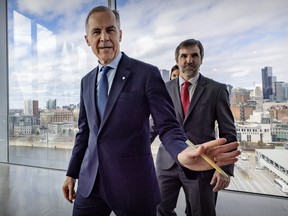
There is nothing as absurd as claims by former environment minister Steven Guilbeault and other green ideologues that Prime Minister Mark Carney has made it impossible to meet Canada’s greenhouse gas emission targets because of his energy policies.
Advertisement 2

THIS CONTENT IS RESERVED FOR SUBSCRIBERS ONLY
Subscribe now to read the latest news in your city and across Canada.
- Unlimited online access to articles from across Canada with one account.
- Get exclusive access to the Toronto Sun ePaper, an electronic replica of the print edition that you can share, download and comment on.
- Enjoy insights and behind-the-scenes analysis from our award-winning journalists.
- Support local journalists and the next generation of journalists.
- Daily puzzles including the New York Times Crossword.
SUBSCRIBE TO UNLOCK MORE ARTICLES
Subscribe now to read the latest news in your city and across Canada.
- Unlimited online access to articles from across Canada with one account.
- Get exclusive access to the Toronto Sun ePaper, an electronic replica of the print edition that you can share, download and comment on.
- Enjoy insights and behind-the-scenes analysis from our award-winning journalists.
- Support local journalists and the next generation of journalists.
- Daily puzzles including the New York Times Crossword.
REGISTER / SIGN IN TO UNLOCK MORE ARTICLES
Create an account or sign in to continue with your reading experience.
- Access articles from across Canada with one account.
- Share your thoughts and join the conversation in the comments.
- Enjoy additional articles per month.
- Get email updates from your favourite authors.
THIS ARTICLE IS FREE TO READ REGISTER TO UNLOCK.
Create an account or sign in to continue with your reading experience.
- Access articles from across Canada with one account
- Share your thoughts and join the conversation in the comments
- Enjoy additional articles per month
- Get email updates from your favourite authors
Article content
It’s absurd because Canada was never going to meet the targets under former prime minister Justin Trudeau’s government.
Article content
Article content
It’s true that under Carney, meeting Canada’s 2026, 2030, 2035 and 2050 targets is now an even more distant memory than it was under Trudeau – the same outcome as previous emission targets set by every federal government, Liberal or Conservative, since 1988.
That said, Carney’s energy policies so far have been more realistic than Trudeau’s, which is somewhat surprising given Carney’s previous life as the world’s leading corporate shill for higher carbon taxes.

New bitumen pipeline from Alberta to B.C. will increase emissions
True, the deal Carney signed Friday with Premier Danielle Smith on a new bitumen pipeline from Alberta to B.C., which will lower the federal industrial carbon price and extend the deadlines for implementing it, may fall apart for a dozen reasons.
And yes, it will increase emissions.
So will Carney delaying the emission targets under his national electricity strategy, which includes the use of natural gas – a fossil fuel – released Thursday.
By signing up you consent to receive the above newsletter from Postmedia Network Inc.
Article content
Advertisement 3
Article content
Ditto Carney’s cancellation of the consumer carbon tax, the oil and gas emissions cap, EV mandates and his promised fast-tracking of major infrastructure projects.
But that doesn’t change the fact that claims by Guilbeault, when he was Trudeau’s environment minister, that the Trudeau government was on track to meet its emission targets were fantasies.
In December 2023, Guilbeault said the Trudeau government was “projected to exceed Canada’s interim objective of (reducing emissions to) 20% below 2005 levels by 2026” while remaining “firmly on track to meet our ambitious but achievable 2030 target” of 40% below.
In fact, exceeding the 2026 target would have required the Trudeau government, if it was still in power, to shut down the equivalent of Canada’s heavy industry sector by the end of this year.
To meet the 2030 target (40% below 2005) would have required the Trudeau government to shut down the equivalent of Canada’s entire oil and gas sector in four years.
Advertisement 4
Article content
Read More
-

GOLDSTEIN: Mark Carney must kill Justin Trudeau’s anti-growth agenda
-

GOLDSTEIN: Canada’s big bet on electric vehicles goes bust
-

GOLDSTEIN: Climate hysteria wasted our money, failed to reduce need for fossil fuels


Trudeau’s emission targets purely aspirational
Trudeau’s emission targets were purely aspirational.
Their real purpose as the lynch-pin of Trudeau’s program for fighting climate change was to expand the reach and power of the federal government, redistribute income and interfere in the marketplace by picking private sector winners and losers.
The cost to federal taxpayers, as of April 2023 in a statement by Guilbault, was more than $200 billion, with 13 government agencies administering 149 programs.
Add in provincial and territorial spending estimated at $303 billion for 364 programs (excluding municipal ones) and the total taxpayer-funded cost comes to over $500 billion or $12,000 per Canadian.
Thomas Sowell described in his 1995 book, The Vision of the Anointed – Self Congratulation as a Basis for Social Policy, how interventionist governments repeatedly create massive and costly programs, regardless of whether they will work, ostensibly to address society’s ills, but really to extend the reach and power of government.
Advertisement 5
Article content
Written 20 years before Trudeau became PM in 2015, see if it reminds you of Trudeau’s approach to addressing climate change.
First, Sowell wrote, there are “assertions of a great danger to the whole of society, a danger to which the masses of people are oblivious.”
Second, the government asserts there is “an urgent need for action to avert impending catastrophe.”
Third, the government claims “there is a need … to drastically curtail the dangerous behaviour of the many, in response to the prescient conclusions of the few.”
Fourth, is a “disdainful dismissal of arguments to the contrary as either uninformed, irresponsible or motivated by unworthy purposes.”
This is how the Trudeau government convinced the Canadian public for a decade of their moral responsibility to address climate change by spending hundreds of billions of their tax dollars on programs that not only failed to achieve the government’s stated goals, but that everyone who could add using the government’s own data knew were failing, year after year, while they were being imposed.
Advertisement 6
Article content
RECOMMENDED VIDEO

We apologize, but this video has failed to load.
Canada’s emissions too small to globally impact climate change
Even if they had succeeded, they would have failed because Canada’s emissions are too small to globally impact climate change.
Sowell noted the anointed’s response to these failures is to argue things would have been worse if they had not acted.
This is exactly what the Trudeau government did by blaming the previous Stephen Harper government for failing to meet its emission targets – ignoring the fact that the previous Jean Chretien and Brian Mulroney governments also failed to meet their targets.
Now, even Carney has acknowledged that Trudeau’s climate change strategy would have failed to meet the government’s 2030 and 2035 emission targets because, he said, its response was “too much regulation (and) not enough action” with a lot of talk “and then nothing happens.”
The question now, of course, is whether Carney’s new strategy will succeed where Trudeau failed.
Article content























/https%3A%2F%2Fsportsmole-media-prod.s3.gra.io.cloud.ovh.net%2Fuploads%2F2026%2F05%2Fchamp-69fa166311171530187348.jpg)
 Bengali (BD) ·
  English (US) ·