.png)
 1 hour ago
8
1 hour ago
8
Article content
Many Canadians are familiar with the United Nations Declaration on the Rights of Indigenous Peoples (UNDRIP), due to media coverage of both the content of the declaration, legislation passed by Ottawa and Victoria, along with court cases declaring it positive Canadian law. What many may not understand is that UNDRIP has been the “holy grail” of the activist Aboriginal movement in Canada, and particularly in British Columbia, for many years.

THIS CONTENT IS RESERVED FOR SUBSCRIBERS
Enjoy the latest local, national and international news.
- Exclusive articles by Conrad Black, Barbara Kay and others. Plus, special edition NP Platformed and First Reading newsletters and virtual events.
- Unlimited online access to National Post.
- National Post ePaper, an electronic replica of the print edition to view on any device, share and comment on.
- Daily puzzles including the New York Times Crossword.
- Support local journalism.
SUBSCRIBE FOR MORE ARTICLES
Enjoy the latest local, national and international news.
- Exclusive articles by Conrad Black, Barbara Kay and others. Plus, special edition NP Platformed and First Reading newsletters and virtual events.
- Unlimited online access to National Post.
- National Post ePaper, an electronic replica of the print edition to view on any device, share and comment on.
- Daily puzzles including the New York Times Crossword.
- Support local journalism.
REGISTER / SIGN IN TO UNLOCK MORE ARTICLES
Create an account or sign in to continue with your reading experience.
- Access articles from across Canada with one account.
- Share your thoughts and join the conversation in the comments.
- Enjoy additional articles per month.
- Get email updates from your favourite authors.
THIS ARTICLE IS FREE TO READ REGISTER TO UNLOCK.
Create an account or sign in to continue with your reading experience.
- Access articles from across Canada with one account
- Share your thoughts and join the conversation in the comments
- Enjoy additional articles per month
- Get email updates from your favourite authors
Sign In or Create an Account
or
Article content
Article content
Once only considered a non legally binding UN document, UNDRIP rose to prominence when the Truth and Reconciliation Commission called on all levels of government to “fully adopt and implement (it) as the framework for reconciliation.”
Article content
Article content
By signing up you consent to receive the above newsletter from Postmedia Network Inc.
Article content
Never mind that Canada had already baked Indigenous rights into the Constitution Act, 1982, with the additions of sections 25 and 35. Those rights have been defined over subsequent years not by Canadians or Canadian governments, but by the Supreme Court of Canada.
Article content
A primary example arose in 1997, when the court used Sec. 35 — which recognizes and affirms the “existing Aboriginal and treaty rights of the Aboriginal peoples of Canada” — to justify the legal concept of “Aboriginal title.”
Article content
We have recently witnessed in the Cowichan decision involving private lands in Richmond, B.C., where Aboriginal title was found by a B.C. court to be a “superior” interest in land to fee simple land. The vehement response to the Cowichan decision by private landowners demonstrates clearly how well that judicial invention is now working out in furthering “reconciliation.”
Article content
Article content
UNDRIP, of course, is not Sec. 35. It is a far more challenging set of legal assumptions, and arguably far broader in scope and reach than even the concepts that the Supreme Court has defined to be constitutional law under Sec. 35.
Article content
Article content
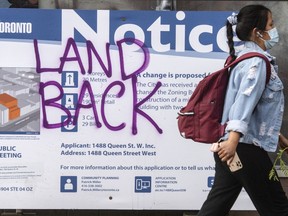
In fact, UNDRIP goes far beyond Sec. 35 in what it demands sovereign states accept as being the “rights” of Indigenous peoples, and those expansive definitions have become one of the driving forces behind the modern “land back” movement, particularly in British Columbia.
Article content
It is a concept that the present B.C. government’s adoption of UNDRIP has brought to the forefront of provincial political discourse, largely due to Premier David Eby’s obvious interest in forging agreements to convert vast areas of Crown lands into Aboriginal title lands.
Article content
What the adoption of UNDRIP has led to in British Columbia are two highly controversial and constitutionally questionable assumptions about the rights of Indigenous peoples.
Article content
First, following Article 26 of UNDRIP, which deals with the rights of Indigenous peoples to their traditional territories, is the supposed conclusion that any Aboriginal community that claims a territory — no matter how large or doubtful the claim — has ownership rights over those lands and all the natural resources on them.


























/https%3A%2F%2Fsportsmole-media-prod.s3.gra.io.cloud.ovh.net%2Fuploads%2F2026%2F09%2Ficonsport-373637-0018-6a9e6d20a27e0398293470.jpg)
 Bengali (BD) ·
  English (US) ·