.png)
 6 hours ago
14
Article content
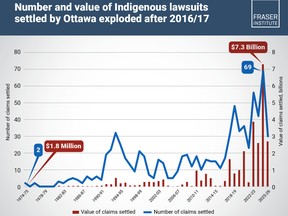
A new report from the Fraser Institute calculates that the federal government has paid out more than $110 billion to First Nations for lawsuit and class action settlements since 1974, with the vast majority of that amount coming from recent class action lawsuits.

THIS CONTENT IS RESERVED FOR SUBSCRIBERS
Enjoy the latest local, national and international news.
- Exclusive articles by Conrad Black, Barbara Kay and others. Plus, special edition NP Platformed and First Reading newsletters and virtual events.
- Unlimited online access to National Post.
- National Post ePaper, an electronic replica of the print edition to view on any device, share and comment on.
- Daily puzzles including the New York Times Crossword.
- Support local journalism.
SUBSCRIBE FOR MORE ARTICLES
Enjoy the latest local, national and international news.
- Exclusive articles by Conrad Black, Barbara Kay and others. Plus, special edition NP Platformed and First Reading newsletters and virtual events.
- Unlimited online access to National Post.
- National Post ePaper, an electronic replica of the print edition to view on any device, share and comment on.
- Daily puzzles including the New York Times Crossword.
- Support local journalism.
REGISTER / SIGN IN TO UNLOCK MORE ARTICLES
Create an account or sign in to continue with your reading experience.
- Access articles from across Canada with one account.
- Share your thoughts and join the conversation in the comments.
- Enjoy additional articles per month.
- Get email updates from your favourite authors.
THIS ARTICLE IS FREE TO READ REGISTER TO UNLOCK.
Create an account or sign in to continue with your reading experience.
- Access articles from across Canada with one account
- Share your thoughts and join the conversation in the comments
- Enjoy additional articles per month
- Get email updates from your favourite authors
Sign In or Create an Account
or
Article content
Class action payments since 2007 have cost the government an estimated $83.2 billion, the report found. That’s 73.5 per cent of all payouts since 1974.
Article content
Article content
Advertisement 1
Article content
This is outside of what Canada already spends on Indigenous issues. Last year, the budget included $25.3 billion for the Department of Indigenous Services, and $16.5 billion for the Department of Crown-Indigenous Relations and Northern Affairs. That was more than the country spent on its defence budget of $33.9 billion.
Article content
By signing up you consent to receive the above newsletter from Postmedia Network Inc.
Article content
The report, Compensation for Past Treatment of Indigenous People, focuses on federal Indigenous spending based on rectifying past grievances and offering compensation through treaty negotiations, lawsuits and settlements, with an emphasis on British Columbia. It was released this month.
Article content
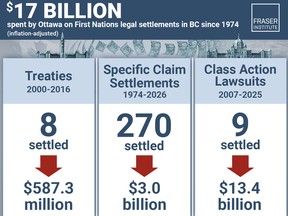
In B.C. alone, treaty settlements from 2000 to 2016 amounted to $587 million in payouts, and specific claims settlements, of which there were 270, came to $3 billion. But a small number of class action lawsuits settled between 2007 and 2025 added a further $13.4 billion to the total.
Article content
Article content
Numbers from the rest of Canada tell a similar story. In the past 52 years, the federal government has given an estimated $113.2 billion (adjusted for inflation) to First Nations in Canada as payouts for lawsuits and class action settlements.
Article content
Advertisement 2
Article content
“Most Canadians are not aware of the enormous payments Ottawa has made to First Nations to settle legal claims and class action lawsuits,” said Tom Flanagan, Fraser Institute senior fellow and co-author of the report.
Article content
Article content
Of this, some $29.4 billion or about a quarter of the total amount was to settle specific claims — essentially cases where a court ruled the federal government had violated treaty rights or the Indian Act in the past.
Article content
There has been a distinct increase in the number and value of those claims settlements by Canada for violations of the Indian Act or of historic treaties, the report found.
Article content
The Indian Act, first introduced in 1876, is the primary law the federal government uses to deal with First Nations governments and the management of reserve land. It also outlines governmental obligations to First Nations peoples.
Article content
Manitoba Premier Wab Kinew this week called on the federal government to abolish the Act, showing his status car to reporters in Ottawa. Kinew is Anishinaabe from Onigaming First Nation in Ontario.
Article content
“I don’t know how many folks in Canada have seen one of these before, but this is a status card, and it says your friend Wab Kinew is an Indian, within the meaning of the Indian Act,” he said. “I’m not sure if that lines up with your vision of Canada, that we still have a race-based form of identification in this country. But this is a reality.”


























 Bengali (BD) ·
 English (US) ·