.png)
 1 hour ago
2
1 hour ago
2
Article content
OTTAWA AND PENTICTON, B.C. — As the moon circles Earth, its gravitational pull moves the oceans back and forth, creating the cycle of high and low tides.

THIS CONTENT IS RESERVED FOR SUBSCRIBERS
Enjoy the latest local, national and international news.
- Exclusive articles by Conrad Black, Barbara Kay and others. Plus, special edition NP Platformed and First Reading newsletters and virtual events.
- Unlimited online access to National Post.
- National Post ePaper, an electronic replica of the print edition to view on any device, share and comment on.
- Daily puzzles including the New York Times Crossword.
- Support local journalism.
SUBSCRIBE FOR MORE ARTICLES
Enjoy the latest local, national and international news.
- Exclusive articles by Conrad Black, Barbara Kay and others. Plus, special edition NP Platformed and First Reading newsletters and virtual events.
- Unlimited online access to National Post.
- National Post ePaper, an electronic replica of the print edition to view on any device, share and comment on.
- Daily puzzles including the New York Times Crossword.
- Support local journalism.
REGISTER / SIGN IN TO UNLOCK MORE ARTICLES
Create an account or sign in to continue with your reading experience.
- Access articles from across Canada with one account.
- Share your thoughts and join the conversation in the comments.
- Enjoy additional articles per month.
- Get email updates from your favourite authors.
THIS ARTICLE IS FREE TO READ REGISTER TO UNLOCK.
Create an account or sign in to continue with your reading experience.
- Access articles from across Canada with one account
- Share your thoughts and join the conversation in the comments
- Enjoy additional articles per month
- Get email updates from your favourite authors
Sign In or Create an Account
or
Article content
A similar law of physics applies to Canadian politics.
Article content
Article content
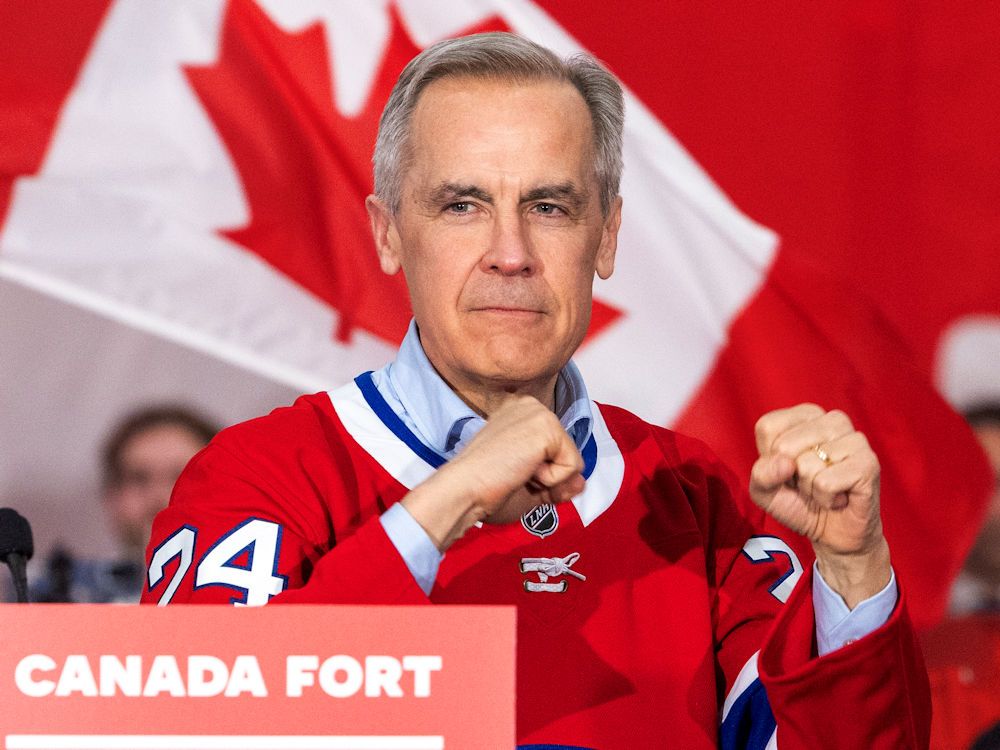
As U.S. President Donald Trump spins himself in and out of the news cycle, Liberal party poll numbers move up and down in accordance with the president’s shifting gravitational force. The latest breakdown of trade talks in late August, and the barrage of insults from Washington that followed, predictably delivered another “Trump bump” for Prime Minister Mark Carney who has positioned himself, and is widely perceived as, Canada’s most reliable defender.
Article content
Article content
That same cycle has been savage for Conservatives, who gathered as a caucus in B.C.’s Okanagan region this week, and are once again relegated to the sidelines while forces outside the party’s control manage its fate.
Article content
Article content
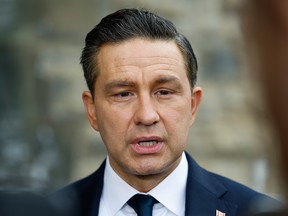
In a sign that people inside the party may be moving through the stages of grief since losing the 2025 election, Conservative MPs seemed more willing to acknowledge the steep hill they must climb, with their party and their leader trailing Carney and the Liberals by significant spreads.
Article content
“The popularity of Mark Carney is what it is,” said Bob Zimmer, who represents the northern B.C. riding of Prince George–Peace River–Northern Rockies, outside the party’s caucus retreat in Penticton, B.C.
Article content
Conservatives popularity is now in the low 30 per cents, according to polling aggregators. Having dipped below the psychologically important 30-point mark in a few single polls this year, even the Tory leadership has to admit that things don’t look rosy for the Conservative party these days.
Article content
“This is not the position we want to be in at this juncture,” said Conservative deputy leader Melissa Lantsman, to reporters gathered at the caucus meeting.
Article content
Article content
Most Conservative strategists say that in the current environment, with Carney’s stature and popularity booming and Trump’s belligerence giving the prime minister a new boost every few months, it’s unlikely that the party will be able to close the gap with the Liberals anytime soon.
Article content
Article content
Trump is scheduled to depart the Oval Office in January 2029, which many Tories will have circled in their calendars. But that means the party is looking down the barrel of a gruelling couple of years. The party’s braintrust either needs to reverse Carney’s advantage on the trade war or grind out the rest of Trump’s term when it, hopefully, goes away.
Article content
“Hanging on for two years and hoping things get better, that’s not easy, right?” said Dan Robertson, a former chief strategist for the Conservative party. “You’re basically conceding that your strategy is just hope. And that’s a pretty poor basis for a strategy.”
Article content
Even the most optimistic Conservative strategists don’t see a clear path to any big gains for the party soon. Carney is simply too popular right now. And, despite the prayers of Tories across the country, the conflict with Trump hasn’t become any less salient in Canada since the April 2025 election, when Liberals successfully sold their leader as the best man to fight it.
Advertisement 1
Advertisement 2
Article content
___
Article content
The political backdrop of British Columbia is an ominous one for a Conservative party caucus retreat.
Article content
The province has become a cautionary tale. After narrowly losing the 2024 provincial election to the incumbent NDP, the B.C. Conservatives fired their leader. The new one, Kerry-Lynne Findlay, is just over four months into her tenure and has already seen 12 of her MLAs resign from her caucus as a result of a fierce internal battle. There are echoes of skirmishes within the federal party.
Article content
Leader Pierre Poilievre even waded into B.C. politics earlier this year, congratulating Findlay for defeating the “Liberal lobbyists from out east” who he said ran her opponent’s campaign. It was widely interpreted as a shot at Kory Teneycke, who previously organized Ontario Premier Doug Ford’s three successful provincial campaigns and had become a fierce critic of Poilievre during the federal election. (Teneycke helped run the campaign of a rival to Findlay, but so had many Poilievre loyalists.) The remarks set off a flurry of unhelpful headlines about party infighting and frustrated Conservatives, who saw them as a distraction and a needless reopening of old wounds.
Article content
Article content
Other moves by Poilievre in recent months have also landed poorly. The public response was not kind to his October 2025 attack against the RCMP, calling the Mounties’ leadership “despicable” for what he claimed were cover ups of former prime minister Justin Trudeau’s scandals.
Article content
And there was his attack on the government in May over early reports that the economy had slipped into a “technical recession” after Statistics Canada reported a slight decline in the first quarter, following a previous decline. Poilievre called for an emergency debate in Parliament over the “full-blown recession,” as headlines focused on economists urging caution about the recession definition and the data’s accuracy. Later revisions by Statistics Canada showed it turned out to not be a recession, by any definition.
Article content
I don’t think we should chase shiny objects in Parliament and think that we can land short-term, quick wins on corruption and ‘gotchas’ on the economy
Article content
To Ginny Roth, a longtime political strategist who was Poilievre’s director of communications for his successful leadership run in 2022, it looked like the party not seeing the forest for the trees. Rather than a quick “gotcha” attack, the Opposition could have made a substantial case about the economy’s lack of growth over the last decade.
Article content
Article content
“The reason it’s unclear whether it was a technical recession or not is because we’ve been in this secular stagnation for years and will continue to be, which is obviously a much more compelling and bigger point to make,” she said.
Article content
Instead, the Conservatives were forced to wear an unforced error, being technically wrong by declaring a technical recession too hastily.
Article content
“I don’t think we should chase shiny objects in Parliament and think that we can land short-term, quick wins on corruption and ‘gotchas’ on the economy,” said Roth. In this unforgiving political environment, she thinks, the smartest approach is to stop reading snapshot polling and focus on the medium- and long-term future. Instead of getting into the weeds of technical recessions, she said, keep reminding Canadians that on cost-of-living, the government is failing Canadians.
Article content
But the party would have to get comfortable with the reality that the argument might not land today, or even a year from today. She admits that it will be difficult “from a caucus management perspective because it can feel ungratifying when you don’t score that quick win.”
Article content
Poilievre has waged this kind of disciplined campaign before, when he targeted the carbon tax with a dogged effectiveness. Even as conservative-sympathetic voices urged him to move on, he would not relent until a majority of Canadians shared his view — and the Carney government eventually did, too, cancelling the consumer tax last year.
Article content
“It requires a great deal of discipline. It will be very challenging. There could be tough moments,” said Roth. “But I think it still would be foolish to try to play Whac-A-Mole on the short-term wins.”
Article content
Coming out of the caucus meeting in B.C. this week, there are some indications that Poilievre is thinking the same way.
Article content
Even among his supporters in the party, the leader is not known as someone who will easily change course once he’s determined a path. But he has in recent days shown signs that he plans to make tweaks in his approach and messaging.
Article content
After frequent criticisms that he’s too quick to take easy political shots at the prime minister and government, Poilievre has lately been projecting something more statesmanlike, including his comment last week in New York that he wouldn’t criticize his government while on foreign soil. The Conservative leader told CNBC that Canadians were feeling “wounded” by U.S. tariffs and urging cooler heads to prevail. But, he said, “I’m not going to attack my prime minister on foreign soil. It’s just not something I’m going to do.”
Article content
Article content
He referred to that during a speech Wednesday to his caucus, saying that some U.S. media were “befuddled” that he wouldn’t criticize his opponents.
Article content
Poilievre has also emphasized in recent days that he would like the Liberal government to succeed in its trade war with Trump, despite what that would mean for his own aspirations.
Article content
“Our duty is country before party,” he told Conservative MPs.
Article content

Article content
The comments stood out for their willingness to disown a noisy, very online faction of conservative-minded Canadians who have taken Trump’s side against Carney. That has created a more complicated calculus for Poilievre, given a recent poll by the Angus Reid Institute found that 33 per cent of Conservative voters have a favourable view of the U.S. president, while 59 per cent of them have an unfavourable view. (By comparison, 95 per cent of Liberals disapprove of Trump, along with 92 per cent of NDP voters and 94 per cent of Bloc Québécois voters, making a fighting posture far more comfortable for those parties.)
Article content
Poilievre was criticized during last year’s federal election campaign for not being clear enough in condemning Trump and his attacks on Canada. But that looks to be changing, too. In his speech on Wednesday, the Conservative leader referred to Trump’s “trolling,” knowing full well that some of his caucus members and party supporters are Trump fans.
Article content
Article content
___
Article content
Patience and focusing on the long term is an easy strategy to recommend when there doesn’t seem to be any other one on offer.
Article content
But it’s not easy imagine it being carried out by a caucus this restless. The gathering in Penticton this week was an assembly of thoroughly grumpy MPs.
Article content
Two former high-ranking staffers confirmed that the mood is as bad as they can remember it in the party. People are depressed and, even a year-and-a-half after the election, they are still grieving a loss that they feel was unfairly imposed on them by outside forces.
Article content
Since then, Carney has successfully lured four MPs to join his caucus, and won six of seven byelections this year (the exception being Poilievre winning back a seat in Parliament in Battle River–Crowfoot last year, where the Liberals did not run). Conservatives have averaged just 24.6 per cent support across all seven byelections (that includes Poilievre’s 80 per cent victory), a shadow of the 41 per cent support they earned in last year’s election.
Article content
When Carney speaks to reporters lately, he almost never mentions Poilievre or the Conservative party by name. It’s a tactic that more than one senior Conservative said (with at least one adding some reluctant admiration) is driving Conservatives mad. Since Carney became Liberal leader, he has tried to convince Canadians his real opposition is the Trump administration, not the other party in the House of Commons, because the Trump contrast is the one that has propelled him to historic highs in the polls.
Article content
But that has also blunted Poilievre’s best political skill, which is hand-to-hand combat, and it has only fuelled the party’s feeling of irrelevancy.
Article content
The longer-term strategy also doesn’t reckon with the fact that most Conservative MPs fully expect Carney to go to the polls before Trump leaves the scene, although not even Liberals are sure about that. If they’re right, it means the slow-burn approach could still be unhurriedly sputtering along by the time the next election happens.
Article content
“Every available piece of public polling shows us that we’re getting absolutely obliterated if there’s an election anytime soon,” said a senior Conservative source.
Article content
Conservative members of Parliament, whose jobs are on the line if the party takes a beating in the next election, are as aware of that as anyone else. If projections by the current polls are mapped onto election scenarios, it’s possible that more than four in 10 Conservative MPs could be out of a job as the Liberals romp to a possible 228-seat majority.
Article content
The foreboding has fuelled questions in the media about Poilievre’s leadership, although on the ground it’s hard to find anyone who genuinely thinks he is in any imminent trouble.
Article content
Article content
Even Tories who would prefer to see a new leader in place point to Poilievre’s overwhelming endorsement at the party’s convention in January — from 87 per cent of party members — and the support he stills commands.
Article content
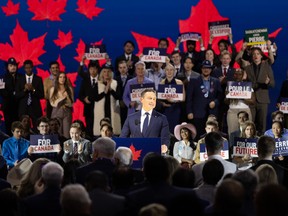
“I still don’t think Liberals and non-Conservatives and people who don’t pay attention understand just how dominant a force he has become in the national federal party,” said Ben Woodfinden, who was Poilievre’s director of communications until 2025.
Article content
Article content
At least half a dozen Conservatives made the point to National Post that if the Reform Act was used to topple the leader (as Conservative MPs had done with Erin O’Toole), Poilievre could simply run in the resulting leadership race to replace himself and win easily.
Article content
He is not seen as the kind of guy who would go quietly.
Article content
There is also a fear, now being made publicly by some longtime party operatives, that a leadership race in the Trump era would be massively damaging to the party. It would bring internal disputes about the direction of the party into the limelight and it would activate a legion of online influencers that more moderate members of the party believe have been too sympathetic to the U.S. president.
Article content
Article content
“I don’t see the value in going through a really bloody, nasty leadership race, rip each other apart, open up wounds that don’t need to be reopened up, so that we can throw somebody new in, so that he or she could get f-cking torched,” said Anthony Koch, a longtime Conservative adviser.
Article content
And the payoff with a new leader remains extremely questionable. David Coletto, who runs the polling firm Abacus Data, tried to quantify the effect of a hypothetical new leader on the national polls recently, and found that even with an ideal new leader, the Conservatives could gain all of about two percentage points from where they are now.
Article content
That would put the Conservatives 11 points behind the Liberals, rather than the current 13-point deficit per the polling average at 338Canada.
Article content
Coletto’s hypothetical also has some major caveats. It assumes a new leader with zero negative impressions among voters and it assumes that the new leader will hold all the voters that support the party because of Poilievre.
Article content
“What I take from this is that any Conservative leader, this one or the next, faces the same underlying problem: a prime minister who is liked, whose government is approved of, and who is seen as best able to handle the issues Canadians care most about right now: Trump and U.S. file,” wrote Coletto in early September.
Article content
The pollster argues that voters aren’t supporting the Liberals because they hate Poilievre, but because they are very impressed with Carney.
Article content
Canadians who are open to voting Conservative, but who won’t commit to casting a ballot for the party, actually like Poilievre. The problem for the Conservatives is that they like Carney even more.
Article content
Poilievre’s net favourability, which is the percentage of people with positive perceptions minus those with negative impressions, is plus nine. But Carney’s is plus-43.
Article content
Although most Tories don’t think Poilievre is under any immediate threat, some are looking ahead to a major test of his leadership that could change that.
Article content
I don't see the value in going through a really bloody, nasty leadership race, rip each other apart, open up wounds that don't need to be reopened up, so that we can throw somebody new in
Article content
On Friday, Conservative MP Larry Brock officially resigned from Parliament, as he promised he would several weeks ago. He won his Brantford—Brant South—Six Nations riding by 11 percentage points in the 2025 federal election. But pollsters are already warning that the Liberals have a chance to wrestle the seat away from the Conservatives in a byelection, which would be a crushing blow for a party that needs to gain and hold seats in the Greater Toronto Area and Southwestern Ontario to have any hope at forming government.
Article content
Article content
“If there is a movement to get rid of Pierre, it would probably massively intensify following a loss at Brantford. It would be driven by MPs out of just pure self interest,” said one senior Conservative.
Article content
One Conservative strategist estimated that losing Brock’s former seat in Brantford would be a sign that the party could be looking at a single-digit seat count in Ontario in a hypothetical federal election, compared to the 52 they hold in the province today.
Article content
Conservative MPs who see a threat brewing to their parliamentary salary may not be convinced by Coletto’s data that a new leader would be no saviour. Or they may accept it, yet consider a roll of the leadership dice to be as good an option as any in a desperation situation.
Article content
___
Article content
Anyone keeping track of all these possible scenarios for the Conservatives over the next two years will notice there is risk in every path that lies ahead.
Article content
Toppling Poilievre could spark an all-out civil war, or it could lead to a vengeful leader returning to regain his place at the top of the party.
Article content
Sticking with Poilievre and doing the hard work of holding the government to account could risk the party getting marginalized by the ongoing trade war with Trump. It could also demoralize the caucus and spark one of the most commonly heard fears of Tory insiders: an epidemic of “quiet quitting” among the best and brightest among them, who will begin planning for a future outside of politics rather than grinding out another decade in opposition.
Article content
Article content
And whatever happens, the Trump effect will loom large over any path the party chooses to take.
Article content
But like the ocean’s tides, Trump is a force of nature, impossible to control no matter how much a Canadian party leader might bay at the moon.
Article content
Instead, Poilievre may have to channel his experience with the carbon tax, building a case against a popular Liberal agenda and trusting that Canadians will be won over — eventually.
Article content
“As our skepticism proves to be correct, that more Crown agencies won’t drive growth, and countless other examples, Canadians will turn to the Conservatives and say, ‘Oh, you guys have kind of been saying this all along, haven’t you? Now it seems to be true’,” said Roth.
Article content
It might be a long shot requiring the perseverance and patience that seem hard to find among Conservatives today. But it could be the only shot they have.
Article content
National Post
Article content
[email protected]
[email protected]
Article content
Our website is the place for the latest breaking news, exclusive scoops, longreads and provocative commentary. Please bookmark nationalpost.com and sign up for our daily newsletter, Posted, here.
Article content




















 Bengali (BD) ·
  English (US) ·