.png)
 6 hours ago
10
Like The Godfather, Dune gives us plenty of reasons to root for a son whose rise should worry us. The sympathy we have carries us into dangerous territory in Dune: Part Two. When Timothée Chalamet delivers that thunderous speech to the Fremen fanatic warriors, he, as we know, is exploiting their faith. He once feared becoming this man. And yet, somehow we feel the pull too. It is rabble-rousing, and it works on us.
Released in US theaters on October 22, 2021, Dune turns five today. Now, Dune: Part Three is arriving later this year. It tells a story that could make its resemblance to The Godfather even more uncomfortable. Both follow sons who inherit institutions that are inherently violent. They find increasingly elaborate and destructive reasons to keep them running.
Paul Atreides’ Arc Mirrors Michael Corleone’s Moral Collapse
Al Pacino‘s Michael Corleone’s introduction in The Godfather, easily the best among the 20th-century gangster movies, gives us a reassuring point of entry into his family. He is the respectable son. He knows how the world his father inhabits works. But he is not interested, for he has a life outside it. We take his distance from the family business as evidence of his character.
Paul, much younger, gets a similarly sympathetic introduction. He is uncertain about what’s expected of him. He loves his father. Neither young man appears particularly eager or even destined to become the person the story eventually makes of him. Then their families come under attack. Suddenly, violence begins to look reasonable. Michael protects his hospitalized father when the people paid to guard him disappear. Paul survives the destruction of House Atreides and eventually learns that the Emperor helped arrange it. At that point, asking either man to trust the existing order would be absurd.
This is why their respective journeys are persuasive. We understand the first steps so well that we can be slow to question the later ones. Michael’s decision to kill Sollozzo and McCluskey has a specific purpose. By the time he orders the murders accompanying his godson’s baptism, killing is a habit for him. The family’s security can accommodate a remarkable number of corpses.
Paul’s turn has its own awful logic. He fears the war he sees in his visions and resists traveling south because he knows what awaits him there. He goes anyway. He embraces the religious authority he previously distrusted and uses it to take the throne.
Prescience complicates Paul’s responsibility, of course. Michael does not have to assess several possible futures before making a decision. But knowing the danger also makes Paul’s choice harder to excuse. He understands that the Fremen’s belief in him can become something monstrous, then draws upon that belief when he needs power.
The women watching these transformations give both stories their emotional clarity. Kay hears Michael deny his involvement in Carlo’s death, then watches his associates acknowledge him as their new Don. Chani sees Paul becoming a despot in real time.
The political arrangement makes sense. That is precisely the trouble. Paul has become someone for whom this arrangement makes sense. And while Leto’s decency matters, House Atreides was never offering Arrakis self-government. It arrived to take over an imperial assignment. Paul’s affection for the Fremen does not erase that inheritance. By the end of Part Two, their fight against occupation has helped put another emperor on the throne.
Dune: Part Three Will Put Paul’s Savior Myth on Trial
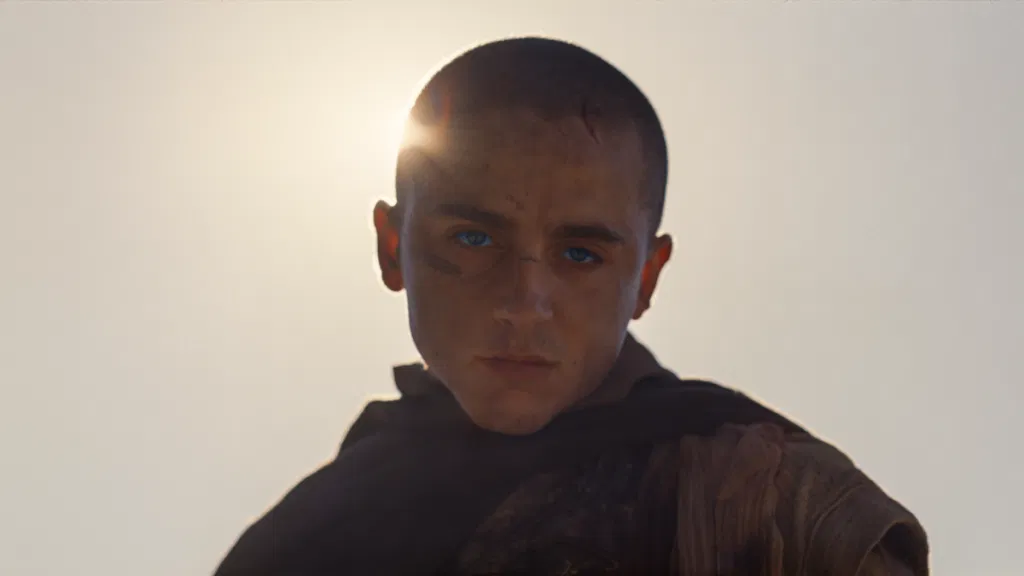 Paul Atreides, shaven and scarred, in Dune: Part Three | Credits: Warner Bros. Pictures
There is an understandable temptation to treat Paul defeating Feyd-Rautha as the moment everything comes together. The duel is thrilling. Feyd is a horrible human being, a sadistic psychopath who kills for sport.
Naturally, we want Paul to win. Villeneuve gives us that satisfaction. Chani understands that danger. The Great Houses reject Paul’s claim. He sends the Fremen to war. And the movie ends.
Based on Frank Herbert’s 1969 novel Dune Messiah, the second book in his series, Dune: Part Three will return to those consequences nearly two decades later. Its official synopsis describes Paul as a “ruthless emperor” confronting the results of his reign, which is a considerable distance from the boy receiving gentle advice on Caladan (via Warner Bros.).
The Dune: Part Three trailer already hints at that reckoning. Paul asks for forgiveness, while the returned Duncan Idaho tells him he is “way beyond redemption“. Coming from someone who died protecting him, that judgment stings. Paul has won the throne, but someone he once trusted with his life can barely recognize the man sitting on it.

The challenge is bigger than showing that Paul has become unhappy. The novel questions what happens to a society that entrusts its future to a supposedly extraordinary man. Brian Herbert’s introduction explains that his father was concerned with the damage heroes could cause when their followers’ devotion magnified their mistakes (via Penguin Random House).
You can already see the problem in Stilgar. Javier Bardem makes his faith funny, touching, and increasingly alarming, sometimes within the same scene. Paul denies being the messiah. Stilgar finds the denial wonderfully messianic. What could Paul possibly say that would persuade him otherwise?
That leaves Paul with followers whose loyalty offers very little resistance to his judgment. It also leaves the Fremen vulnerable to having their own ambitions swallowed by his. They wanted freedom from the Harkonnens. How much say will they have in the empire their sacrifices helped create?
Paul’s regret may be moving, but the people living under his rule deserve more than a scene establishing that their emperor feels terrible. That is where Dune can become a worthy companion to The Godfather. Michael’s success leaves him surrounded by the evidence of what he has destroyed. Paul has gained an empire large enough to make the damage much harder to see from the throne.
Do you think Paul’s rise makes him the sci-fi equivalent of Michael Corleone? Let us know in the comments.


















 Bengali (BD) ·
 English (US) ·