.png)
 1 hour ago
6
Article content
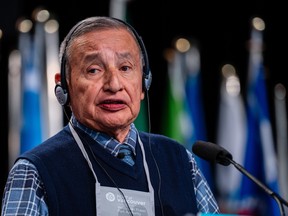
As the incoming B.C. Conservative government prepares to deliver on its promise to repeal the Declaration on the Rights of Indigenous Peoples Act (DRIPA), Grand Chief Stewart Phillip, president of the Union of B.C. Indian Chiefs, stated this week that doing so would be a “declaration of war.”

THIS CONTENT IS RESERVED FOR SUBSCRIBERS
Enjoy the latest local, national and international news.
- Exclusive articles by Conrad Black, Barbara Kay and others. Plus, special edition NP Platformed and First Reading newsletters and virtual events.
- Unlimited online access to National Post.
- National Post ePaper, an electronic replica of the print edition to view on any device, share and comment on.
- Daily puzzles including the New York Times Crossword.
- Support local journalism.
SUBSCRIBE FOR MORE ARTICLES
Enjoy the latest local, national and international news.
- Exclusive articles by Conrad Black, Barbara Kay and others. Plus, special edition NP Platformed and First Reading newsletters and virtual events.
- Unlimited online access to National Post.
- National Post ePaper, an electronic replica of the print edition to view on any device, share and comment on.
- Daily puzzles including the New York Times Crossword.
- Support local journalism.
REGISTER / SIGN IN TO UNLOCK MORE ARTICLES
Create an account or sign in to continue with your reading experience.
- Access articles from across Canada with one account.
- Share your thoughts and join the conversation in the comments.
- Enjoy additional articles per month.
- Get email updates from your favourite authors.
THIS ARTICLE IS FREE TO READ REGISTER TO UNLOCK.
Create an account or sign in to continue with your reading experience.
- Access articles from across Canada with one account
- Share your thoughts and join the conversation in the comments
- Enjoy additional articles per month
- Get email updates from your favourite authors
Sign In or Create an Account
or
Article content
After an election in which competing positions were openly debated and voters knew what was at stake, any talk of war is wholly unnecessary and provocative. Concerns over DRIPA did not suddenly emerge with the selection of a new government. Even outgoing premier David Eby acknowledged the serious legal uncertainty it created, proposing amending or even suspending the legislation before retreating in the face of opposition from First Nations leaders and his own caucus.
Article content
Article content
Advertisement 1
Article content
Premier-elect Lorne Doerkson was unambiguous throughout the election campaign that repealing DRIPA was a top priority, while also reaffirming that he is “completely committed to working with First Nations.”
Article content
By signing up you consent to receive the above newsletter from Postmedia Network Inc.
Article content
Phillip can oppose repeal, but suggesting that British Columbia could become a battleground over a legislative decision he opposes only serves to stifle public debate. B.C. Green Leader Emily Lowan recently reinforced this narrative by linking Conservative efforts to repeal DRIPA with anti-Indigenous racism.
Article content
Their approach fosters the mistaken impression that DRIPA is somehow necessary to protect Aboriginal rights. It isn’t. Opposition to the legislation should not be conflated with opposition to Aboriginal rights.
Article content
As Aboriginal law expert Tom Isaac recently explained on CBC’s “B.C. Today,” Aboriginal rights do not flow from the declaration. They are recognized and protected under Section 35 of the Constitution Act, 1982, regardless of whether DRIPA remains in force. Isaac has also described Canada’s legal framework as the world’s leading system for protecting Indigenous rights against unilateral government action.
Article content
Advertisement 2
Article content
Several Indigenous leaders have openly challenged the confrontational rhetoric surrounding DRIPA and questioned whether it reflects the views of their communities.
Article content
Article content
Chris Sankey, an Indigenous business leader and former elected councillor of the Lax Kw’alaams Band, addressed Phillip, B.C. Assembly of First Nations Regional Chief Terry Teegee and Heiltsuk Chief Marilyn Slett, writing: “You do not represent the vast majority of our communities.” He argued that their comments have hurt reconciliation and damaged relationships with other British Columbians.
Article content
Chawathil First Nation Chief Aaron Pete was unequivocal in his response to Phillip: “It is not a declaration of war.” He called such language “irresponsible, dangerous and not productive in the least,” adding that legislation must reflect the expectations of voters, as “that’s how democracy works.”
Article content
Former Haisla chief and now federal MP Ellis Ross, who originally voted for the legislation, later acknowledged: “I thought it was harmless, and I was wrong.” Responding to Phillip’s latest remarks, Ross called for an end to the divisive politics, warning that ordinary people are “paying the price.”




















 Bengali (BD) ·
 English (US) ·