.png)
 23 hours ago
11
23 hours ago
11
It’s always interesting to see which movie critics are going to put as “best known for” for a filmmaker who is prolific but not necessarily iconic. Although you can probably narrow down the consensus pick(s) for well-known directors like Steven Spielberg or Martin Scorsese, that’s a more difficult task for someone like documentarian Sam Pollard, who has directed or co-directed eleven feature films since 2020. For this writer, Pollard’s most memorable work is likely MLK/FBI, which makes it a shame that his latest movie, The Lorraine, will probably live in its shadow.
What is The Lorraine about?
The Lorraine explores the story and history of the Lorraine Motel in Memphis, Tennessee — a historic place which used to be a cultural refuge for the African-American community during the era of Jim Crow before becoming the site of Martin Luther King Jr.’s assassination. This place has such a rich history that it could have a multiple-episode History Channel docuseries about it, but Pollard’s documentary clocks in at under an hour and a half.
The Lorraine Review
Like much of Pollard’s work, the highlight of The Lorraine is the abundance of archive material it showcases. Pollard creates an incredible atmosphere here, immersing us in the world of Civil Rights era Memphis (for better or worse). The film throws audiences into the joys of Black excellence along with the anxieties of tumultuous times in a way that few documentarians are able to achieve.
This, of course, is largely thanks to the editing and soundtrack, which lend the movie its propulsive rhythm. The Lorraine shares the stories of some of the various guests who laid their heads to rest at the eponymous motel while visiting Memphis, which included some of the most famous singers of the era, and their music makes up much of the soundtrack. And there is no denying how infectious the energy of these tunes is.
It is this first half of the movie, exploring what the Lorraine meant to the African-American community and Memphis and beyond, that the film is its most interesting. It explores the history of the Green Book in the segregated South and how the motel’s owners, Walter and Loree Bailey, used this as an opportunity to create one of the main refuges for everyone from musicians to activists.
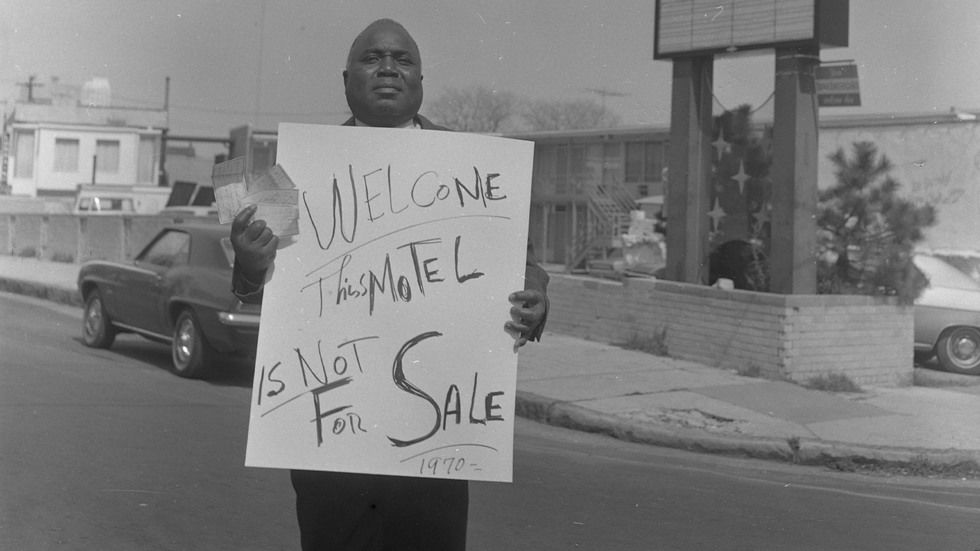
Unfortunately, this celebration is burdened by the spectre we know is looming over it: that the motel’s joyous past would soon be overshadowed by the tragedy that happened within its walls. And while there is an interesting discussion to be had here on the relationship that historical events have with the place in which they occurred, The Lorraine doesn’t quite get there. Instead, what we get is yet another exploration of this well-documented historical event. Although it does come from a slightly different perspective, it still feels like subject matter that Pollard had explored deeper and more effectively in MLK/FBI.
The fundamental flaw of Pollard’s approach to The Lorraine is that, in a documentary that is supposed to be about correcting the history books — pointing out the history of the Lorraine Motel that audiences are likely unfamiliar with — his documentary commits the same sin he criticizes. Because of its structure, The Lorraine seems destined to be “the documentary about the hotel where MLK died,” not a documentary about a revered cultural institution in the African-American community.
The other result of the movie being divided into these two almost disparate portions is a pace that feels off. In a miniseries or even a two-part documentary, it would make sense to have episodes that have different focuses and even tones to explore the different eras of this place’s history. However, in a sub-90-minute feature, the film really struggles to find the right balance between a buoyant cultural doc and a heavy historical survey.
Is The Lorraine worth watching?
That is not to say The Lorraine is without its merits — the first half of the movie, exploring an aspect of African-American history that isn’t written in the history books, is both entertaining and informative. But just because something else that happened in a place is more important to history, that doesn’t make it more important to the film’s story — particularly if you have already made another documentary that explores that same topic.
The Lorraine premiered at the 2026 Tribeca Film Festival, which runs from June 3-14, 2026.
The Lorraine Tribeca Review: Civil Rights Doc Falls Victim to Convention
The first half of The Lorraine is excellent, exploring the unwritten cultural impact of an institution overshadowed by tragedy. However, once it begins to explore that tragedy, it falls commits the same sin it criticizes.


























 Bengali (BD) ·
  English (US) ·