.png)
 13 hours ago
23
13 hours ago
23
23,000 Lives, Netflix‘s new German-language movie, is based on a gripping true story. It follows a group of young Berliners. In 2015, they watched the Mediterranean migrant crisis unfold on the news, decided they couldn’t stay on the sidelines, and bought an old fishing boat to do something about it. A 112-minute runtime is a small container to hold nine years of events, one would think. In reality, the legal battle was fought over one year following a seizure and the laying of criminal charges, more than 40 court days, and a four-year period before receiving a decision, which doesn’t often translate well into a movie script. It will be interesting to see how the film condenses this period of time.
The German movie is directed by Markus Goller. It stars Louis Hofmann (best known for playing Jonas in Dark, one of the best Netflix’s thriller shows) as Lukas. Lukas is the activist at the center of the story. Maria Dragus, Mala Emde, Katharina Stark, Franka Potente (who essayed Marie Kreutz of the Jason Bourne franchise), and Frederick Lau also star. Here’s what actually happened to the people the film is based on.
But first, a quick reference:
| Title | 23,000 Lives |
| Director | Markus Goller |
| Cast | Louis Hofmann, Maria Dragus, Mala Emde, Katharina Stark, Frederick Lau, Franka Potente |
| Premise | A group of young Berliners with no maritime experience buy an old fishing boat to rescue refugees in the Mediterranean, only to be prosecuted by Italian authorities for their efforts |
| Release Date | July 17, 2026, on Netflix |
The Real Rescue Mission Behind 23,000 Lives
-

Credits: Netflix
-

Credits: Netflix
-

Credits: Netflix


The film arrives during a packed month for streaming. It opens in Berlin in 2015, during what became known as the “summer of migration,” with a group of young people following news of thousands attempting the crossing from Libya to Europe on overcrowded rubber boats after official state rescue missions had been discontinued. None of the group had any maritime rescue experience. They launched a crowdfunding campaign anyway, raised enough money, and bought an old fishing vessel. This was a decision that became the NGO Jugend Rettet, German for “Youth Rescues,” which began its search and rescue program in the Mediterranean in 2016.
The ship at the center of the film, the Iuventa, operated in the central Mediterranean through 2016 and 2017. The crew took part in rescuing more than 23,000 people over sixteen separate missions, the number the film takes its title from (via the official website Iuventa-case.org). In other reports concerning the first years of existence of the organization, however, the number is mentioned to be lower. The crew received the Amnesty International Human Rights Prize in 2020 for rescuing 14,000 people (via DW).
That difference in the figures (23,000 versus 14,000) is telling in itself, since the official website presents its tale in an explicitly combative manner. One section header literally reads “How to get away with organized crime”. It is presumably directed at the state. This is certainly a more political approach than what you’re going to see in the promotional material for any movie studio. It’ll be interesting to see if Netflix manages to keep that spirit intact or smooth out some of its rough edges.
Why the Iuventa Crew Ended Up in Court
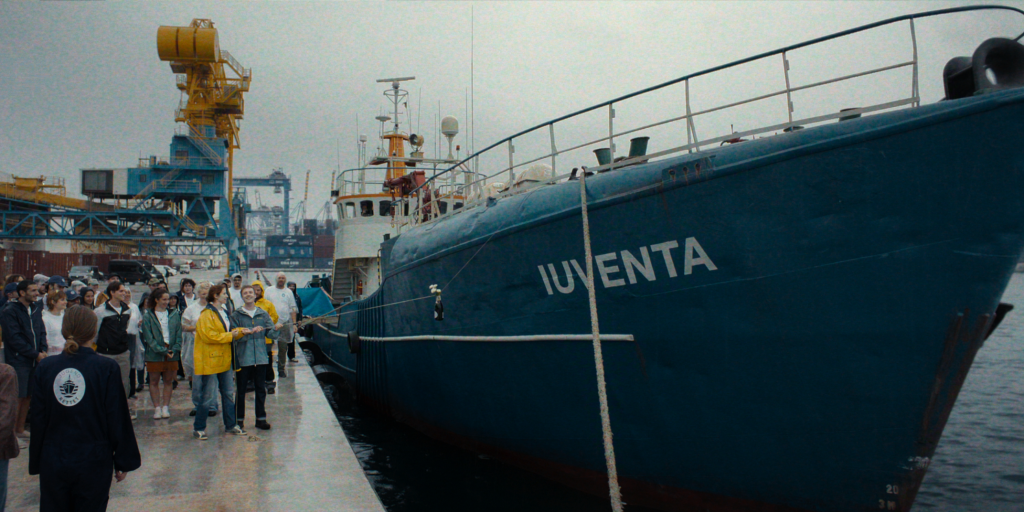 The Iuventa rescue ship as shown in 23,000 Lives | Credits: Netflix
The Iuventa ship was deliberately tricked into docking in August 2017 at Lampedusa by the Italian government and arrested on suspicion of assisting illegal immigration. In January 2021, the prosecutor’s office of Trapani issued a 30,000-page-long dossier and charged twenty-one people and three organizations, among which was Jugend Rettet, with a crime known as aggravated facilitation of illegal immigration, carrying a maximum sentence of five to twenty years. Over the three following years, more than forty days of hearings were conducted in Trapani in what human rights activists have described as one of the biggest cases ever launched against civilian sea rescuers.
On April 19, 2024, a “non luogo a procedere” (“no grounds to proceed“) verdict was issued by the judge in Trapani, putting an end to seven years of court proceedings in which the crew had been involved. Ahead of the ruling, Amnesty International’s regional researcher Elisa De Pieri had called the prosecution an injustice that needed correcting, arguing the crew members had risked their own safety to save others and should never have faced criminal charges for it (via Amnesty International). By that time, the Iuventa itself had been impounded for several years in the port of Trapani. If done right, it could prove that movies based on true stories don’t have to sacrifice nuance for the sake of a tidy runtime.
Let us know in the comments what you make of the true story behind this German movie, and whether you think it will do justice to stories like the Iuventa crew’s.
23,000 Lives releases on Netflix on July 17.





























/https%3A%2F%2Fsportsmole-media-prod.s3.gra.io.cloud.ovh.net%2Fuploads%2F2026%2F07%2Fdaniel-mcgregor-huyer-zuma-press-wire-luciano-gonzalez-anadolu-abacapress-com-estadio-azteca-harry-kane-jude-bellingham-composite-6a49eb8857b70695441164.png)
 Bengali (BD) ·
  English (US) ·