.png)
 1 hour ago
5
1 hour ago
5
Article content
“I like to call my sister once a week, but I use location sharing to see if she’s home before I do,” Lymburner said. When she’s at the family cottage on Lake Huron, location sharing is just a matter of convenience. She times the arrival of her daughters with her to-do list. “I know they’re on their way and I see how close they are, so I can get their bedrooms ready or get dinner ready,” she said.
Article content
Those mundane uses show up in the research, too. The 2026 study found people regularly bypassed a conversation altogether, checking someone’s location to coordinate meetings or decide when to start dinner. Researchers also found people checked simply to “stay informed” about where someone was, usually without describing that behaviour as surveillance or mistrust.
Article content
“For me personally, it gives me this extra layer of confidence that someone’s always looking out for me
Paige Bradbury, 24
Article content
But there is a line.
Article content
“It would be a breach of trust if you have your phone out and are following their exact route along the course of events of a day,” said Adam Boothe, 39, of Edmonton, who shares his location with his wife. “Monitoring is a lot more meticulous and you’re doing it with a different purpose than just making sure someone is OK.”
Article content
Article content
Boothe remembers when even the advent of cellphones made some people uncomfortable with the idea that they could suddenly be reached anywhere.
Article content
“Now, take that to the next level,” he said, “actually being able to see specifically, without contacting you, at any moment where you are.”
Article content
Deciding when access expires
Article content
Sometimes location sharing is clearly temporary. What’s less clear is what happens when nobody turns it off.
Article content
Bradbury has shared her location with friends of friends at music festivals simply so everyone could find one another. Usually, that access ends along with the event.
Article content
But not always.
Article content
“I do have one person who I hung out with once three years ago and we’ve just had each other’s locations the entire time,” Bradbury said. “I feel like we’ve been through so much, we’ve kind of bonded after that, a weird connection.”
Article content
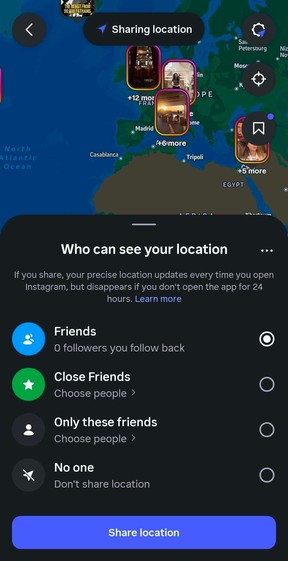
It’s a quirk of location sharing the researchers identified as “boundary passivity.” Unlike telling someone where you are once, location sharing can become a continuous stream of information that remains available until somebody actively switches it off on their mobile device. It was uncommon for participants to consider turning the faucet of information off once it was switched on. Some simply said there was “no reason to stop.”
Article content
Article content
Article content
That can make it difficult to know whether continued access is intentional. Boothe noticed a friend was still sharing her location after a conference where the pair had used it to coordinate networking.
Article content
“I messaged her to ask if she knew that she had it on,” Boothe said.
Article content
There are also times when lingering access is useful. Boothe once lent his father a car equipped with its own location-tracking app. Boothe kept getting notifications showing where his father was going, along with alerts that he’d left the doors unlocked.
Article content
“I was able to lock the doors remotely,” Boothe said.
Article content
Often best friends will share their location. So, in some social circles this is a symbol of love and trust
Suzie Dunn, Dalhousie University
Article content
The rules become considerably less ambiguous when a relationship ends.
Article content
“The etiquette very much is, you stop following that person’s location immediately,” Bradbury said. “You’re blocked and unfriended on everything. It’s one thing to forget, it’s another thing to keep it going.”
Article content
Sometimes the ability to turn location sharing off is itself an important dividing line between consensual tracking and control.
Article content
Suzie Dunn, interim director of the Law and Technology Institute at Dalhousie University, studies technology-facilitated gender-based violence. She said sharing can begin as an expression of connection and trust but take on a very different meaning in an unhealthy relationship.



























 Bengali (BD) ·
  English (US) ·