.png)
 1 day ago
14
1 day ago
14
Article content
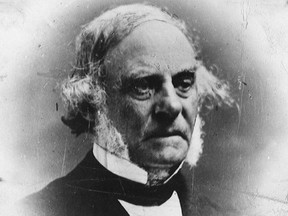
The first man is the great Sir James Douglas, born in Dutch Guyana, the son of a Scottish planter and a “free coloured woman” from Barbados. A lifelong fur trader, Douglas had just risen to the rank of chief factor at the Hudson’s Bay Company’s headquarters at Fort Vancouver on the Columbia River when the vast Columbia territory was partitioned at the 49th parallel by the Oregon Treaty of 1846. Douglas would go on to become the governor of both the colonies of Vancouver Island and British Columbia.
Article content
Article content
The other man is the U.S. Army’s Gen. William Harney, known to the Lakota Sioux as Woman Killer. Notorious for his policy of slaughtering the inhabitants of entire Indigenous villages, Harney was court-martialled four times, but he always landed back on his feet owing to his close association with the senator, slavery enthusiast and secretary of war Jefferson Davis, who would go on to serve as the president of the Confederate States in the U.S. Civil War.
Article content
In the exodus north of the 49th parallel to establish a new headquarters in Victoria on Vancouver Island, Douglas brought with him what HBC governor George Simpson described as “the prettiest congregation of nations, the nicest confusion of tongues, that has ever taken place since the days of the tower of Babel.”
Article content
Article content
While Douglas was a bear of a man with a quick temper he was a devoted follower of the British abolitionist William Wilberforce. When he was appointed Vancouver Island’s governor in 1851, the Crown Colony was already a thriving loyalist society of Orkney Islanders, Iroquois and Métis traders, Québécois voltigeurs, Hawaiian Kanakas and various “King George Indians” who had retreated ahead of the American advance across the Rockies into what is now Montana and Idaho.
Article content
It wasn’t long before Victoria’s Chinatown was the second largest on the continent after San Francisco’s, and Douglas invited a community of Black pioneers in California to make a new home under the Union Jack. During the height of the gold rush, in 1860 — in the days immediately before the American Civil War — miners arriving in Victoria harbour from San Francisco were greeted at dockside by the Victoria Pioneer Rifle Corps, an all-Black militia known as the African Rifles.
Article content
Everyone north of the 49th soon became aware of the American cavalry’s wars of extermination to the south: the Cayuse War, the Klamath War, the Salmon River War, the Yakima War, and the Nisqually War. In his genocidal zeal to clear the West of its independent tribes, Harney once told the New York Times: “I have come to kill Indians, and believe it is right and honourable to use any means under God’s heaven to kill Indians. Kill and scalp all, big and little; nits make lice.”
Article content
Article content
On Vancouver Island, the local tribes — the Songhees, the Esquimalt, the Tsartlip, Tseycum, Malahat and the rest — welcomed a military alliance with Douglas and the Crown. They didn’t have to be strong-armed into the treaties Douglas offered them, which were co-existence arrangements derived from the Crown’s Treaty of Waitangi with the Maoris in New Zealand.
Article content
It was the gold rush to the Fraser Canyon that threatened to spark an all-out war pitting Douglas and his polyglot community of loyalists, along with B.C.’s Indigenous people, against the thousands of heavily armed American miners who had flooded into the Stó:lō and Nlaka’pamux territories in 1858.
Article content
Douglas had retained his HBC duties on the mainland while serving as Vancouver Island’s governor, which left him in charge of the entire British half of the old Columbia territory. That August, in the rush to assert British sovereignty on the mainland against what would have been certain and bloody American annexation, the Colonial Office in London established the mainland Colony of British Columbia and appointed Douglas its governor.



















/https%3A%2F%2Fsportsmole-media-prod.s3.gra.io.cloud.ovh.net%2Fuploads%2F2026%2F07%2Fwc26-stencil-generic-1-player-email-6a5efced3be22784676779.jpg)
/https%3A%2F%2Fsportsmole-media-prod.s3.gra.io.cloud.ovh.net%2Fuploads%2F2026%2F04%2Fimago1075785696-69f1c41377d96073966575.jpg)
 Bengali (BD) ·
  English (US) ·