.png)
 2 hours ago
9
2 hours ago
9
Some in U.S. government circles are against the rapid rise of data centres.
Published May 09, 2026 • Last updated 22 minutes ago • 3 minute read
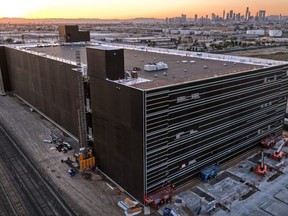
Data centres are big buildings full of machines that process what we do on our phones and computers.
Advertisement 2

THIS CONTENT IS RESERVED FOR SUBSCRIBERS ONLY
Subscribe now to read the latest news in your city and across Canada.
- Unlimited online access to articles from across Canada with one account.
- Get exclusive access to the Toronto Sun ePaper, an electronic replica of the print edition that you can share, download and comment on.
- Enjoy insights and behind-the-scenes analysis from our award-winning journalists.
- Support local journalists and the next generation of journalists.
- Daily puzzles including the New York Times Crossword.
SUBSCRIBE TO UNLOCK MORE ARTICLES
Subscribe now to read the latest news in your city and across Canada.
- Unlimited online access to articles from across Canada with one account.
- Get exclusive access to the Toronto Sun ePaper, an electronic replica of the print edition that you can share, download and comment on.
- Enjoy insights and behind-the-scenes analysis from our award-winning journalists.
- Support local journalists and the next generation of journalists.
- Daily puzzles including the New York Times Crossword.
REGISTER / SIGN IN TO UNLOCK MORE ARTICLES
Create an account or sign in to continue with your reading experience.
- Access articles from across Canada with one account.
- Share your thoughts and join the conversation in the comments.
- Enjoy additional articles per month.
- Get email updates from your favourite authors.
THIS ARTICLE IS FREE TO READ REGISTER TO UNLOCK.
Create an account or sign in to continue with your reading experience.
- Access articles from across Canada with one account
- Share your thoughts and join the conversation in the comments
- Enjoy additional articles per month
- Get email updates from your favourite authors
Article content
AI requires even more computing power, so companies are eager to build more data centres.
Article content
Recommended Videos
Article content
The usual suspects are freaking out.
“We must stop it!” says Rep. Alexandria Ocasio-Cortez.
“Slow it down!” demands Sen. Bernie Sanders.
Data centres do use lots of power, and water to cool them down because their computers generate heat. One centre can use as much power and water as a small town.
“Uses resources like a madman!” says one protester in my new video.
Last year, protesters blocked or stalled at least 48 projects.
One fired 13 bullets at an Indiana politician’s home because he supports data centres.
Now AOC and Bernie Sanders have introduced a bill that will pause new centre construction.
That’s just dumb.
“If our economy was allowed to develop at the speed of Bernie Sanders, we would be significantly worse off,” says Paige Lambermont of the Competitive Enterprise Institute.
“If we slow down, other countries are not going to. You’re going to be getting the authoritarian Chinese version of AI rather than the United States innovators’ version of AI.”
By signing up you consent to receive the above newsletter from Postmedia Network Inc.
Article content
Advertisement 3
Article content
She plays down fears about rising electricity prices.
So far, “it’s raised prices nowhere,” adds Lambermont. “Prices in Virginia are rising more slowly than some other places, even though more data centres are in Northern Virginia than anywhere else.”
The Institute for Energy Research found “no statistically significant relationship between data centre concentration and faster increases in electricity rates.”
Still, as demand for AI increases, there will be price increases. But that’s mostly because short-sighted politicians have limited our use of the most efficient fuels, like natural gas and nuclear power, favouring wind and solar power.
“If we hadn’t done that,” says Lambermont, “we probably would have between 100 and 200 gigawatts of slack capacity in the power grid already.”
Part of the problem: Government rules that say only government, or a government-approved business, may produce and sell power.
And government’s monopolies are unbelievably slow.
Advertisement 4
Article content
Microsoft now suffers from that because it struck a deal with Constellation Energy to reopen the nuclear reactor at Three Mile Island.
The renovated plant will be able to produce power next year, but our government won’t allow Microsoft to use that power until other utilities build powerlines in other states … often hundreds of miles away.
Government rules stop so much progress.
A company could avoid burdensome rules by building a plant for itself, off the grid.
Elon Musk did that, setting up gas turbines to power his supercomputer in Tennessee.
“If you’re Elon Musk, you can build your own,” notes Lambermont, “but most people can’t afford to build a gas or nuclear plant.”
Even if they could, why would they invest billions when the next politicians in power might be socialist luddites?
“No one wants to invest (billions) in something that the next presidential administration could come in and say: ‘Actually, it’s been illegal the whole time,’ ” sighs Lambermont.
Advertisement 5
Article content
Some in Congress now want to make building off-grid power easier.
“You can do new and interesting things if you’re running your own thing and making your own rules.” says Lambermont. “That’s pretty much how every major technological advance we’ve had in other areas has come about. It’s never been the government that comes up with the advancement. It’s usually private actors doing interesting things and trying to figure out what works. … (Data centres) are resource intensive, but so are most productive things we’ve done in human history.”
Usually, productive things happen only when government gets out of the way.
– Every Tuesday at JohnStossel.com, Stossel posts a new video about the battle between government and freedom. He is the author of “Government Gone Wild: Exposing the Truth Behind the Headlines.”
Read More


Article content






























 Bengali (BD) ·
  English (US) ·