.png)
 12 hours ago
6
12 hours ago
6
The warp drive technology is the core of the Star Trek universe. It is the marker for a civilization to be developed enough for space travel and for the Federation to go there. Ever since Zefram Cochrane’s 2063 flight of the Phoenix attracted Vulcan attention and triggered First Contact, warp has defined exploration, war, and diplomacy alike.
However, there have been far superior technologies made since warp drive was invented. Many of these technologies are superior and faster than regular warp drive, and dealing with them has become a task for newer Starfleet officers. Here are all the Faster Than Light technologies present in the Star Trek universe, ranked by speed.
8 Excelsior-Class Transwarp Drive
 The USS Excelsior in Star Trek VI: The Undiscovered Country | Credits: Paramount
First shown in Star Trek III: The Search for Spock, the USS Excelsior was Starfleet’s first attempt at a dedicated transwarp drive. It was meant to completely eliminate conventional warp. Unfortunately, Scotty sabotaged the ship’s transwarp computer to help Kirk steal the Enterprise.
The transwarp experiment was scrapped by the Federation, and the ship later ran on conventional warp. While it was theoretically fast, it never left the barrier of ordinary warp field efficiency in practice, making it the weakest and the only failed entry on the list.
7 Coaxial Warp Drive
 A still from Star Trek: Voyager | Credits: Paramount
Seen in Star Trek: Voyager, the coaxial warp drive folds a standard warp field back on itself to fold space, allowing a small vessel to cover vast distances faster. A shapeshifting alien named Steth used a modified shuttle equipped with this drive.
However, it was dangerously unstable and was prone to particle instabilities that nearly destroyed nearby space within a billion kilometers. Starfleet considered it purely theoretical before encountering a working model.
6 Graviton Catapult
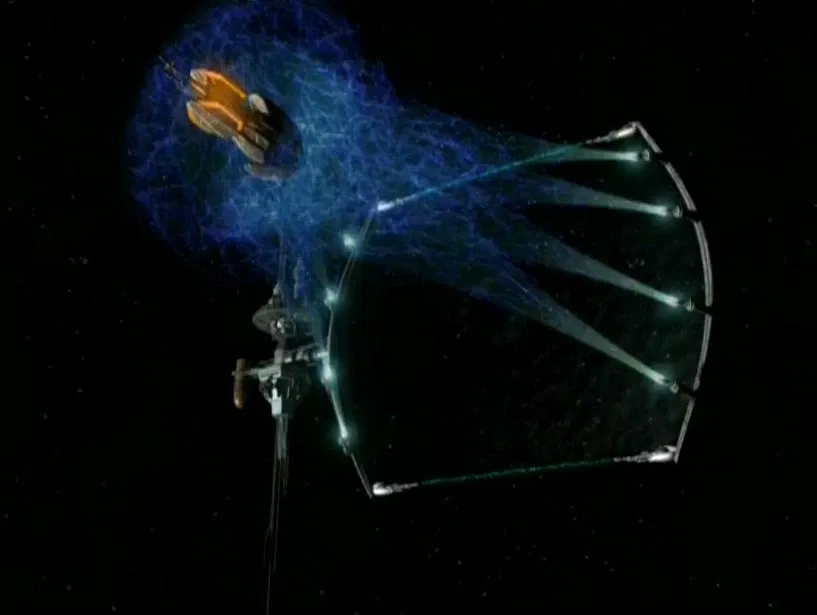 The Graviton Catapult in Star Trek: Voyager | Credits: Paramount
The Graviton Catapult was a fixed station built by a stranded alien engineer named Tash. It launched vessels through ‘null space’ using graviton pulses. The Voyager was flung roughly 600 light-years in a single use, which shaved three years off its journey home. While it is faster than conventional warp drive, the catapult has some limitations, as it is on a fixed station and is single-use.
5 Sikarian Spatial Trajector
 A spatial trajector in Star Trek: Picard | Credits: Paramount+
Having explored the Delta Quadrant, the Voyager came across many different kinds of technology, some even more advanced than their own. They encountered the Sikarians, whose trajector technology could fold space to transport people 40,000 light-years in an instant. The Sikarians’ own prime directive barred them from sharing the tech, and when Voyager’s engineers acquired one anyway, it proved incompatible with the ship’s systems and had to be destroyed.
4 Quantum Slipstream Drive
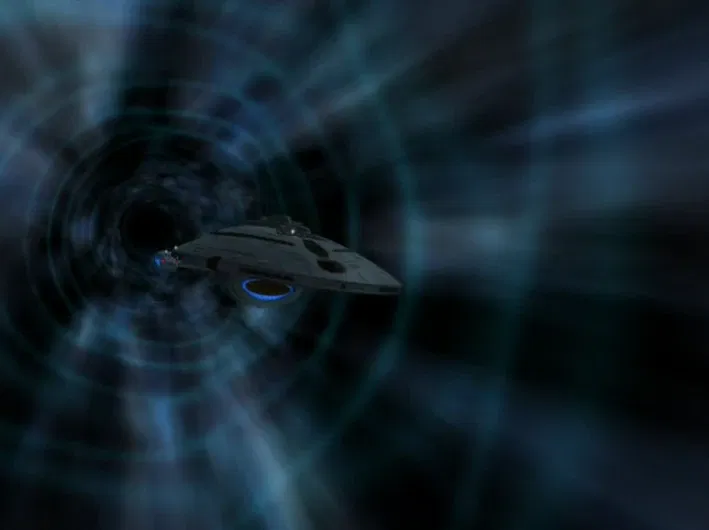 A still from Star Trek: Voyager | Credits: Paramount
The quantum slipstream drive uses a ship’s deflector to pierce a quantum barrier and ride a tunnel through subspace. A basic version let Voyager cover 10,000 light-years in a single flight, and Seven of Nine noted it functioned much like Borg transwarp. However, it was extremely unstable and nearly destroyed the Voyager. The crew shelved it, only reacquiring the completed technology from the future in the series finale.
3 Borg Transwarp
 A Borg Transwarp hub in Star Trek: Voyager | Credits: Paramount
The Borg are antagonists in Star Trek, but credit where credit is due, they have some of the best technologies. Having assimilated the technology of various civilizations, they have created some of the fastest and most dangerous drives. According to Geordi La Forge, the Borg’s signature propulsion moves ships 20 times faster than Galaxy-class ships’ maximum drive.
A stolen transwarp coil let Voyager traverse 20,000 light-years before burning out, cutting roughly fifteen years from their trip. The Borg also built stable transwarp hubs, letting the Collective cross vast stretches of the Milky Way in a matter of minutes, faster than any single coil-equipped ship could manage alone.
2 Protostar Drive
 USS Protostar in Star Trek: Prodigy | Credits: Paramount+
Star Trek: Prodigy‘s USS Protostar had an experimental Starfleet engine, which was powered by a literal miniature protostar contained within a gravity shell. A proto-jump allowed the ship to cross roughly 4,000 light-years in just minutes. The drive’s immense power made it highly in demand, but it drained enormous energy reserves and could only manage a couple of jumps before needing to recharge.
1 Spore Drive
 The Mycelial Network in Star Trek: Discovery | Credits: Paramount+
Developed by Paul Stamets, who is one of the smartest science officers in Star Trek, aboard the USS Discovery, the spore drive taps into the mycelial network, which is a web of fungal spores that connects every point in the universe simultaneously. Instead of crossing intervening space, Discovery simply vanishes and reappears anywhere in the galaxy, or even in other universes like the Mirror Universe.
Which FTL tech do you think is the fastest? Comment below.
All Star Trek shows are available to stream on Paramount+.






























 Bengali (BD) ·
  English (US) ·