.png)
 1 week ago
11
1 week ago
11
Pragmata has emerged as one of 2026’s biggest hits, quickly becoming one of the highest-rated games of this year. Among the voices bringing the game’s world to life, David Menkin’s terrific and warm portrayal of Hugh Williams stands out as one of the emotional anchors within Pragmata’s gorgeous yet terrifying sci-fi setting, and FandomWire got the opportunity to sit down for an interview with him.
In this exclusive FandomWire interview, we speak with Menkin about his career and his experience playing Hugh Williams in Pragmata. Below is our conversation discussing Pragmata, his performance as Hugh, the game’s shocking ending, his illustrious career in the industry, live-action adaptations of video game IPs, and his upcoming performance.
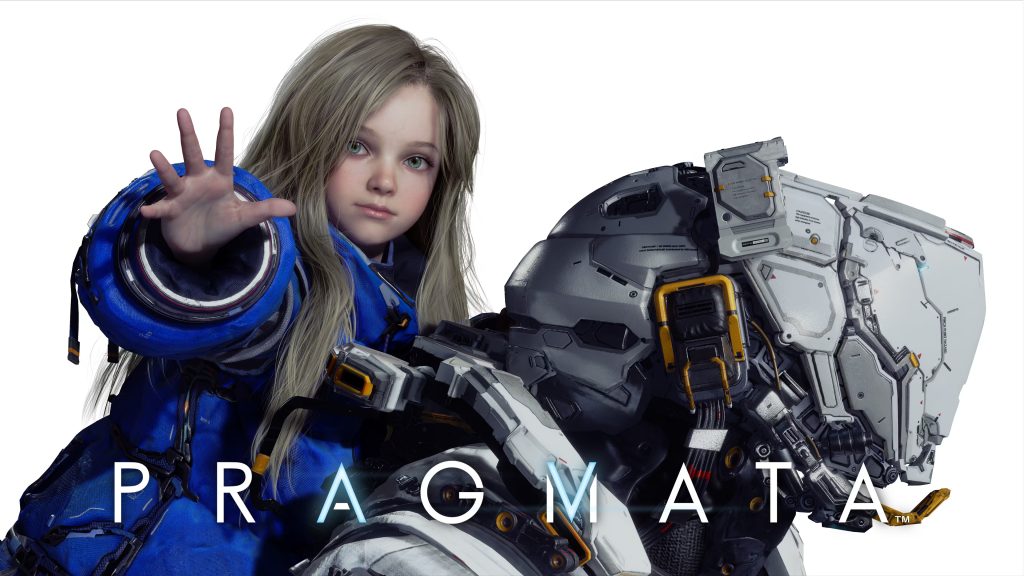 One of the highlights of this year! | Credits: Capcom
FandomWire: First of all, I would like to congratulate you on Pragmata selling over 2 million copies and becoming one of this year’s highest-rated games. That’s an incredible achievement for a brand-new IP. What has it been like being part of a completely new project that has managed to establish itself so quickly alongside Capcom’s other iconic franchises, such as Resident Evil and Street Fighter?
David Menkin: It’s amazing, because I remember being told that [Capcom] was going to do a Resident Evil reference in [Pragmata], in the New York section, and I was going, “Oh wow, we’re making references to something else within this universe.” It is very humbling, and I won’t lie, I was very nervous, because I just didn’t know if it was going to be received well or not.
I’ve been in hits before, I’ve been in games that have disappeared without a trace, and I was just desperate for people to meet Diana. That was the thing, I was like, “I don’t care about me, but if they don’t have a chance to experience Diana’s thirst for life, it would make me very sad“.
FandomWire: Diana’s story is complete with Hugh. It’s because she meets him that she goes on this journey. So, you’re a huge part of it.
David Menkin: That’s the thing, we save each other, right? There is no one without the other. But I wish everyone had the experience that I had during the read-through. Grace Saif, who plays Diana, wasn’t able to join us in person, so she went into a cafeteria, joined us, and then started saying her lines. I’ll give you the visual representation of how I went [drops to the floor in disbelief].
I’ve worked with voice for a long time, so I’ve heard adults playing children before. But when I closed my eyes, all I heard was a little girl, and then I opened my eyes, and there was this grown woman. It’s crazy!
FandomWire: You’ve been very open about your love for space and science fiction, and you’ve even played Neil Armstrong twice in your career. When you joined Pragmata, how much of Hugh’s character came from [Capcom’s] direction, and how much did your own personality and interests shape the character?
David Menkin: When you’re asked to audition for a game these days, [the studio] will send you a biography and some script. I read the first page, and it was very action-oriented. But then I got to the next page, and it was the moment on the beach, and I went, “wait, what? Oh, okay, I’m not your typical protagonist who’s going to shoot things. Pew pew pew, I’m going to save you. Jump on my back.”
Here was this opportunity to find depth, and I won’t lie, science fiction doesn’t necessarily evoke the word ‘depth’. But my favorite sci-fi works have deep emotion. It plumbs the depths of emotion, and some of them have been labeled as space operas because of it. I grew up with Star Wars, Star Trek: The Next Generation and Star Trek: The Voyager, those were my series. I read a lot of Isaac Asimov, and I’m a big sci-fi nerd.
But I’m always interested in the fact that you can be on a spaceship, far between the stars, and it’s still always about the relationships. The successful sci-fi stories that I have enjoyed talk about the fact that relationships are universal. It doesn’t matter what planet you’re from, if you’re a biped or an amorphous blob, the only way that things get done and the only reason why stories get told is because of our need to relate to others. Therefore, that is the thing I took with me when coming into the job.
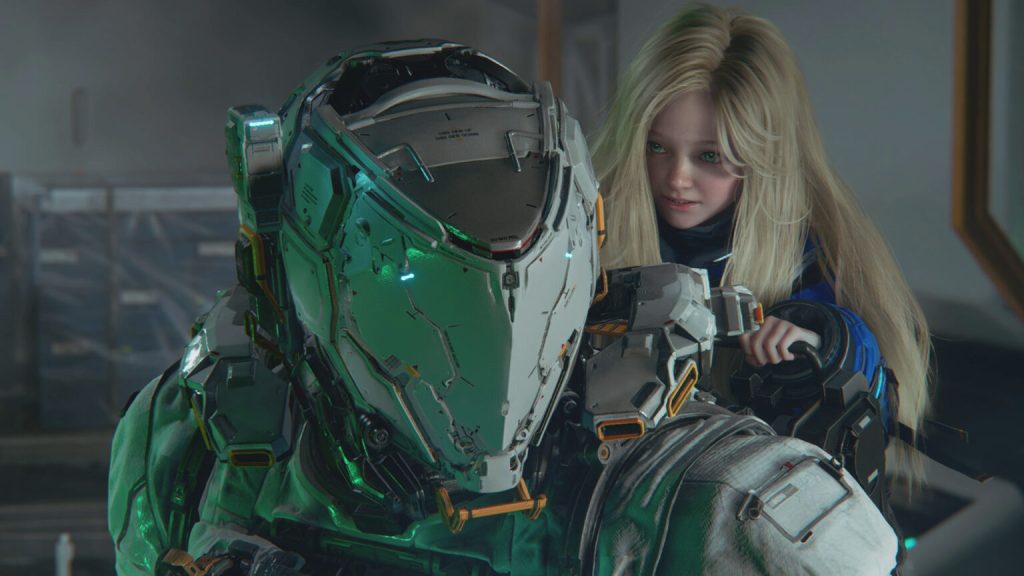 Table reads were a crucial part of developing Pragmata! | Credits: Capcom
FandomWire: You mentioned that Capcom did table reads for Pragmata, which is quite unconventional for gaming. Did that make the project feel more like a television or film work compared to the games that you’ve worked on before?
David Menkin: Before I answer, I want to make it clear that we are not trying to make games more like film and TV, because they are different art forms. But then again, one thing that I have been fighting against when it comes to video games is that performances were very often seen as post-production. So, the performances were brought in when a game was finished.
That’s useful, from a budgetary perspective, because you don’t necessarily have to spend double the amount on an actor. If you brought in an actor at the beginning of a project, then you had to make loads of changes, then bring them back again to fix it — why not just bring them in once? That’s something that my colleagues and I have been fighting against for a while because we do feel that actors can actually contribute quite a lot to the actual development and making of a game.
Therefore, there are a few things I always try to push for, one of them is a table read, and the other is to bring actors together to record, because then you can either see the whites of each other’s eyes, and you can navigate each other. But for Pragmata, it was made very clear that they needed to have us recorded separately because Diana will do very different things at certain times compared to Hugh. Therefore, you don’t want me speaking at a point that is very important for Diana, and they are so close together that it would be very difficult.
They gave me lots of really good reasons [for recording separately], and I still kicked some stones about it. [About the table read] It made me understand immediately who Diana was, through Grace’s performance, and then, it also made me understand the pace of their conversations. We were shown some footage, and what we noticed throughout was that they were expecting us to take our time, and this isn’t something you hear very often in games. You just need to get on with it because you don’t want to bore the player; they’ll just switch it off.
What they told us was that a hero needs a reason to be heroic. You need a reason to do good, a reason to do things, not necessarily just good things. So [Hugh and Diana] give each other the reason to keep going, and all of this was informed just from this one table read one morning. I left the room floating on air, because I got to listen to a team in Osaka, Japan, who were so passionate about their game. I sat there, and then they showed me some of the trailers, and I went, “I’ve seen these! I know what this game is!”
I was like, “Oh my God, do we get to go to New York?” and all this kind of stuff, and they were like, “Yeah!” That was very exciting, and games are notoriously secretive. They don’t want to let us know anything because they think that we’ll tell everybody. Actors cannot be trusted to keep their mouths shut, because we get overexcited. But I’ve learned, and I’ve become very well-behaved. I honor my NDAs, so if you could tell my lawyers, too, please.
But this was an opportunity for us to ask all these questions and for them to show us their excitement about the game. Therefore, we immediately became a team. That was a long answer to say that the table read immediately made us allies in a team.
FandomWire: Speaking of performances, you just mentioned that you and Grace recorded separately for Pragmata. Were there any moments where you heard her performance and then you changed your initial performance accordingly?
David Menkin: Annoyingly, for the first half of the recordings, I had to go in and record first. So, I would get Holly and Frances’ [Vocal & Facial Capture Directors] versions of Diana. Also, Nathaniel Somers, the Localization Director — and sort of our Narrative Lead — would sometimes voice Diana in the cutscenes, and he did a very good job. But then, about halfway through, I had to go shoot a film, and it meant that I fell behind.
From that moment on, when I got to hear Grace’s performance, I made sure to never catch up. I was like, “Oh, have we caught up? Oh, good, okay, we haven’t, great.” I always wanted her to be ahead of me, and that was it. I do think that whenever I would get to hear Grace’s performance with mine, or as a lead into what I did, it would make me better.
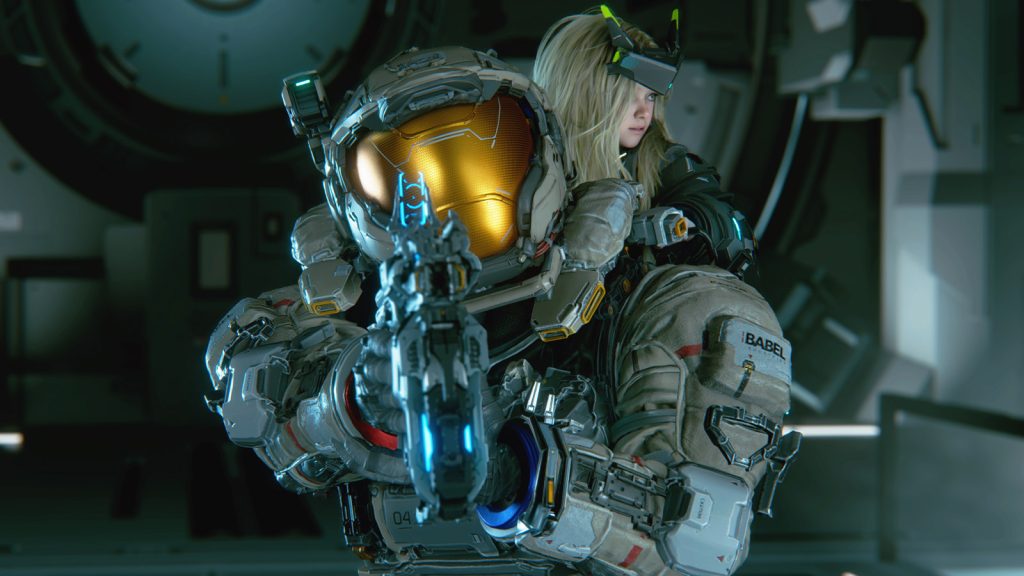 Should Pragmata be adapted into live-action? | Credits: Capcom
FandomWire: We are perhaps in the most prominent era of live-action adaptations of iconic video games, with Capcom’s own Resident Evil and Street Fighter being the next major video game adaptations. If Pragmata were ever adapted into a live-action movie or series, would you be interested in reprising your role as Hugh Williams?
David Menkin: You know what? I’m gonna say yes. Because you look at Pedro Pascal, right? He’s the Mandalorian. Whenever something really physically demanding has to happen, Mando has his mask on. He’s not gonna fight with his mask off because it’s written into lore that it would be shameful, and he could no longer be a Mandalorian.
As far as I’m concerned, whenever Hugh has to do something more than a walk, the mask has to come down. So, yeah, it’s definitely gonna be me, because I will have a team of amazing stunt actors doing all the difficult stuff. If they’ll have me, I will do anything to be considered. I will do some looksmaxxing and break some bones to be prettier, because hey, I’m pretty, but I’m not Hollywood pretty.
I would love to be involved in a film or TV adaptation [of Pragmata]. It would have to be a TV adaptation, because we would have to have the relationship between Hugh and Diana develop organically. In a film, you don’t have time, and it’s something that I’ve been trying to explain to people that games give you more of an opportunity to invest in your characters, and to learn more about them.
I remember being interviewed by BAFTA when they were talking about what I knew about games versus film and TV. And I said, it’s been really interesting to go from a time where, to make a blockbuster movie, you would have to have a game tie-in. Back in the old days, you would have a big action movie, and then they would have a game come out pretty much at the same time. It had nothing to do with the movie, because [the developers] weren’t given any information about it. They just had to make a game and then plaster something on it.
As time has gone on, you are now seeing that games are informing film and TV. Composers are saying that they like working on games more than the usual media because it gives them a chance to write the full score and let it be heard. You see the Fallout TV series and The Last of Us. The reason why they’re good TV shows is that the narratives in the games were f**king amazing.
Maybe we should allow games to be games and films to be films, and then every so often, when the connection can be made, we do it. If it comes from games first, and goes to film and TV second, you have to honor the people who play the games and made that game popular. That is my direct challenge to the people making Elden Ring. If they do not honor the people who played it and made it popular, why are you making it?
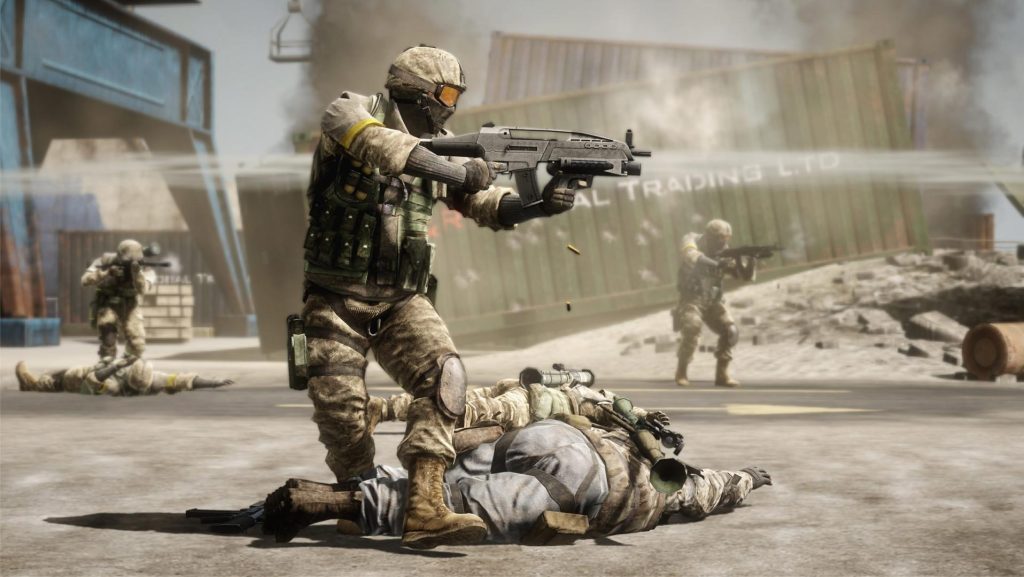 From Battlefield: Bad Company to Pragmata! | Credits: DICE
FandomWire: Your first lead role was Preston Marlowe in Battlefield Bad Company 1 and 2, and now you’re playing lead characters like Hugh Williams and Luke Skywalker. Over the years, how has your approach to leading a video game performance changed as the industry has evolved?
David Menkin: To tell you the truth, I’m just as scared whenever I go in to start the job. I am always thinking that they’re going to find out and fire me, that I’m not right. For some reason, I go in, and I go, at least I get to work for a day before they figure out that I’m the wrong person for the job. When I played Preston, I was just helping out at an audition. It wasn’t meant to happen, so everything was just a nice surprise.
As I’ve gone on, I’ve made sure that the people that I work for have understood that I don’t have an ego when it comes to these things. Just because I play a lead role doesn’t mean that I insist on playing lead roles from then on, because then it would mean that I don’t work. There are not enough lead roles to go around.
But what have I learned? Since I started, I’ve become more of a gamer. So, now I understand what is expected of me, maybe more than I did when I started, and I think that I also now honor the gamers a little bit more than I did before. I think I went in at the beginning, thinking this was just a job. Now, I worry more about the game as a whole and not just my performance. Because, as you and I know, so many games are released, and games that deserve to be honored and to be played sink without a trace for a variety of reasons, and some get review bombed.
I was just desperate for people to meet Diana. But have I learned anything? Yeah, I think of a game as a whole rather than just the microcosm of my performance.
FandomWire: Returning to Pragmata, the game was delayed three times from its initial release window. When games get delayed, expectations and speculations skyrocket within the community. Did you think about how players would react once they got the game, and if it would live up to everyone’s expectations?
David Menkin: Yeah, it’s a very strange thing when you’re an actor, because you go in after the game has been in development for a long time, and in the case of Pragmata, a very long time. You go, and you do your job. You’ll go in for a week, maybe two weeks, and then you’ll go away for three months while they get everything else ready. Then you’ll go in for another week or a couple of days, and you’ll go away, and your contribution is, in my case, about a year and a half.
Then someone comes in with a bunch of flowers, you get thanked, and then you go away. Then you go, “Oh sh*t….I’m done”. So, I mourned Hugh in the sense that I mourned the fact that I wouldn’t get to play him anymore. I mourned the fact that I couldn’t go back and work with these amazing people anymore. Then, I felt a little bit sorry for myself, and I realized, it’s not about me, it’s about the gamers.
So, I had an ending, and then a few weeks before the game got released, I was looking around, and I found Grace, and I was like, “Hi, do you think people would be interested in hearing from me?” and she was like, “Yeah, I think so, why don’t we give it a shot?” I had no idea how the game was going to be received. People might’ve hated it, and I had to be prepared for that. In my heart, I had to have a room that said, “What if they hated it? What if they hate your performance? What do you do then?“
Well, then you move on to the next thing, and you’ve already mourned it, so you can move on. But every single time I finish a project, I always have to remind myself that it’s not about me, it’s about the people who play it. Then I’m absolutely fine.
FandomWire: Now that players have spent a lot of time with both Hugh and Diana in Pragmata, was there a scene or line that you read and felt, “Oh, so this is who Hugh is, and these are the shoes that I have to wear for the next year or so?”
David Menkin: It was my audition. I had a straightforward script, being a very typical protagonist, and on page 2, it was the beach scene, and everything changed for me then. I understood immediately that this was someone who had a slightly complicated but happy upbringing. He was open enough to say that he was okay, and that life, as far as he was concerned, was good. Then he got to ask, “Well, this is me, but that’s not the important thing. What do you want?”
How often does a protagonist in a game say to someone, “What about you?” Because in games, usually people impose their situation onto the protagonist, so that you, as the gamer, will turn to them and join their quest or whatever it may be. And here it was, nope, I am this character who stops, bends down, and says, “What about you?” From that moment on, I wanted to play this guy.
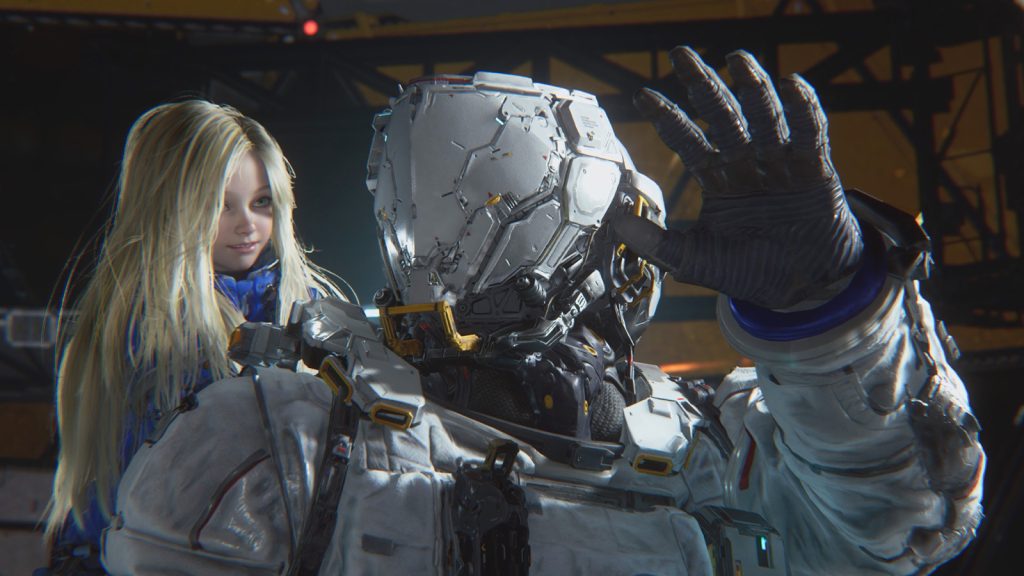 Will their stories continue? | Credits: Capcom
FandomWire: I want to talk about Pragmata’s ending. Hugh keeps his promise, sends Diana to Earth and sacrifices himself. However, in the bonus post-game mode ‘Unknown Signal’, the ending features Cabin talking to someone. Many players, including myself, think that he’s talking to Hugh, so what can you tell us about his fate, and what’s your take on the ending?
David Menkin: What I can tell you is that I ended my work on this game thinking that my work was done, and I was like okay that’s an interesting way to start an IP. Then, when people started playing the game, they talked about Unknown Signal. No one at Capcom told me about this! The b*stards! So, Vilhelm, who’s in Capcom and is from Iceland, and I are connected on LinkedIn, and I was like, “What the hell?“
They’re lovely people, but they’re also really evil because they kept that information from me, and I will destroy them all. No, it was none of my business, and I am just as confused and as excited as you because maybe it means that there’ll be more.
FandomWire: This actually perfectly leads into my next question. Do you think Pragmata’s narrative can go anywhere from where it ended?
David Menkin: Oh yeah! I mean, we have beef with Delphi [Corporation] for sure. First of all, I’m so worried that Diana’s not going to be able to recharge well enough without the floor. Now I understand that she can recharge from the sun as well, so that’s all right, but can she recharge enough? Is she going to be able to do all her hacking? What about her hacking? What about her superpower? Will she be able to find people who take care of her on Earth? Will she have to hide in plain sight?
All of these questions need to be answered, and also, is Hugh alive? The great thing about it is that I can’t answer any of these questions, because Capcom doesn’t trust me. They’re not stupid, but they clearly think that I am. I just really hope that if Pragmata continues, Hugh gets to continue his journey with Diana, or maybe Hugh has a twin brother. Maybe he has an evil twin.
See, this is why Capcom doesn’t talk to me about this stuff, because they’re like, “Evil twin, now we can’t use that storyline anymore.” I’m kidding, I really hope that Diana’s story, especially, but also Hugh’s story, is not over, and that there’s more to be said and done.
FandomWire: 2026 has been a terrific year for gaming. We had LEGO Batman, Forza, and 007 come out in one week, with heavy-hitters like Wolverine and Grand Theft Auto VI yet to be released. What’s your current game of the year, barring Pragmata?
David Menkin: Unfortunately, because of my work, I’ve not been able to play so many games. That being said, I played and loved Ghost of Yotei, but that classifies as last year. But I had to go and do some promotion with Capcom — I wanted to. I have been playing Resident Evil Requiem in the dark, and I have been scared s**tless. I am such a little scaredy cat, and I’ve been loving it so much.
I’m not sure if my neighbors like it very much when I shriek. But I have a feeling that it’s up there as my game of the year. So, yeah, I think I’m gonna stick with Resident Evil Requiem.
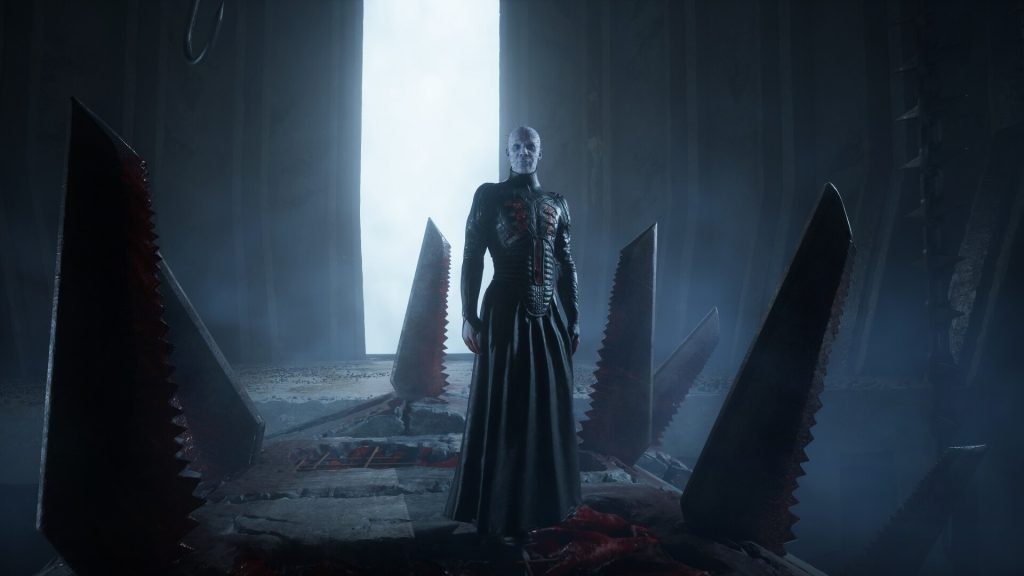 Menkin is set to raise hell in the upcoming Hellraiser: Revival! | Credits: Saber Interactive
FandomWire: Finally, before we wrap up, is there a video game character that you want to play or a developer that you want to work with after Capcom?
David Menkin: Oh man — I have a list [of developers]. I’m not gonna tell you the whole list, because it’s embarrassing, but up at the top is Naughty Dog. I want to work with that team. Are they working on something? Yes, they are [working on Intergalactic: The Heretic Prophet]. I could continue my sci-fi [streak], but I do get to embrace my villain status later this year because I will be in Hellraiser: Revival.
No spoilers there, it’s very bloody, it’s very s*xy, and it’s very camp. It’ll be a lot of fun.
David’s career has been marked by a wide range of distinctive performances, bringing complex characters to life. His most recent roles as Hugh in Pragmata and The Waif in Luna Abyss couldn’t be more strikingly different from one another, highlighting his versatility as a performer. With a villainous role on the horizon in Hellraiser: Revival, his range only keeps expanding as time progresses.
Keep an eye on FandomWire for more exclusive interviews, and let us know what you’d like to ask David next time he joins us in the comments section below.


















 Bengali (BD) ·
  English (US) ·