.png)
 2 hours ago
7
2 hours ago
7
Article content
Article content
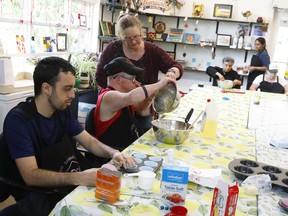
Ferguson said 22 of the studio’s 250 or so customers lived on site in one of its three group homes: Moffatt House, Campbell House and Charette House.
Article content
Ontario closed its last institutions for people with developmental disabilities in 2009 after 133 years of “housing people with disabilities in institutions, away from their families and their communities,” opting for group homes instead, according to an article by academic Ivan Brown in the Journal on Developmental Disabilities.
Article content
Some argue that this change hasn’t changed much.
Article content
Kendal David, a PhD graduate from Carleton with a research focus on ODSP barriers, said that group homes were still institutions despite being perceived as different.
Article content
“They are often smaller. They’re run by non-profits instead of the government. The conditions within them tend to be different. But they are still places where you don’t get any choice over where you live or with whom you live or other facets of your day-to-day life,” David said.
Article content
Even those who live independently or with family don’t have easy access to their benefits.
Article content
The funding usually comes through either the ODSP or Special Services at Home, another provincial support for families of children under 18 with developmental disabilities, Ferguson said.
Article content
Article content
“A lot of our individuals don’t have credit cards or any means of potentially putting up a few hundred dollars. It’s not a lot of money for daily life,” Ferguson said.
Article content

Article content
David agreed. “If you’re struggling to afford food and rent, spending money on art class or a social program is probably low on your priority list,” she said.
Article content
The amount of ODSP funding one receives is based on their level of need, said Heather Williams, the studio’s director of supports and services.
Article content
But Shotwell believes that this funding — which, according to the provincial government’s website, can be up to $1,436 a month, but often isn’t — as well as barriers to accessing it, reinforces poverty among people with disabilities.
Article content
One of the barriers, she said, is a monthly requirement to prove you still need support by re-certifying your disability.
Article content
“When their funding gets cut for the next month, they have to figure out what to do. The sheer amount of time that people with disabilities have to spend to access benefits and to keep them is a full-time job,” Shotwell said.
Article content
When you add chronic pain or cognitive processing difficulties on top of that, it seems like a near-impossible feat, she added.
Article content
Article content

Article content
Community support
Article content
It’s been difficult for the studio to access funding, too, said Ferguson, who is only paid for 35 hours a week, but works closer to 60 hours.
Article content
Though she wants to pay volunteers and offer direct billing rather than reimbursement, classes currently cost hundreds of dollars.
Article content
So, she said, community support is essential to keeping the studio afloat.
Article content
Support has come through the infrastructure of their entire garden-in-progress, which was built by students from St. Paul High School’s Elite Skilled Trades Academy, in collaboration with Local 93, a carpenters’ union.
Article content
The garden’s cedar trellises, benches and tables still smelled fresh — the students completed the project at the end of the 2026 school year.
Article content
The picnic tables had spaces for wheelchairs in the middle, rather than at the ends, and planters were raised for wheelchair access.
Article content
This is all part of the studio’s five-year plan — Ferguson laughed, sitting on a built-in planter bench, that she initially thought of it more as a 25-year plan — to create an entirely accessible garden.
Article content
Though it’s only Year 2, the harvest is already part of the studio’s programming.
























/https%3A%2F%2Fsportsmole-media-prod.s3.gra.io.cloud.ovh.net%2Fuploads%2F2026%2F03%2Ficonsport-361551-0102-1-69b560866f7b6508942731.jpg)

 Bengali (BD) ·
  English (US) ·