.png)
 1 day ago
15
Researchers found fewer chicks were being raised each year when compared to previous decades
Published Oct 23, 2026 • Last updated 6 minutes ago • 1 minute read
See more Toronto Sun on Google — save as a Preferred Source
Advertisement 2

THIS CONTENT IS RESERVED FOR SUBSCRIBERS ONLY
Subscribe now to read the latest news in your city and across Canada.
- Unlimited online access to articles from across Canada with one account.
- Get exclusive access to the Toronto Sun ePaper, an electronic replica of the print edition that you can share, download and comment on.
- Enjoy insights and behind-the-scenes analysis from our award-winning journalists.
- Support local journalists and the next generation of journalists.
- Daily puzzles including the New York Times Crossword.
SUBSCRIBE TO UNLOCK MORE ARTICLES
Subscribe now to read the latest news in your city and across Canada.
- Unlimited online access to articles from across Canada with one account.
- Get exclusive access to the Toronto Sun ePaper, an electronic replica of the print edition that you can share, download and comment on.
- Enjoy insights and behind-the-scenes analysis from our award-winning journalists.
- Support local journalists and the next generation of journalists.
- Daily puzzles including the New York Times Crossword.
REGISTER / SIGN IN TO UNLOCK MORE ARTICLES
Create an account or sign in to continue with your reading experience.
- Access articles from across Canada with one account.
- Share your thoughts and join the conversation in the comments.
- Enjoy additional articles per month.
- Get email updates from your favourite authors.
THIS ARTICLE IS FREE TO READ REGISTER TO UNLOCK.
Create an account or sign in to continue with your reading experience.
- Access articles from across Canada with one account
- Share your thoughts and join the conversation in the comments
- Enjoy additional articles per month
- Get email updates from your favourite authors
Article content
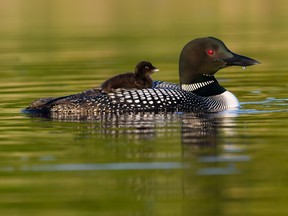
The common loon appears to be less common in many places across Canada.
Article content
Article content
That’s according to new research published in Canadian science journal FACETS this week.
The iconic waterbirds, famously featured on the dollar coin since it was introduced in 1987, are declining not only in Canada – which represents about 94% of the total population based on approximately 254,000 breeding pairs – but in much of the United States as well.
Scientists collected data from more than 4,000 volunteers in Birds Canada’s Canadian Lakes Loon Survey across nine provinces – Prince Edward Island was not part of the research – and U.S. states Maine, New Hampshire, Massachusetts, Vermont, New York, Wisconsin, and Washington.
Fewer chicks being raised
Researchers found fewer chicks were being raised each year when compared to previous decades, based on tracking about 30 years of loon productivity on 3,421 lakes. Productivity is the number of young produced per territorial pair.
Advertisement 3
Article content
More specifically, there were significant breeding declines in seven regions, slight downward trends in four others, and a marginal increase in Maine.
“Although productivity is only one of three demographic parameters that dictate the stability of a population, long-term decreases in productivity could signal looming population declines in Ontario, the Prairie, and Atlantic provinces, New York, Massachusetts, and New Hampshire,” wrote the study’s authors.
Loons are a top predator in freshwater areas but are also exposed to high levels of environmental pollutants like mercury.
Difficult to get overall picture
The authors cautioned that, based on the regional focus of most studies showing population increases and declines, it is difficult to get an overall picture of loon productivity.
A 2013 study said loon productivity across southern Canada decreased by 14% between 1992 and 2010.
“Achieving a broader understanding of productivity, and the factors influencing it, across the breeding range, might enable us to recognize where population declines are occurring or are likely to occur,” the authors wrote.
Article content




























 Bengali (BD) ·
 English (US) ·