.png)
 1 hour ago
10
1 hour ago
10
Iran has maintained a blockade on commercial shipping through Hormuz since the war began in late February.
Author of the article:

Published Sep 29, 2026 • 3 minute read

See more Toronto Sun on Google — save as a Preferred Source
Advertisement 2

THIS CONTENT IS RESERVED FOR SUBSCRIBERS ONLY
Subscribe now to read the latest news in your city and across Canada.
- Unlimited online access to articles from across Canada with one account.
- Get exclusive access to the Toronto Sun ePaper, an electronic replica of the print edition that you can share, download and comment on.
- Enjoy insights and behind-the-scenes analysis from our award-winning journalists.
- Support local journalists and the next generation of journalists.
- Daily puzzles including the New York Times Crossword.
SUBSCRIBE TO UNLOCK MORE ARTICLES
Subscribe now to read the latest news in your city and across Canada.
- Unlimited online access to articles from across Canada with one account.
- Get exclusive access to the Toronto Sun ePaper, an electronic replica of the print edition that you can share, download and comment on.
- Enjoy insights and behind-the-scenes analysis from our award-winning journalists.
- Support local journalists and the next generation of journalists.
- Daily puzzles including the New York Times Crossword.
REGISTER / SIGN IN TO UNLOCK MORE ARTICLES
Create an account or sign in to continue with your reading experience.
- Access articles from across Canada with one account.
- Share your thoughts and join the conversation in the comments.
- Enjoy additional articles per month.
- Get email updates from your favourite authors.
THIS ARTICLE IS FREE TO READ REGISTER TO UNLOCK.
Create an account or sign in to continue with your reading experience.
- Access articles from across Canada with one account
- Share your thoughts and join the conversation in the comments
- Enjoy additional articles per month
- Get email updates from your favourite authors
Article content
Tehran, Sept 29, 2026 (AFP) — Iran on Tuesday threatened to attack infrastructure around the Middle East, intensifying its rhetoric as it awaits a formal response from Washington on a new plan to reopen the Strait of Hormuz.
Article content
Article content
US President Donald Trump has already dismissed the proposal from Tehran, but Iran’s foreign minister said Monday that he was expecting a formal response from American officials in the coming day.
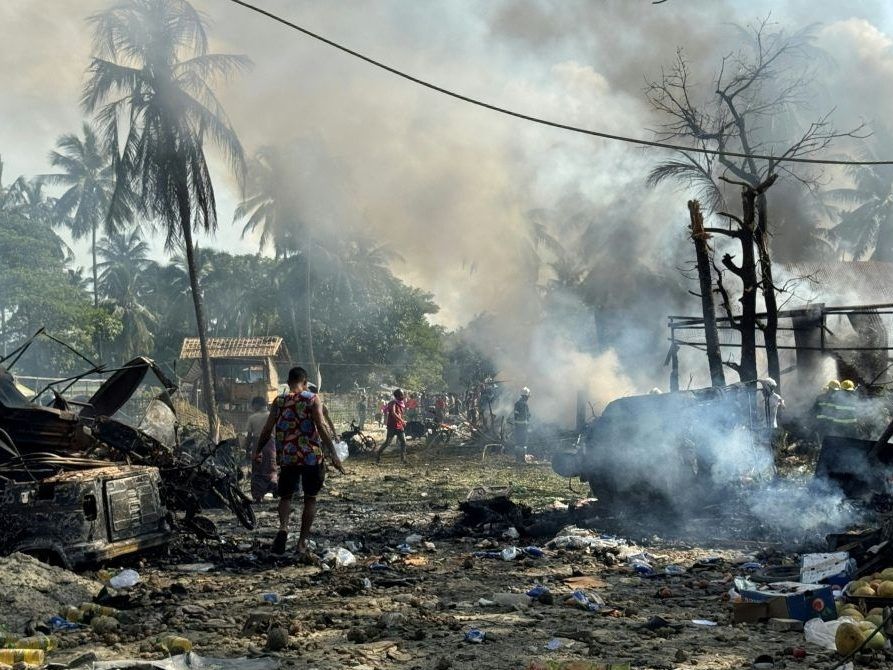
Fighting has subsided in recent weeks, though Tehran has continued to target ships in the strait, with Washington falling back on an economic pressure campaign instead of further military action.
Iran’s chief negotiator Mohammad Bagher Ghalibaf on Tuesday threatened new attacks, saying no infrastructure in the region would be safe if his country’s security was not guaranteed.
“In a region where we cannot sell oil, no one else will sell oil either; or if our security is not guaranteed, no infrastructure will remain safe,” Ghalibaf, who is also Iran’s parliament speaker, said according to a video released by state TV.
By signing up you consent to receive the above newsletter from Postmedia Network Inc.
Article content
Advertisement 3
Article content
Iranian Foreign Minister Abbas Araghchi said he expected a formal answer from the US on Tuesday to Tehran’s proposal, state media reported.
Iran has maintained a blockade on commercial shipping through Hormuz since the war began in late February with US-Israeli strikes on the Islamic Republic.
The shipping route carried a fifth of the world’s oil and liquefied natural gas before the conflict began.
The US military has been maintaining a counterblockade of Iran’s ports in an effort to prevent Tehran from exporting oil.
– Conditions –
Araghchi said late Monday that Qatari intermediaries “presented ideas, and we discussed them; they are set to raise the matter with the American side once more, after which the final US response will be conveyed to us”.
The top diplomat, who was in New York for the UN General Assembly, said “the Qataris hope this will be done by tomorrow”.
“The current focus is solely on the Strait of Hormuz, and the reopening of the strait is contingent upon the fulfilment of certain conditions that we have communicated to the other side,” he added.
Advertisement 4
Article content
Last week, discussions were held in New York between Araghchi and US envoys Steve Witkoff and Jared Kushner.
As a precondition for ending its blockade, Iran is demanding a seven-day ceasefire across the Middle East, including in Lebanon, where its ally Hezbollah is regularly bombarded by Israel.
It is also demanding the unfreezing of Iranian assets abroad, the lifting of sanctions on its oil sector and an end to the US naval blockade on its ports.
Both sides claim to have control of Hormuz, with the US saying oil is moving through and Tehran insisting the waterway is closed.
On Tuesday, Iran’s Revolutionary Guards, the ideological arm of the country’s military, said “the US claim that it remains open is false”.
“Sneaking a few hundred barrels of oil through under the cover of darkness — with transponders turned off and at great cost — does not constitute the strait being open,” said spokesperson Hossein Mohebi.
“A truly open strait is one where, as in the past, at least 125 vessels would pass through daily, transporting a minimum of 20 million barrels of oil and petroleum products.
“Any vessel attempting to pass through sustains damage — either we strike it, or it hits a mine,” he added.
Article content






















 Bengali (BD) ·
  English (US) ·